
Guides
Car Listing Alerts in Albania: Set Them Up and Act Fast
Car Listing Alerts in Albania: Set Them Up and Act Fast

A car listing alert is a saved search that tells you when a matching vehicle appears, so you see it before the crowd does. In Albania, where a well-priced used car can draw calls within hours, the setup matters more than the speed of your thumbs: a tight filter, a realistic price ceiling and a clear plan for what you do in the first ten minutes after a match. This guide covers all three, plus what sellers can do so their cars get noticed on a phone screen.
TL;DR
- Build two or three saved searches instead of one: an exact match, a broader version and a wider-region version.
- Filter by make, model, year range, fuel type, mileage and a realistic price ceiling. Too wide a net produces noise, and noise gets ignored.
- An alert only tells you a car exists. Inspect the car, check the paperwork and the mileage, and meet the seller safely before paying anything.
- Sellers win on mobile with a strong first photo, a title that leads with year, make and model, and short, scannable descriptions.
- Planning an electric car? Check household charging tariffs and your connection capacity before you buy.
Table of Contents
- Why alerts matter in the Albanian market
- Build your searches before you turn anything on
- Watching several platforms without going crazy
- What to do in the first ten minutes after a match
- If you want an electric car: check home charging first
- For sellers: make your listing win on a phone
- Our perspective
- List your car on CarPulse
- FAQ
- Sources
Why alerts matter in the Albanian market
The best-priced cars rarely sit for long. A buyer who checks a marketplace twice a day sees what was left over; a buyer with a saved search sees what is new. That gap is the whole point of an alert.
It also changes how you shop. Instead of scrolling hundreds of listings and getting tired, you define what you want once, then let the platform bring candidates to you. Your time goes into the part that actually protects your money: checking the car.
On CarPulse, buyers can filter new and used vehicles by make, model, year, mileage, price and fuel type, save searches and bookmark favorites. Using those tools well is most of what “alerts” means in practice. Browsing and contacting sellers costs buyers nothing, because the platform is paid by sellers who list.
Build your searches before you turn anything on
An alert is only as good as the search behind it. Most disappointing alerts come from searches that were written in a hurry.
Start with three searches, not one
A useful pattern is to split your need into layers:
- Exact: the make, model, year range, fuel type and transmission you actually want, with your real price ceiling.
- Broader: the same model but a wider year range, or a neighboring trim, or a slightly higher mileage limit.
- Nearby regions: the exact search, but covering other cities, for the case where the right car is two hours away.
This approach is also what marketplace-monitoring guides tend to recommend: separate searches for exact, broader and nearby needs, rather than one giant filter. The exact search tells you when to drop everything. The broader ones tell you what the market looks like and whether your expectations are realistic.
Pick filters that cut noise
The filters that matter most:
- Make and model. Never leave these empty if you know what you want.
- Year range. Two or three years of range is usually enough. A ten-year range pulls in cars with completely different equipment and risk profiles.
- Fuel type. Petrol, diesel, hybrid and electric cars have different running costs and different checks. Pick one per search.
- Mileage ceiling. Set it, but treat it as a starting point. Odometer figures need verifying (more on that below).
- Price ceiling. Set it at what you can really pay, not at an optimistic number. A ceiling that is too low hides cars you could negotiate down to; one that is too high floods you.
If you shop on platforms that support keyword rules, the same logic applies to words in the description. Alert tools commonly suggest excluding terms such as salvage, rebuilt, flood, parts and as-is, and limiting results by radius. Even where you cannot exclude words, you can scan for them quickly when a notification arrives.
Match the notification to how fast you can act
Urgent hunt: you want a push notification on your phone, because you can call within minutes. Slow research: an email digest is enough, and it spares you constant interruptions. The rule is simple: the channel should match how quickly you are really able to respond. A push you cannot answer for six hours is no faster than an email.
Watching several platforms without going crazy
Many Albanian buyers look at more than one place: a dedicated marketplace, social media groups, dealer websites and foreign portals where cars are imported from. Following all of them manually is where people burn out.
A workable routine:
- Use identical filters everywhere. Same make, model, year, mileage, price and location on each platform. Otherwise you cannot compare what you find. Buyer guides that cover searching across several used-car sites make the same point: save each search first, then switch on notifications.
- Keep one master note. A simple phone note or spreadsheet with the link, price, mileage, seller name and date you called. Duplicates are common when the same car is posted in several places.
- Pick one primary platform for alerts. Let one place do the push notifications and check the others on a schedule, for instance morning and evening. Alert services that watch many sites exist, but none can promise complete coverage or perfect timing, because sites change and listings are delayed.
- Always contact the seller through the original listing. It keeps a record of what was advertised, including price and photos.
If you are considering a car from abroad, read how to verify a foreign car before buying before you fall in love with a low price. Imported cars are where a cheap listing is most likely to hide a problem.
What to do in the first ten minutes after a match
Speed helps you get to the seller first. It does not make the car trustworthy. Use the first minutes for these steps:
- Read the whole listing. Check that year, mileage, fuel and trim match what you searched for. Look at every photo, including the odometer and any damage shots.
- Compare the price. If it is far below similar cars, treat that as a question, not a gift.
- Call, then message. A phone call tells you more about a seller than text. Ask why they are selling, how many owners, whether there is a service history and whether the paperwork is in their name.
- Ask for specific proof. Registration papers, service records, and the VIN so you can run a history check.
- Book a viewing in daylight, in a public place if it is a private seller. Bring someone with you, ideally someone who knows cars.
Check the mileage and the history
The number on the dashboard is not proof. Our guide on how to check the real mileage of a used car walks through the digital odometer clues, and you can also read about vehicle history reports and how to price-check a car against the market.
It also helps to understand what verification on a listing does and does not mean. We explain it in what car listing verification is. The short version: a verified listing or dealer lowers your risk, but it replaces neither an inspection nor a paperwork check.
Alerts are not due diligence
This is the part people skip when they are excited. An alert finds a car. It does not inspect the car, confirm that the seller owns it or check that the documents are clean. Before you hand over money, you should see the car in person, verify ownership and registration papers, and ideally have a mechanic look at it. If the seller refuses an inspection, walk away, however good the price.

Once you have bought, protecting the finish is a sensible next step, especially on a newer car. This overview of protecting a new car’s paint explains what film and coatings do.
If you want an electric car: check home charging first
Setting an alert for a used EV is easy. Living with one is a different question, and the answer starts at your own electrical connection.
As published by the distribution operator OSHEE, household slow charging up to 11 kW is billed at 9.5 lekë per kWh and typically takes 6 to 7 hours, while charging points above 11 kW connected at 0.4 kV are charged 22 lekë per kWh from November 1, 2025 (OSHEE). For a home wall charger, the household rate is the one that matters. Check OSHEE’s current tariff page before you rely on any number, because tariffs can change.
What to think through before you buy:
- Contracted capacity. A charger adds a large, steady load. If your home’s contracted capacity is low, you may need more. The national regulator publishes the rules for new connections and modifications in the distribution system, and your request goes through the distribution operator.
- Installation. Have a licensed electrician inspect your panel, wiring and earthing. Do not plug a high-power charger into old or doubtful wiring.
- Grid limits. Regulators have already flagged that EV charging can add to urban grid congestion, which is why network upgrades and time-based tariffs are discussed in a regional regulatory survey. In practice, this means a strong local connection is not guaranteed everywhere.
- Apartment buildings. You will need building approval and a safe place for the cabling or charge point.
If you are filtering for electric cars, set a dedicated saved search for them, with a lower mileage ceiling and a note to ask about battery health in your first call.
For sellers: make your listing win on a phone
Most buyers who receive an alert open it on a phone. Your listing has a few seconds to look worth a call.
The first photo and the title
The cover photo is what appears in the notification and the results list. Use a clean exterior shot in daylight, with the car filling most of the frame. Start the title with year, make and model, then the main selling point, such as one owner or full service history. We cover the rules in used car photos: how to photograph your car to sell fast and car listing photos: rules of the European market.
Cover exterior from several angles, the interior, the odometer, the engine bay and any damage. Showing flaws honestly saves both sides time and builds trust. Compress images so they load quickly on mobile data.
Description that reads well on a small screen
Lead with a short paragraph, two or three lines, then put specifications in bullet points. Fill every field the platform offers, because buyers’ saved searches filter on exactly those fields: if you leave fuel type or mileage blank, your car may never match an alert. Our guide on how to write car descriptions that sell fast has examples. Make it easy to call: list your phone number and the hours you answer.
Reposting and refreshing
Sellers often ask how often to repost. We are not aware of an official rule, so treat this as practical advice. Refresh when something real changes: a price cut, new photos or an updated description. A price drop is also the moment that can trigger buyers’ saved searches again, since your car now fits under more people’s ceilings. Before you edit, check that the mileage, price and contact number are correct, and that the car is still available. Reposting the same unchanged ad repeatedly tends to annoy buyers who have already seen it. Check each platform’s own rules before duplicating a listing.
Our overview of how to list cars online in Albania for fast, safe sales goes through the full process, and how CarPulse makes vehicle listings clear for you shows how the listing is structured for buyers.
Our perspective
We build a marketplace, so we see both sides of an alert: the buyer waiting for a specific car and the seller who needs the right buyer to find it. What we notice is that the quality of a match depends on the quality of the listing data. When a seller lists with VIN-based autofill, the make, model, year and specifications are populated automatically, which means fewer typos and fewer cars that fail to appear in the right search.

For buyers, our advice is to resist the urge to chase every notification. Decide your three searches, decide your price ceiling, and keep your budget for inspection and paperwork, not for a rushed deposit. A car that is gone in an hour was usually priced to attract the unprepared. A car that survives a mechanic’s check is the one worth your money.
For sellers, honesty is the fastest strategy. Accurate fields, real photos and a fair price get the right people to call, and they call once.
— Henri
List your car on CarPulse
If you are selling, CarPulse lets private sellers and verified dealerships list vehicles directly, with VIN-based autofill that fills in the vehicle details for you. Sellers can also use AI price evaluation and a vehicle history check to present the car clearly. Plans start with Basic at €14.99 per month and Premium at €29.99 per month; see the pricing page for what each includes.
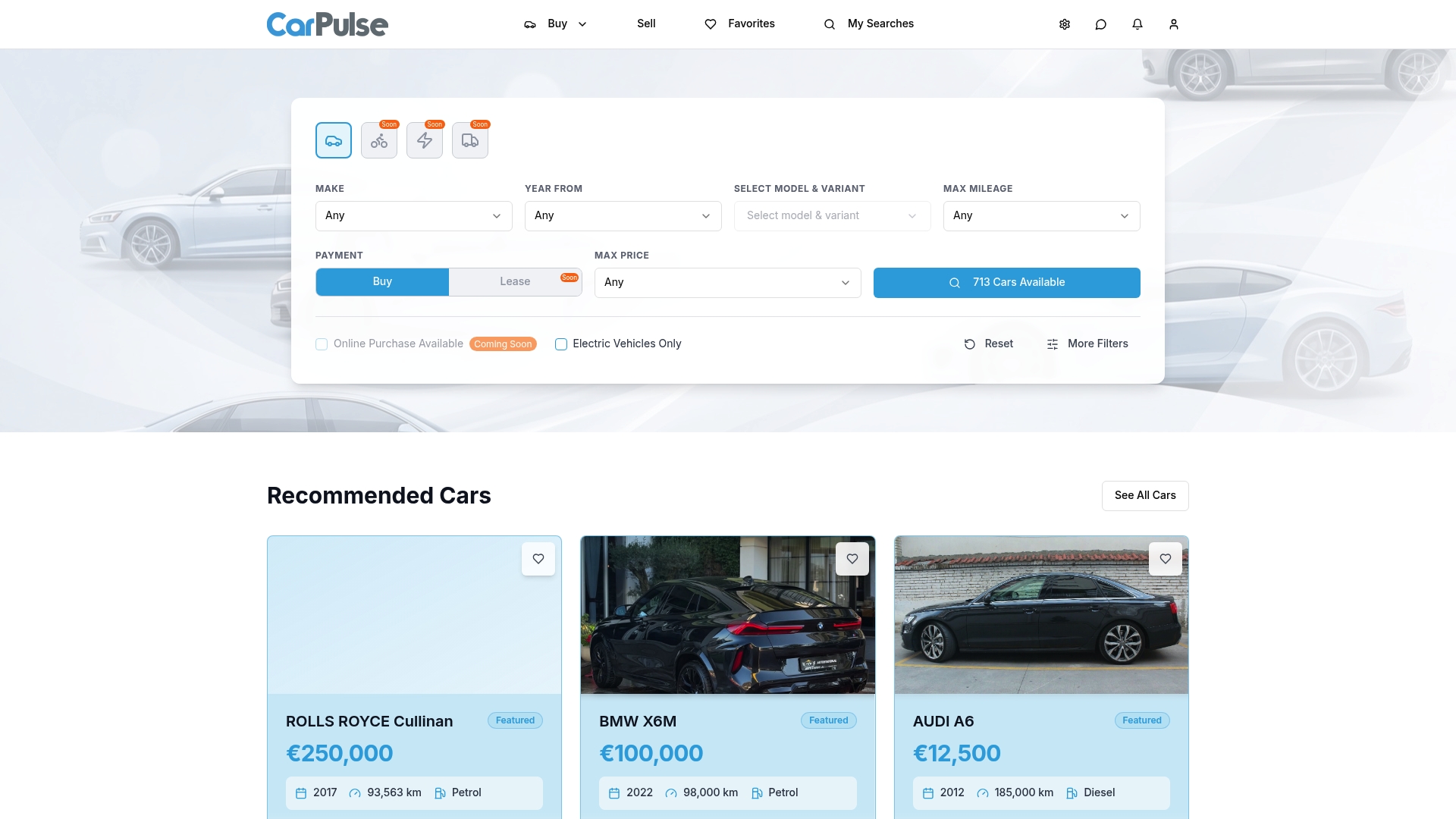
Buyers pay nothing to browse, save searches and contact sellers. Start on the CarPulse marketplace, where cars, motorcycles, vans, trucks, trailers and more are listed.
FAQ
How many car alerts should I create?
Two or three is a good number: one exact search, one broader and one for nearby regions. More than that and you will start ignoring notifications. Review them every couple of weeks and delete any that no longer match what you want.
Do I need to pay to get alerts?
On CarPulse, buyers do not pay to browse, save searches or contact sellers. Sellers pay to list vehicles. If you use a third-party tool that watches several sites, check its pricing and what it covers before relying on it.
Is a fast alert enough to buy a car safely?
No. An alert only brings the listing to you sooner. You still need to inspect the car, verify the ownership documents and the mileage, and meet the seller safely. Walk away from any seller who pushes you to pay before you have seen the car.
How do I stop getting irrelevant alerts?
Narrow the year range, set one fuel type per search, lower your price ceiling to a realistic number and add a mileage limit. Where a platform allows keyword exclusions, remove terms like salvage, rebuilt or parts. Keep a separate broader search so you do not lose useful cars.
Can I charge an electric car at home in Albania?
Often yes, but check first. The household slow-charging tariff published by OSHEE is 9.5 lekë per kWh for charging up to 11 kW, and you should confirm that your electrical capacity and wiring can handle a charger. Ask a licensed electrician and your distribution operator before you buy.
Sources
- OSHEE: ERE approves the 22 lekë/kWh tariff for EV charging above 11 kW
- ERE: Regulation on new connections in the distribution system
- ERE: E-mobility in the Energy Community Contracting Parties
- Protecting a new car’s paint