Guides
What Is Adaptive Cruise Control and How Does It Work?
What Is Adaptive Cruise Control and How Does It Work?
TL;DR:
- Adaptive cruise control automatically maintains your set speed and following distance using radar and cameras. It is a Level 1 driver-assistance feature that requires continuous driver supervision and performs best on highways, especially with fusion sensor systems.
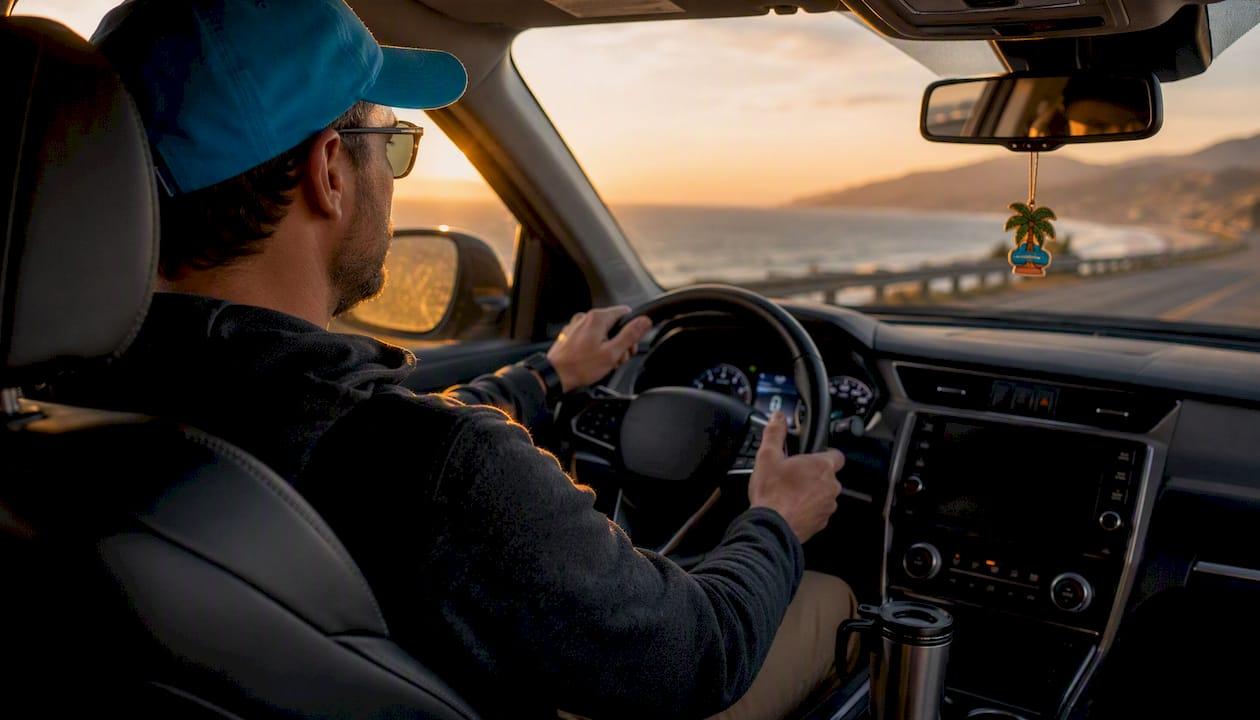
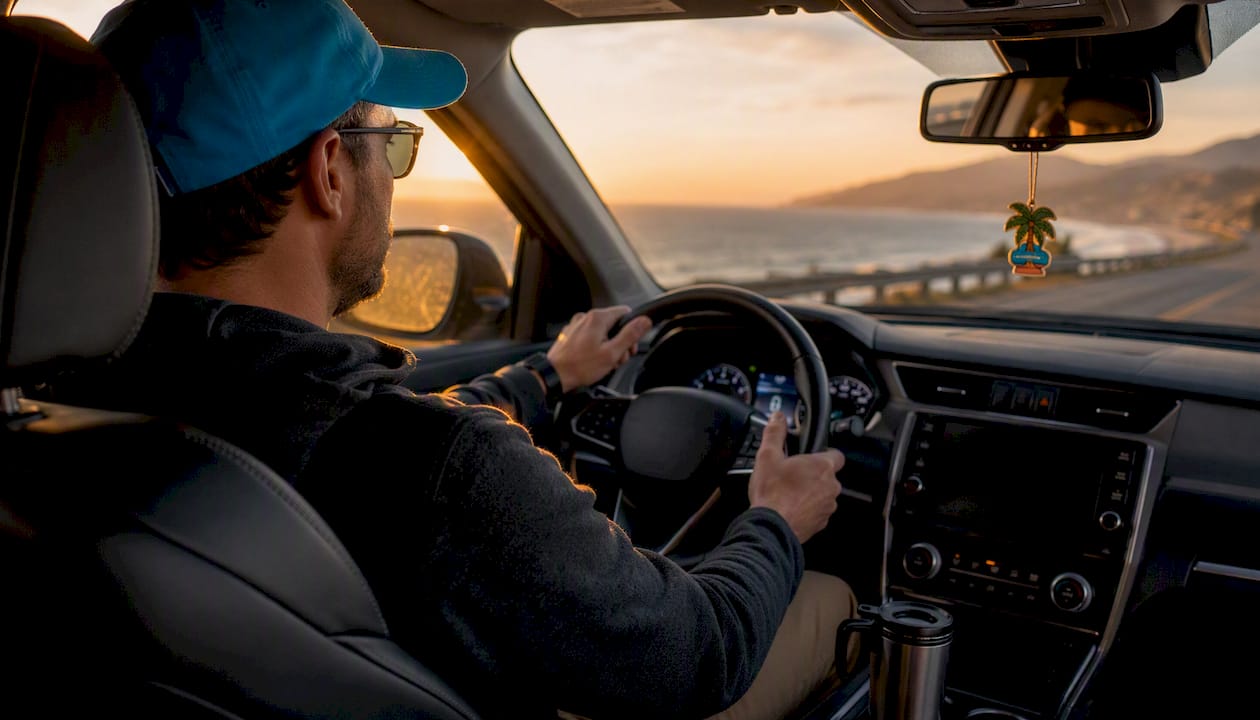
Adaptive cruise control (ACC) automatically maintains your chosen speed and keeps a set following distance from the vehicle ahead by modulating throttle and brakes without driver input. It is classified as an SAE Level 1 driver-assistance feature, meaning it handles one axis of control (longitudinal speed) while you remain fully responsible for steering and overall situational awareness. NHTSA and IIHS both categorize ACC as a convenience aid, not a self-driving system.
The short version:
- ACC holds your set speed and adjusts it automatically when traffic slows or speeds up
- It uses radar, cameras, or a combination of both to measure the gap to the car ahead
- It is a comfort feature, not a substitute for an attentive driver
- Carpulse listings often include ACC as a searchable feature so you can filter for it when shopping
Table of Contents
- How does adaptive cruise control actually work?
- What types of ACC systems are there?
- How do you use ACC safely?
- What are the real benefits of ACC for drivers?
- What are the limitations and safety risks of ACC?
- How do manufacturers name their ACC systems?
- Can you add ACC to a car that doesn’t have it?
- What do safety experts and research data say?
- Key Takeaways
- ACC is more useful than most buyers realize, but only if you test it first
- Useful sources and where to look in your owner’s manual
How does adaptive cruise control actually work?
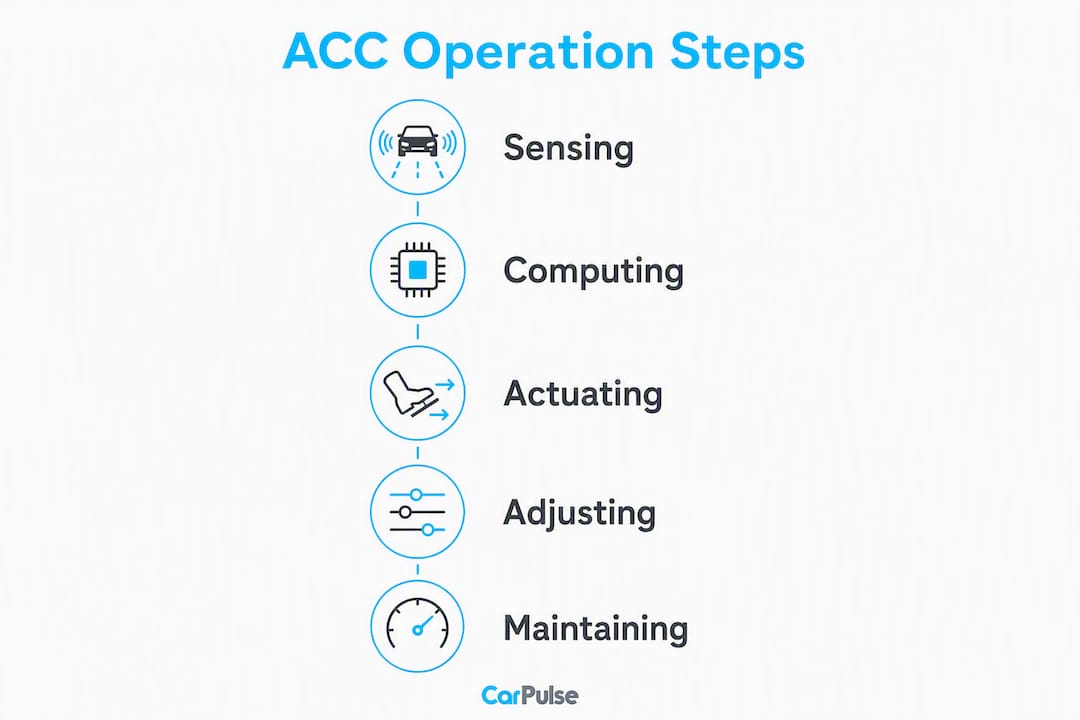
The system runs a continuous sense-compute-actuate loop. A front-facing sensor measures the distance and closing speed to the vehicle ahead. An onboard processor compares that reading to your chosen following gap, then sends corrections to the throttle or brakes thousands of times per second. The whole cycle happens in milliseconds, which is why the speed adjustments feel smooth rather than jerky.
U.S. DOT research confirms that ACC systems typically rely on front-facing radar, cameras, and sometimes lidar, with the sensor data feeding an onboard computer that makes continuous micro-adjustments.
What each sensor type contributes:
- Radar: Measures range and closing speed reliably in rain, fog, and darkness. Struggles to classify what it is detecting (car vs. guardrail vs. debris).
- Camera: Identifies object type (vehicle, pedestrian, lane marking) and reads lane context. Performance drops in glare, heavy rain, or when the windshield is dirty.
- Lidar: Delivers precise three-dimensional distance mapping. Rare in production ACC systems because of cost; more common in higher-automation prototypes.
- Sensor fusion: Combines radar and camera data so the system gets both reliable range measurement and accurate object classification. Most modern ACC systems use this approach.
Most highway-only ACC systems activate above roughly 20 mph. Stop-and-go variants can operate down to 0 mph, bringing the car to a complete stop and resuming when traffic moves.
What types of ACC systems are there?
Not all ACC systems are built the same. The sensor architecture and speed range determine what the system can and cannot do in real traffic.
Sensor architectures
Radar-only systems are the most common entry-level configuration. They are weather-tolerant and cost-effective but cannot classify objects well, which is why they sometimes fail to react to stationary hazards.
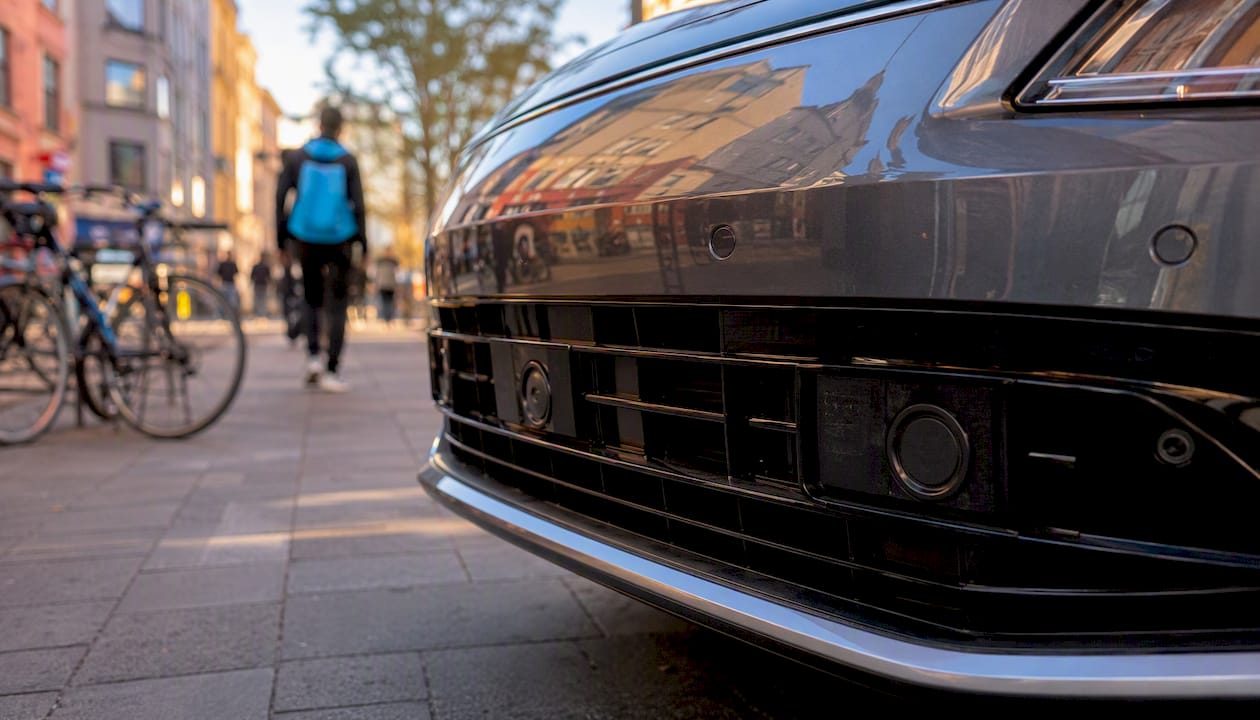
Camera-only systems are less common for ACC specifically; cameras excel at classification but struggle with range accuracy at highway speeds and in low-visibility conditions.
Fusion systems (radar + camera, and occasionally lidar) are the current standard in mid-range and premium vehicles. They combine the weather resilience of radar with the classification accuracy of cameras.
Speed range variants
| System type | Sensor type | Stop-and-go support | Lane-centering pairing | Typical availability | Primary benefit |
|---|---|---|---|---|---|
| Highway-only ACC | Radar or camera | No (min. ~20 mph) | Rarely included | Often standard on base trims | Long-highway comfort |
| Full Speed Range (FSRA) | Radar + camera fusion | Yes (0 mph) | Frequently paired | Mid/upper trims or option | Stop-and-go stress relief |
| Lidar-enhanced ACC | Radar + camera + lidar | Yes | Usually paired | Premium/luxury vehicles | Precision distance control |
| Cooperative ACC (CACC) | Fusion + V2V comms | Yes | Paired | Emerging / fleet-focused | Platoon efficiency |
Pros and cons by sensor type:
- Radar-only: Reliable in bad weather; poor object classification; may miss stationary objects
- Camera-only: Strong classification; degrades in glare, rain, and dirty-lens conditions
- Fusion: Best overall robustness; higher cost; calibration after windshield replacement is required
- Lidar-enhanced: Highest precision; expensive; not yet mainstream in consumer vehicles
How do you use ACC safely?
Step-by-step operation
- Locate the controls. ACC buttons are usually on the steering wheel. Look for a speedometer icon with an arrow, or the letters “ACC.” Your owner’s manual has the exact layout for your trim.
- Reach a safe speed. Accelerate to your desired cruising speed (typically above 20 mph for highway-only systems).
- Activate ACC. Press the main ACC button. The system captures your current speed as the set speed.
- Set your following gap. Use the gap or distance button (often shown as a car-with-bars icon) to choose between two and four gap settings. A larger gap gives the system more reaction time.
- Monitor continuously. Keep your hands near the wheel and eyes on the road. ACC handles speed; you handle steering and hazard response.
- Resume or cancel. Pressing the brake pedal cancels ACC on most vehicles. A “Resume” button restores the previous set speed when conditions are clear. Pressing the accelerator temporarily overrides the set speed without canceling the system.
Consumer Reports’ guide to adaptive cruise control walks through dashboard icons and gap-setting controls in detail.
Pro Tip: Before relying on ACC in real traffic, test stop-and-go behavior in a low-risk setting: follow a slow-moving vehicle in a parking lot exit lane or light traffic and note whether the system resumes automatically after a stop or requires you to press Resume. Write down the behavior so you have a baseline for any future service conversation.
Troubleshooting common alerts:
- “ACC unavailable” warning: Clean the front radar housing and camera area on the windshield. Dirt, ice, or bug splatter are the most frequent causes.
- Phantom braking (sudden deceleration with no visible obstacle): Increase your following gap setting and check for firmware updates from the dealer.
- System deactivates on curves: Normal on some highway-only systems; if it happens on gentle curves, have the camera alignment checked.
- Post-windshield-replacement errors: Camera recalibration is required after any windshield work. Confirm this with the shop before leaving.
What are the real benefits of ACC for drivers?
The most consistent benefit is reduced cognitive workload on long trips. Maintaining a precise following distance manually requires constant micro-adjustments; ACC handles that automatically, which lets you focus on steering, hazard scanning, and navigation.
U.S. DOT research found modest fuel savings on highway trips when ACC smooths throttle use and eliminates the repeated accelerate-brake cycles that waste fuel. The savings are most pronounced on open highways with moderate traffic density.
Where ACC delivers the most value:
- Long highway commutes: Reduced physical and mental fatigue over 45+ minute stretches
- Stop-and-go traffic (FSRA systems only): Lower stress during slow urban or suburban crawls; AAA notes that ACC reduces driver stress in this context specifically
- Fuel economy: Smoother throttle management on steady highway runs
- Consistent following distance: Removes the tendency to tailgate when distracted
For fleet operators, the fatigue-reduction benefit compounds across drivers and shifts. Driver management research from Nomora highlights how driver-assist technologies like ACC can reduce fatigue-related incidents in professional driving contexts.
What are the limitations and safety risks of ACC?
ACC has real failure modes, and understanding them is more useful than a generic “stay alert” reminder.
Environmental and sensor failures:
- Heavy rain, snow, or fog can obscure radar and camera sensors, causing the system to disengage or react incorrectly
- Dirty sensor housings or a film on the windshield camera area degrades detection range
- Bright glare (low sun angle, reflective road surfaces) can confuse camera-based systems
Road geometry problems:
- Sharp curves cause some systems to misidentify vehicles in adjacent lanes as the lead vehicle, triggering unnecessary braking
- Highway-only systems may disengage on tight on-ramps or winding roads
Cut-ins and stationary objects:
- A vehicle cutting in from an adjacent lane gives ACC very little reaction time; the system may brake hard or not react at all depending on closing speed
- Many ACC systems do not reliably detect stationary objects (a stopped car, a stalled truck) at highway speeds because radar returns from stationary targets can be filtered out to avoid false positives
The synchronized braking problem:
Vanderbilt research found that multiple ACC-equipped vehicles following each other can synchronize braking responses and actually amplify traffic waves, creating or worsening phantom traffic jams rather than smoothing flow.
Automation level and driver responsibility:
ACC is an SAE Level 1 system. Pairing it with lane-centering creates Level 2 behavior (the vehicle manages both speed and steering), but neither Level 1 nor Level 2 is autonomous. Both require continuous driver supervision. NHTSA and IIHS are consistent on this point: ACC does not reduce the driver’s legal or practical responsibility for the vehicle.
| Failure mode | Trigger | Driver action |
|---|---|---|
| Sensor obscured | Dirt, ice, rain, glare | Clean sensor area; disengage ACC |
| Phantom braking | Dense ACC traffic, curves | Increase gap setting; take manual control |
| Cut-in reaction lag | Vehicle merges close | Maintain readiness to brake manually |
| Stationary object miss | Stopped vehicle at highway speed | Never rely on ACC alone in construction zones |
| System disengagement | Sharp curve, weather | Resume manual speed control immediately |
ISO 15622 is the international technical standard that defines ACC performance requirements. NHTSA references it in its driver-assistance technology guidance as the baseline for evaluating system behavior.
How do manufacturers name their ACC systems?
Every major automaker has branded their version differently. Here is what to look for on U.S.-market vehicles:
- Mercedes-Benz Distronic: Full Speed Range radar-based ACC with stop-and-go; pairs with Active Steering Assist for Level 2 behavior on many trims. Standard on most Mercedes models above the entry tier.
- Toyota Dynamic Radar Cruise Control: Radar and camera fusion; stop-and-go available on many trims (called “Low Speed Follow”); pairs with Lane Tracing Assist. Widely available across the Toyota lineup, often standard on mid and upper trims.
- Honda Sensing (Adaptive Cruise): Camera and radar fusion; includes stop-and-go on most current Honda models; pairs with Lane Keeping Assist. Standard across most Honda trim levels since 2022.
- Subaru EyeSight ACC: Stereo camera-based (no radar on most trims); stop-and-go capable; pairs with Lane Centering. Standard on most EyeSight-equipped Subaru models. Note: camera-only means weather sensitivity is higher than radar-fusion systems.
- Volvo Pilot Assist: Radar and camera fusion; stop-and-go standard; pairs with steering assistance for Level 2 behavior. Available on most Volvo models; the system is notably conservative and hands-on in its supervision requirements.
- Tesla Traffic-Aware Cruise Control: Camera-based (Tesla’s vision-only approach since 2022); stop-and-go capable; pairs with Autosteer for Level 2 behavior. Standard on all current Tesla models. Performance in heavy rain has drawn scrutiny because of the camera-only sensor architecture.
Naming conventions shift by model year and trim. Always check the owner’s manual and ask the dealer to demonstrate the exact feature on the specific trim you are considering, not a higher trim on the lot.
Industry analysis from TomTom notes that ACC is increasingly integrated with lane-assist systems as a step toward more automated driving, which is why the naming and capability boundaries keep moving.
Can you add ACC to a car that doesn’t have it?
Rarely, and with significant caveats. Full-featured aftermarket ACC retrofits are uncommon. Most products marketed as “aftermarket cruise control” add conventional (non-adaptive) speed holding only, with no following-distance management.
Key concerns with aftermarket ACC:
- Sensor placement and calibration require precision; an improperly mounted radar unit can produce false positives or miss real targets
- Integrating with the vehicle’s braking system (not just throttle) requires access to the CAN bus, which can void the manufacturer’s warranty
- Insurance carriers may treat an uncertified retrofit as a modification that affects liability coverage
- No aftermarket kit has the same regulatory testing history as an OEM system
Practical guidance:
- If your vehicle’s manufacturer offers a factory retrofit or dealer-installed upgrade (some brands offer this for newer model years), that is the only path worth considering
- Get written documentation of the calibration procedure and any warranty implications before agreeing to any installation
- For most drivers, the better answer is to prioritize ACC as a purchase criterion when shopping for the next vehicle rather than retrofitting an existing one
What do safety experts and research data say?
By 2023, more than 60% of new model-year vehicles were equipped with ACC, with installation rates roughly tripling between 2017 and 2023. That growth reflects both consumer demand and the feature’s migration from luxury to mainstream trims.
| Metric | Figure | Source |
|---|---|---|
| New vehicle ACC adoption (2023) | >60% of new model-year vehicles | AAA |
| Highway fuel savings estimate | 5–10% | U.S. DOT research |
| SAE automation classification | Level 1 (longitudinal only) | SAE / Wikipedia |
Consumer Reports finds that ACC reduces cognitive and physical fatigue on long highway trips, but notes that performance varies by system and that drivers should learn their system’s exact speed ranges and behavior before relying on it. AAA echoes this: ACC is a comfort tool that reduces stress in stop-and-go traffic, but drivers must stay engaged and monitor the road at all times.
The fuel-savings figure deserves context: the 5–10% range applies to steady highway driving where ACC eliminates repeated throttle-brake cycles. Urban driving with frequent stops and starts does not produce the same savings.
Key Takeaways
Adaptive cruise control is a proven Level 1 driver-assistance feature that reduces fatigue and smooths highway driving, but it requires continuous driver supervision and has real limits in poor weather, sharp curves, and cut-in scenarios.
| Point | Details |
|---|---|
| What ACC does | Maintains your set speed and following distance automatically using radar and/or camera sensors. |
| Safety classification | SAE Level 1; pairing with lane-centering creates Level 2, but neither replaces an attentive driver. |
| Key limitation | Sensors can fail in heavy rain, snow, glare, or when obscured by dirt; stationary objects are often missed. |
| Adoption rate | Over 60% of new 2023 model-year vehicles included ACC, up from a fraction in 2017. |
| Test-drive action | Verify stop-and-go support and lane-centering pairing on the exact trim before buying. |
ACC is more useful than most buyers realize, but only if you test it first
The conventional wisdom is that ACC is a highway luxury. That framing undersells it for frequent commuters and oversells it for everyone else.
For a driver doing 45 minutes of highway driving each way, five days a week, the fatigue reduction is real and cumulative. The smoother throttle management also produces genuine fuel savings over time. But for someone whose daily drive is mostly surface streets and parking lots, a highway-only ACC system adds almost nothing to the experience.
What buyers consistently underestimate is how much variation exists between systems that carry the same “adaptive cruise control” label. Subaru EyeSight’s camera-only architecture behaves differently from Toyota’s radar-camera fusion in rain. Tesla’s vision-only approach has a different failure profile than Mercedes Distronic. The label tells you the category; the owner’s manual and a real test drive tell you what the system actually does.
My recommendation: when you are evaluating a vehicle with ACC, ask the dealer to demonstrate it on the specific trim you are buying, in conditions close to your actual commute. Test the stop-and-go behavior if the system claims it. Note whether it resumes automatically after a stop or requires a button press. That one detail will tell you more about daily usability than any spec sheet.
Useful sources and where to look in your owner’s manual
Authoritative references:
- NHTSA driver-assistance technology guidance covers ACC classification and safety standards
- IIHS vehicle safety ratings include evaluations of front crash prevention systems that share sensors with ACC
- AAA’s ACC overview explains adoption rates and driver-behavior guidance
- Consumer Reports’ ACC guide covers controls, icons, and test-drive checks
- U.S. DOT research on ACC covers sensor roles and fuel-efficiency findings
- Transport Canada’s ACC overview provides a clear technical definition applicable to North American vehicles
What to check in your owner’s manual:
- The exact section title for ACC (naming varies: “Dynamic Radar Cruise Control,” “Pilot Assist,” “Traffic-Aware Cruise Control”)
- Minimum activation speed and whether stop-and-go is supported
- Gap setting options and what each distance represents in seconds or car lengths
- Camera and radar maintenance instructions (cleaning intervals, windshield replacement calibration requirements)
- Conditions under which the system will automatically disengage
When shopping on Carpulse, you can filter listings by feature keywords to identify vehicles that include ACC or full driver-assistance packages. Browse current listings on Carpulse to compare equipped vehicles by make, model, trim, and price in one place.