
Guides
Check VIN First: Warranty vs Service Contract for Online...
Check VIN First: Warranty vs Service Contract for Online Car Buyers

Your factory warranty came free with the car and covers defects for a set time or mileage. A service contract is a separate product you pay for, and it only makes sense if you expect costly repairs down the road and trust the company standing behind it. Don’t buy one that just duplicates coverage you already have; check the dates, read the exclusions, and confirm who’s actually on the hook if something breaks.
TL;DR:
- Factory warranties typically cover defects in materials and workmanship for a set period and are included in the car’s initial price, unlike service contracts.
- Service contracts often charge deductibles, restrict repairs to specific shops, and may duplicate coverage already provided by the factory warranty.
- Routine maintenance items like oil changes and tire rotations are usually not covered by either product unless specifically included as prepaid services.
- When evaluating a service contract, compare the total cost and coverage exclusions against expected repair expenses to determine if it is cost-effective.
- Verify the provider’s legitimacy, check repair shop networks, and get all promises in writing to avoid scams and ensure valid claim processes.
Table of Contents
- Warranty vs Service Contract: The Coverage You Already Have
- What a Service Contract Actually Is
- Reading the Fine Print: Coverage and Common Exclusions
- What a Service Contract Actually Costs You
- The Checklist That Keeps You From Getting Burned
- How Carpulse Helps You Check Before You Buy
- Why Most Buyers Get This Backward
- Sources
Warranty vs Service Contract: The Coverage You Already Have
A manufacturer’s warranty is baked into the price of the car. It’s the maker’s promise that the vehicle is free from defects in materials or workmanship for a set period, usually measured in months and miles, whichever comes first. A typical new car comes with a limited period of bumper-to-bumper coverage and a longer powertrain term, though exact terms vary by brand.
Federal rules under the Magnuson-Moss Warranty Act require the manufacturer to disclose written warranty terms clearly and treat that promise as part of the deal you struck at purchase. That’s a legal distinction, not marketing language: a warranty is included, disclosed, and tied to the sale itself.
Keeping that coverage active isn’t automatic. You’re expected to:
- Follow the maintenance schedule in your owner’s manual
- Keep receipts or records showing service was done on time
- Use the vehicle as intended (no track days on a warranty meant for daily driving)
- Avoid unapproved modifications that could cause the failure you’re claiming
Skip these and a dealer can legitimately deny a claim, even under a valid factory warranty.
What a Service Contract Actually Is
A service contract, often marketed as an “extended warranty,” is an optional product you buy separately, whether from the manufacturer, the dealer, or an independent company. The FTC is explicit that these plans can duplicate factory coverage and vary enormously in price and scope, which is exactly why comparing terms before signing matters more than the sales pitch.
Two structural differences separate a service contract from a warranty:
- Deductibles. Most service contracts charge $50 to $200 per visit; factory warranty repairs typically don’t.
- Repair network limits. Contracts often require pre-authorization and restrict you to specific shops, while a factory warranty usually just means any authorized dealer.
- Two different products get lumped together. Mechanical breakdown coverage pays for unexpected repairs; prepaid maintenance plans cover scheduled services like oil changes. They’re not interchangeable.
The industry calling this “extended warranty” is a marketing choice, not a legal one. It’s still a service contract under federal law.
Reading the Fine Print: Coverage and Common Exclusions
Factory warranties cover manufacturing defects, things that go wrong because the part or the workmanship was flawed. Service contracts, by contrast, cover a defined list of components, and that list is the entire ballgame.
Neither product typically covers routine maintenance. Oil changes, tire rotations, brake pads, wiper blades: these are wear items you’re responsible for regardless of which coverage you’re holding, unless you’ve specifically bought a prepaid maintenance plan that names them. Carpulse’s own breakdown of warranty coverage makes this distinction clear, and it’s the single most common misunderstanding buyers run into.
Watch for exclusion language around:
- Electrical accessories (infotainment systems, sensors) often get separate, narrower coverage
- Collision or accident damage, which falls under insurance, not warranty or service contract
- Consumables and wear items like brake pads, batteries, and tires
If you’re already handling routine upkeep yourself, a maintenance guide for local driving conditions is more useful than another line item in a contract.
What a Service Contract Actually Costs You
Price depends on the vehicle’s age, mileage, make and model, the deductible you choose, and how many years of coverage you’re buying. A luxury German sedan with 60,000 miles on it will cost far more to cover than a three-year-old economy hatchback.
Run the math before signing anything:
- Add up the contract price plus the deductible per expected visit.
- Estimate likely repair costs for your specific make and model over the same term (a dealer service department or independent mechanic can give you a realistic range).
- Compare that total against what you’d pay out of pocket with no contract at all.
If the contract barely beats the do-it-yourself math, skip it. One detail people miss: a transferable contract with simple transfer terms and a small fee can actually help resale value, but only if you get those transfer terms in writing before you buy, not after.
The Checklist That Keeps You From Getting Burned
Before you sign anything, run through this:
- Compare the service contract’s start date against your factory warranty’s end date so you’re not paying for overlap
- Read every exclusion line, not just the coverage summary
- Confirm the underwriter’s name and check that it’s a real, licensed company
- Verify which repair shops are in-network and whether pre-authorization is required
- Get every promise in writing before you pay
The FTC has flagged aggressive “final warranty notice” mailers and calls as a known scam pattern. Legitimate providers don’t need to scare you into a decision on the spot.
Pro Tip: Ask for the administrator’s claim-denial appeals process in writing before buying. A contract’s only as good as the company that has to pay out on it, and a company that won’t put its appeals process on paper is telling you something.
Keep every maintenance receipt regardless of what coverage you’re under, and know your cancellation window; most contracts let you back out within 30 to 60 days for a partial refund if you paid by cash or check.
How Carpulse Helps You Check Before You Buy
Shopping on a marketplace should make this easier, not harder. Carpulse’s VIN based listing pulls factory data straight from the vehicle identification number, so filtering by year and mileage gives you a real starting point for figuring out how much factory warranty, if any, is likely still active.
Verified dealer listings on Carpulse tend to disclose maintenance history more consistently than private sales, but disclosure isn’t proof. Always ask the seller for maintenance receipts and, if a service contract is mentioned in the listing, the actual contract document, not just a verbal assurance it’s transferable. A side-by-side listing comparison shows how detailed vehicle data should look when it’s done right. Whether you’re browsing on desktop or the Carpulse mobile app, the goal is the same: get the paper trail before you get the keys.
Why Most Buyers Get This Backward
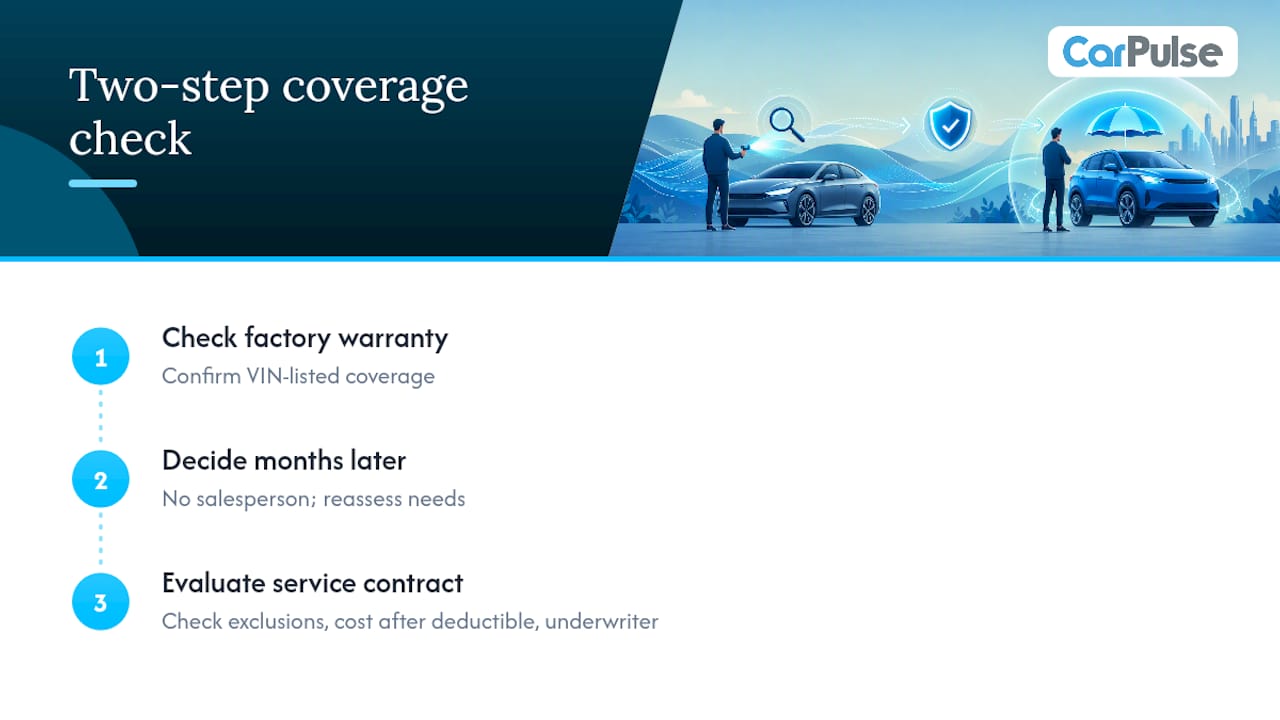
Most advice on this topic treats warranties and service contracts as a binary choice you make once, at the dealership, under pressure. That’s backward. The better approach treats it as two separate decisions made at two separate times: understand what your factory warranty already covers first, then decide months later, with no salesperson in the room, whether a service contract fills a real gap.
The conventional wisdom oversells “peace of mind” as the reason to buy. Peace of mind is worth something, but it’s not worth paying for coverage you already have for free, and it’s definitely not worth paying for a contract with an underwriter you can’t verify. The data backs a narrower case for service contracts than the sales floor suggests: they make sense mainly for buyers keeping a vehicle past its factory coverage window, who’ve done the repair cost math, and who’ve confirmed the underwriter is solid.
If you take one thing from this: don’t evaluate a service contract by what it promises. Evaluate it by what it excludes, what it costs after the deductible, and whether the company behind it will still exist when you need to file a claim.
— Henri
Ready to see what coverage a car actually has before you commit? Browse verified listings on Carpulse and check the VIN details yourself, or if you’re selling, list your vehicle with the maintenance and warranty history buyers are actually looking for.
Sources
- Auto warranties and auto service contracts — FTC
- 16 CFR § 700.11 - Written warranty, service contract, and insurance distinguished for purposes of compliance under the Act — e-CFR / LII