Guides
AI Price Valuation for Car Sellers: A Practical Guide

AI Price Valuation for Car Sellers: A Practical Guide

AI price valuation gives you an instant, market-referenced price range for any vehicle, backed by comparable sales data and a confidence score you can act on today. Run a VIN-backed valuation, verify your key inputs (VIN, mileage, photos), and use the result as your listing price starting point.
Three fastest uses for sellers and dealers:
- Price check: Confirm whether your asking price aligns with current market conditions before you publish.
- Competitive positioning: See where your vehicle sits relative to similar listings and adjust to sell faster or hold for margin.
- Dealer portfolio revalue: Batch-run valuations across your inventory to catch stale prices before they cost you deals.
Pro Tip: Start with Carpulse’s AI valuation tool before you set any price. A VIN-backed result takes under a minute and gives you a defensible starting point.
Key Takeaways
AI price valuation works best when VIN, mileage, photos, and history are accurate, and the output is treated as a market reference rather than a certified appraisal.
| Point | Details |
|---|---|
| Run VIN-backed valuations | A correct VIN auto-fills vehicle details and anchors the entire price range to the right vehicle profile. |
| Verify every input | Mileage errors, missing history, and wrong trim options are the leading causes of inaccurate AI valuations. |
| Read the confidence band | A wide interval signals thin comps or unusual vehicle; verify manually before publishing. |
| Treat AI as a market reference | AI valuations are a fast starting point, not a legal appraisal; supplement with inspection for high-value sales. |
| Use Carpulse’s integrated flow | Carpulse combines VIN auto-fill, AI valuation, and listing in one workflow, cutting time-to-list to under 30 minutes. |
Table of Contents
- How does AI-driven price valuation work for vehicles?
- Which inputs move the needle on valuation accuracy?
- What are the accuracy limits of AI vehicle valuations?
- How to use an AI valuation to price and list your car
- How do you evaluate AI valuation providers?
- Why Carpulse’s AI valuation is the recommended choice
- Are you ready to publish? A pre-listing checklist
- Why we built AI valuation into Carpulse
- Get an instant AI valuation on Carpulse
- Sources
How does AI-driven price valuation work for vehicles?
AI valuations synthesize market listings, transaction history, and vehicle-specific data to return a price range and a confidence band, not a single guess. Understanding the pipeline helps you trust the output and spot when something looks off.
The process starts with input ingestion. You supply a VIN, odometer reading, photos, and any available documents. The VIN alone unlocks the vehicle’s year, make, model, trim, and factory options automatically, which eliminates the most common source of human-entry errors. Used-car appraisal systems combine these many factors with machine-learning on large transaction datasets to produce valuations that reflect local market conditions.
Next comes feature extraction. The model reads mileage, trim level, condition signals from photos, and any reported damage or service history. Each attribute shifts the price band. A vehicle with 30,000 miles and a clean service record lands in a different range than the same model at 90,000 miles with a gap in maintenance history.
Then the system retrieves structured comparables. It pulls recent sales and active listings that match your vehicle’s profile within a defined radius. The quality of those comps drives accuracy more than any other single factor. Thin local markets, rare trims, or heavily modified vehicles can produce wider confidence intervals because fewer genuine matches exist.
Finally, the model scores everything and outputs a price range, a confidence band, and an audit trail showing which comps were used and why. Some platforms, like Value.ai, report a time to first review-ready valuation under one minute, with pricing starting from $0.07 per appraisal.
| Output element | What it tells you |
|---|---|
| Price range | The low-to-high band the market supports for your vehicle |
| Confidence score | How tightly the comps cluster; wide = more uncertainty |
| Comparable examples | The actual listings or sales the model used |
| Audit trail | A record of inputs, comps, and model logic for review |
Pro Tip: Check the audit trail before you publish. If the comps are from a different trim or a market 500 miles away, the range may not reflect your local reality.
Which inputs move the needle on valuation accuracy?
VIN plus accurate mileage plus clear photos plus maintenance and accident history produce the largest accuracy gains. Everything else is secondary.
The model can only work with what you give it. Missing or wrong inputs are the leading cause of valuations that feel off. Before you run a valuation, gather these:
- VIN: Use the 17-character code from the dashboard or door jamb, not the registration document, which can contain transcription errors.
- Odometer reading: Enter the current reading, not an estimate. A 5,000-mile error can shift the range by hundreds of dollars.
- Service records: Documented maintenance history signals lower risk to buyers and pushes valuations toward the higher end of the range.
- Accident and damage history: Unreported damage that surfaces later in a Carfax or AutoCheck report will undercut your asking price and your credibility.
- Trim and factory options: Sunroof, leather, towing package, and similar options each carry a measurable premium. Confirm them against the original window sticker or VIN decode.
- Number of keys: Sounds minor, but missing keys are a deduction item in dealer appraisals.
- Recent repairs: New tires, brakes, or a timing belt are legitimate value adds. Document them.
- Location/zip code: Local supply and demand shift prices. A pickup truck prices differently in rural Montana than in downtown Los Angeles.
For photos, shoot at least eight angles: front, rear, both sides, engine bay, odometer, interior (front and rear), and any visible wear or damage. Natural light beats a garage. Closeups of tire tread, upholstery condition, and any scratches give the model and potential buyers the same honest picture.
Appraiser shows how a single uploaded image can trigger an AI analysis and return an estimated value range. For vehicles, more photos always produce a tighter, more defensible range than one.

Pro Tip: Run a VIN lookup first to auto-populate make, model, trim, and options. It takes 30 seconds and removes the most common input errors before they skew your result. Carpulse’s VIN-based listing does this automatically.
What are the accuracy limits of AI vehicle valuations?
AI gives a market-based reference, not a certified appraisal. It has measurable error bands and can be misled by missing or misleading inputs.
Common causes of inaccurate results:
- Incomplete or wrong VIN: Triggers a wrong vehicle profile, which corrupts every downstream calculation.
- Hidden damage: Structural or mechanical issues not visible in photos or disclosed in history reports won’t appear in the model’s inputs.
- Inaccurate mileage: Even honest rounding errors compound across the model’s comp-matching logic.
- Outdated local comps: In slow markets, the most recent comparable sale may be weeks old. Prices move.
- Rare options or aftermarket changes: A factory-limited edition or a heavily modified vehicle has few genuine comps. The model extrapolates, and extrapolation widens the confidence band.
Online valuation guidance consistently warns that local comparables and physical inspection materially affect accuracy. For high-value transactions, supplementing an automated estimate with a local expert or inspection is the standard recommendation, not an optional extra.
Signals that mean “verify manually”:
- The confidence interval is unusually wide (the high end is more than 20% above the low end).
- The audit trail shows fewer than three comparable matches.
- The comps are from a different trim level or a distant market.
- The vehicle has significant aftermarket modifications not captured in the VIN decode.
Pro Tip: Treat the midpoint of the AI range as your reference price, not your ceiling. Adjust up for documented extras and recent repairs; adjust down for visible wear or a fast-sale timeline. The confidence band tells you how much room you actually have.
How to use an AI valuation to price and list your car
Run a VIN-backed AI valuation, confirm your inputs, then set a listing price using a simple strategy based on confidence and your time-to-sell goal.
For private sellers
- Run the valuation. Enter your VIN, mileage, location, and condition. Upload at least eight photos.
- Verify the inputs. Cross-check the auto-populated trim and options against your window sticker or registration. Correct any errors before you accept the range.
- Set your listing price. Start at the midpoint of the AI range. Subtract 3–5% for visible wear or a fast-sale goal; add 3–5% for documented service history, new tires, or recent repairs.
- Choose your listing options and timeline. Decide how long you’re willing to wait. A price at the top of the range may take longer to attract buyers.
- Reprice after market feedback. If you get no serious inquiries in 10–14 days, drop to the lower third of the range and rerun the valuation to check whether the market has moved.
For dealers
- Batch-run valuations across your inventory. Prioritize vehicles that haven’t been repriced in 30+ days.
- Apply stock-level pricing rules. Set floor prices by segment (economy, mid-range, premium) based on your cost basis and margin targets.
- Factor in refurbishment costs and floor-plan fees. A vehicle that needs $800 in reconditioning needs that cost built into the margin math before you set the listing price.
- Set margins by segment. High-demand vehicles can sit at the top of the AI range. Slow movers need to price toward the midpoint or below to turn inventory.
Sample price calculation:
For a practical buying and selling workflow, Carpulse’s complete seller guide walks through each step in detail.
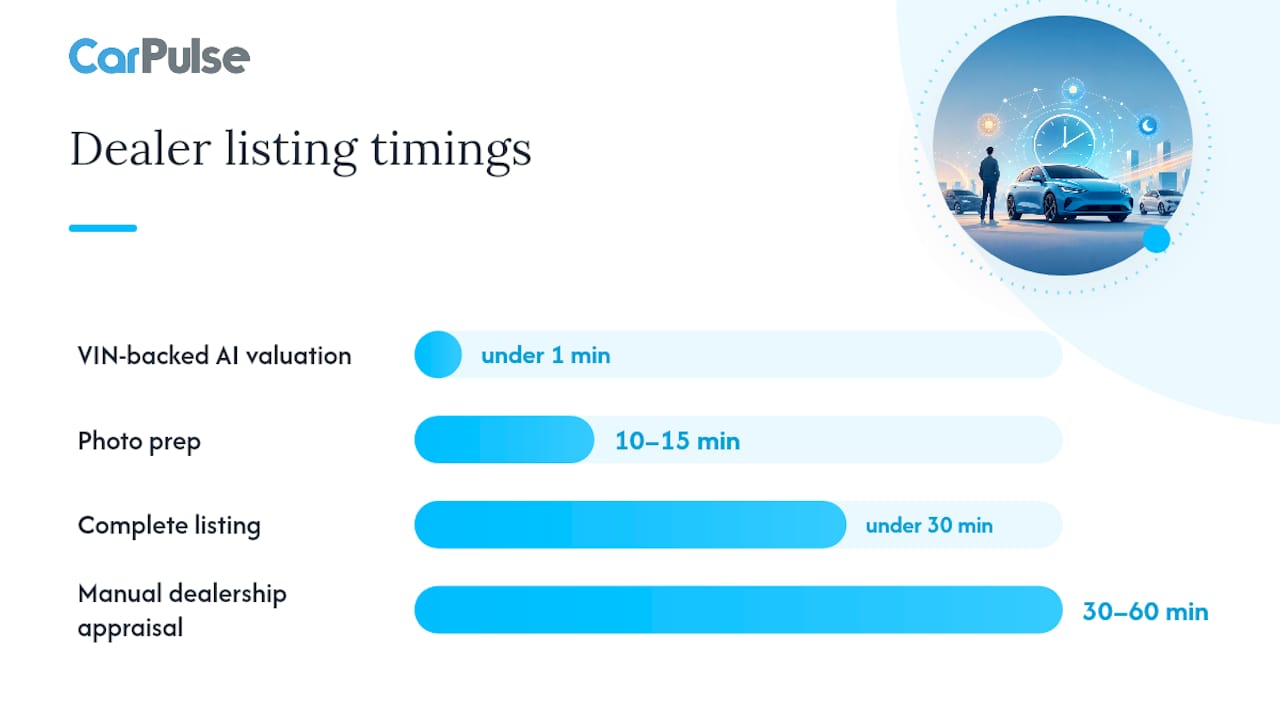
Timeline: A VIN-backed AI valuation runs in under a minute. Photo prep takes 10–15 minutes if you’re organized. A complete listing, photos included, can go live in under 30 minutes. Manual appraisal at a dealership typically takes 30–60 minutes on-site, plus scheduling.
How do you evaluate AI valuation providers?
Prioritize providers that support VIN auto-fill, show confidence intervals, provide an audit trail, and integrate with your listing workflow or API.
Evaluation criteria:
- Speed: Time to first valuation should be under two minutes for a standard vehicle. Value.ai reports under one minute for review-ready results.
- Inputs supported: VIN, photos, and documents at minimum. Providers that accept only a make/model/year/mileage combination are producing a rough estimate, not a valuation.
- Output type: You need a price range plus a confidence score plus comparable examples. A single number with no context is not a valuation.
- Pricing model: Per-appraisal pricing (as low as $0.07 per appraisal at some vendors) suits low-volume sellers. Subscription models suit dealers running daily batch revaluations.
- Integration: API access and batch processing matter for dealers. A clean UI matters for private sellers.
- Human-review fallback: Any serious provider offers an escalation path for unusual vehicles or disputed results.
Red flags:
- No confidence interval or rationale shown in the output.
- No VIN integration (manual entry only).
- No audit trail or provenance of comps.
- No dispute or human-review process.
Questions to ask any vendor:
- How do you source your comparables, and how current are they?
- Do you provide a full audit trail with every valuation?
- Can I batch-revalue my inventory via API?
- What is your dispute or human-review process for unusual vehicles?
| Vendor metric | Reported benchmark |
|---|---|
| Time to first valuation | Under 1 minute (Value.ai vendor claim) |
| Sample per-appraisal price | From $0.07 (Value.ai vendor claim) |
| Audit trail | Available on structured platforms |
| Batch/API access | Available on dealer-tier plans |
Why Carpulse’s AI valuation is the recommended choice
Carpulse’s AI valuation integrates VIN auto-fill, listing workflow, and audit trail into a single marketplace experience. You don’t need a separate appraisal tool, a separate listing platform, and a separate history check. It’s one flow.
Key features that matter for sellers and dealers:
- VIN-based auto-population: Enter the VIN once; the platform fills make, model, trim, and options automatically, cutting listing errors at the source.
- Instant range and confidence score: The valuation returns a price band and confidence level so you know how much to trust the number before you publish.
- Audit trail of comps: Every valuation shows the comparable listings that drove the range. You can review them, dispute them, or use them as negotiation evidence.
- Mobile app integration: The Carpulse iOS app and Android app let you run valuations and manage listings from anywhere, not just a desktop.
- Verified dealer network: Listings sit alongside verified dealerships, which signals buyer trust and supports stronger asking prices.
Carpulse’s integrated approach means the valuation and the listing are the same action. You run the AI valuation, confirm the range, and publish directly. There’s no export, no copy-paste, no second platform to manage. For dealers repricing inventory daily, that workflow difference compounds fast.
An integrated marketplace valuation differs from a standalone appraisal service in one practical way: the price you get is already calibrated to the platform where buyers are actively searching. A standalone tool gives you a number; Carpulse gives you a number in context.
For a deeper look at the factors that drive used-car prices in the local market, the Carpulse blog covers what affects used-car prices in detail.
Are you ready to publish? A pre-listing checklist
If you can check every box below, your listing is ready for a buyer audience and the AI valuation is trustworthy.
- [ ] VIN verified against the physical vehicle (dashboard or door jamb)
- [ ] Odometer reading confirmed and entered correctly
- [ ] At least eight photos uploaded: exterior (all four sides), engine bay, odometer, interior, and any visible wear
- [ ] Service records and maintenance history uploaded or noted
- [ ] Accident or damage history disclosed and documented
- [ ] AI valuation run with all inputs complete
- [ ] Confidence interval reviewed; wide intervals flagged for manual check
- [ ] Listing price set per your chosen strategy (conservative, neutral, or hold)
- [ ] Listing options chosen (duration, featured placement, etc.)
- [ ] Contact details verified and response method confirmed
Print this list or save it to your phone. Running through it before every listing takes two minutes and prevents the most common errors that lead to price disputes or slow sales.
Why we built AI valuation into Carpulse
Pricing a car manually is slow, inconsistent, and often wrong. Sellers undercut themselves because they don’t know the market; dealers overprice aging inventory because repricing is tedious. We built AI valuation into Carpulse to solve both problems at once: faster listings, fewer pricing mistakes, and a transparent audit trail that gives buyers confidence in the price they see.
[Henri’s professional background and credentials in the automotive industry would appear here in the published version.]
Get an instant AI valuation on Carpulse
Carpulse’s AI valuation returns an instant market price and audit trail for every listing, so you publish with confidence instead of guesswork.
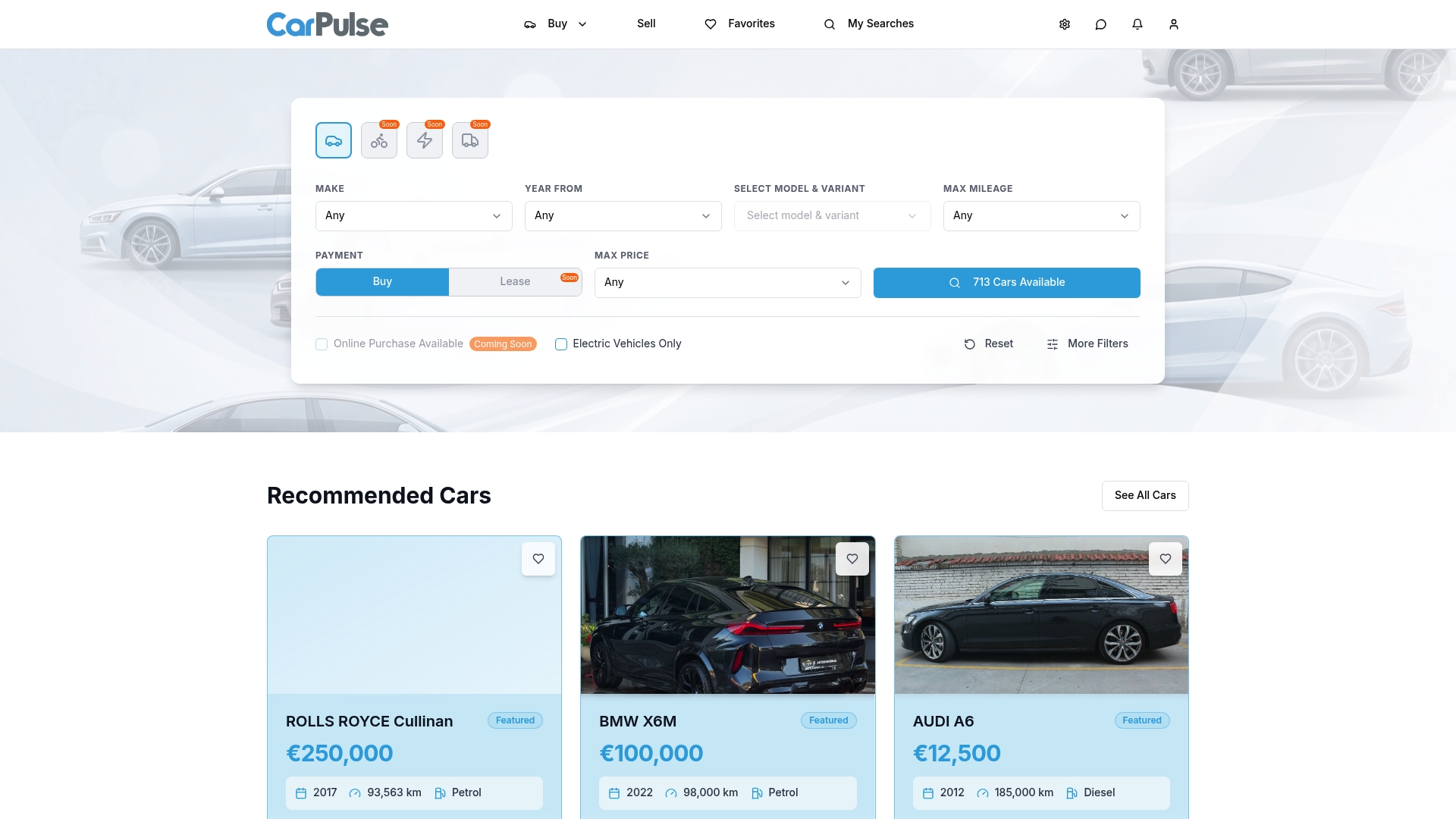
Getting started takes under five minutes:
- Go to Carpulse’s sell page or open the mobile app.
- Enter your VIN or let the app scan it. The platform auto-fills your vehicle details.
- Add your photos (eight or more for the tightest range).
- Run the valuation. Review the price range, confidence score, and comparable listings.
- Publish your listing or request a human inspection for high-value or unusual vehicles.
Dealers can access API and batch revaluation options for full inventory repricing. Pricing details are available directly on the platform. Start your listing on Carpulse and see the AI valuation in action on a real vehicle.