
Guides
Save up to 42% on Cars in Albania by Spotting Verified...
Save up to 42% on Cars in Albania by Spotting Verified Discounts Fast

Verified marketplace listings and dealership clearance posts are where genuine car discounts show up first, and the fastest move is setting a saved search with price alerts before you shop manually. Timing matters more than most buyers realize: buying at the right point in a model’s cycle can shave a serious chunk off the original launch price. Online car marketplaces let you flag that window automatically instead of checking listings every day.
TL;DR:
- Genuine discounts on cars are typically found in verified marketplace listings or dealership clearances, not in social media claims or showroom ads.
- Timing is critical, with the best deals often available during model-year changeovers, end-of-month sales, or dealer clearance events, especially when inventory is being refreshed.
- Confirm the authenticity of discounts by verifying VIN numbers, requesting full out-the-door prices, and seeking independent inspections before purchase.
- Fuel price fluctuations influence demand and pricing strategies, making fuel-efficient or electric models more negotiable during price spikes.
- Using verified online platforms with alerts and valuation tools accelerates access to real discounts and reduces the risk of paying inflated prices.
Table of Contents
- Ulje çmimi makine: where the real discounts show up first
- What discounts actually look like on new and used cars
- How fuel prices push car discounts up or down
- When to buy for the lowest price
- How to check a discount is real before you pay
- How CarPulse helps you spot and confirm genuine discounts
- What financing does to your total savings
- The registration and legal costs that add up fast
- Why discounts look different depending on where you shop
- Getting the dealer to actually move on price
- Author’s take: verify first, negotiate second
- How to start hunting discounts on CarPulse today
- Sources
Ulje çmimi makine: where the real discounts show up first
Not every “discount” you see is a discount. A dealer poster in a showroom window and a genuine price drop on a verified listing are two different things, and telling them apart is the whole game.
Dealership clearance announcements are usually tied to a specific reason: end-of-model-year stock, a new generation arriving, or a dealer trying to hit a quarterly sales target. These often appear as in-store banners or paid social posts, and the discount is real, but only on the specific units named. Call the dealer and ask which VIN numbers the discount applies to before you drive over.
Marketplace listings are the most efficient channel because they let you filter by price, year, mileage, and fuel type all at once, then compare against dozens of similar cars instantly. Setting a saved search on a car marketplace means new price drops land in your inbox instead of you refreshing a page every morning. That’s the single biggest time-saver in this whole process.
Social media deal groups and dealer pages move fast and loose with numbers. A post claiming “20% off” often means 20% off the manufacturer’s suggested price, not the price the dealer was actually asking last week. Treat social posts as a lead, never as a confirmed price.
Before you take any advertised reduction seriously, run through this quick check:
- Match the VIN on the ad to the VIN on the car itself.
- Confirm the dealer or seller has a working phone number and physical address.
- Search the photos in the ad. Stock images recycled from another listing are a warning sign.
- Ask for the full out-the-door price, not just the headline number. Fees and taxes routinely get left off the ad.
What discounts actually look like on new and used cars
Most real-world discounts on used cars in Albania commonly range from several hundred to a few thousand euros off the asking price once you negotiate directly with the seller. That’s the range for a normal, healthy negotiation on a car that isn’t overpriced to begin with.
New cars behave differently. Clearance events tied to model-year turnover or a discontinued trim can push discounts well past that used-car range, especially when a dealership is trying to clear inventory before the next shipment arrives. Research on car-buying timing shows discounts of up to 42% are possible on specific models when you catch the right moment in that model’s life cycle, though that figure applies to particular cases, not every car on a lot.
Why some discounts run bigger than others:
- Model-year clearance, where the dealer needs floor space for the next year’s stock.
- Discontinued trims or colors that sat unsold for months.
- Trade-in oversupply, when a dealer takes in more used units than it can move quickly and prices them to turn over fast.
The advertised discount rarely tells the whole story. A dealer might quote a large percentage off the sticker price while registration fees, dealer prep charges, or optional add ons sit outside that number entirely. Before comparing two “discounted” cars, ask both sellers for one figure: the total price you’d pay to drive away, taxes and fees included.
How fuel prices push car discounts up or down
Fuel prices in Albania have swung noticeably through 2026, and every swing changes what buyers want to drive, which changes what dealers are willing to discount. One report tracked diesel dropping to about 199 lek per liter at one point in the year, only for prices to climb back up shortly after. By August, reports put fuel back above 219 lek per liter, with industry groups publicly pushing for relief on the cost.
That volatility matters directly to your car search. When fuel prices climb, demand for fuel-efficient models and electric cars rises fast, and demand for older, thirstier used cars softens. Sellers holding onto less efficient models often respond by cutting price to attract buyers who’d otherwise skip past that listing. If you’re shopping for a larger SUV or an older diesel model, a fuel-price spike can actually work in your favor at the negotiating table.
There’s a second layer to this that fewer buyers track: input costs. A 2026 industry analysis found finished lubricant prices rose sharply due to base-oil cost increases, with some categories climbing in the 15% to 35% range. That doesn’t just affect your next oil change bill. It feeds into what dealers charge for servicing and prep on new inventory, which shapes the room they have to negotiate on price.
What to keep an eye on:
- Weekly fuel price reports, since a spike often precedes a dip in demand for inefficient used models.
- Dealer service pricing, which reflects rising input costs even when the sticker price hasn’t moved.
- Listings for electric and hybrid models, which tend to hold value better during fuel-price spikes.
When to buy for the lowest price
Timing beats almost every other negotiation tactic, and it’s the one factor most buyers ignore entirely.
- End of month or end of quarter. Sales teams are chasing targets, and a car that closes the gap on a quota often gets a better price than the same car sold three days earlier.
- Model-year turnover, typically late summer through fall. Dealers need lot space for incoming stock, and outgoing models get marked down to move.
- Dealer clearance events. These are announced, not hidden, so watch dealership social pages and marketplace listings for phrases like “clearance” or “end of stock.”
- Holiday sales periods. Traffic to dealerships spikes, and competitive pressure between sellers tends to push prices down across the board.
The practical version of this: keep a saved search live on a marketplace so a price drop reaches you the moment it happens, rather than days later after someone else already bought the car. Contacting dealers early in the week, before the weekend rush of walk-ins, also tends to get you a more attentive salesperson with more room to talk numbers.
Pro Tip: A price that drops and then quietly climbs back up within a week is usually a staged promotion designed to create urgency, not a genuine clearance. A real discount tends to hold steady or keep falling as the dealer works to move that unit.
Knowing when to wait matters as much as knowing when to act. Learn practical tips on how to reduce startup overhead in your auto business reduce startup overhead, which can help dealers manage pricing and discounts more effectively. If a listing has sat for months with no price movement, waiting rarely helps. But if a dealer just posted a fresh clearance batch or a model-year changeover is underway, moving within days can beat the crowd to the best units.
How to check a discount is real before you pay
A discount is only worth acting on once you’ve confirmed it holds up under basic scrutiny. Run through this before handing over money on anything.
- Confirm the VIN. Match the number on the listing to the number on the car’s dashboard or door frame, and run a history check if the seller hasn’t already provided one.
- Request service records. A car with no maintenance history at a discounted price often has the discount for a reason.
- Ask about warranty or return terms. A dealer offering zero flexibility after the sale is a different risk profile than one offering even a short return window.
- Get an independent inspection. This is non-negotiable on anything you haven’t personally driven and checked over.
- Calculate the full out-the-door cost. Add registration, transfer fees, and any dealer charges to the advertised price before comparing offers.
- Confirm payment and delivery terms in writing. Verbal promises about “including” certain fees mean nothing once money changes hands.
When you’re ready to talk price, keep your opening short and specific. Reference a comparable listing or a valuation figure you’ve already pulled, state the number you’re aiming for, and hold that line. Something like: “I found a similar model listed [X] lower with fewer kilometers. Can you match that, or is there flexibility on the price?” gets a faster, more honest answer than a vague request for “your best price.”
Pro Tip: Set a walk-away number before you contact the seller, not during the conversation. Buyers who decide their limit in the moment almost always talk themselves past it.
Watch for these red flags:
- A VIN that doesn’t match public records or won’t be shared before a deposit.
- Sellers who push for a large upfront deposit with no paperwork or receipt.
- Pressure tactics like “three other buyers are interested” with no verifiable listing history.
- Photos that appear on multiple unrelated listings across different cities.
A step-by-step safety guide covers these verification steps in more depth if you want the full walkthrough before your first inspection.
How CarPulse helps you spot and confirm genuine discounts
Finding a discount is only half the job. Confirming it’s real, and moving fast enough to actually get it, is the other half, and that’s where a marketplace built around verification earns its place.
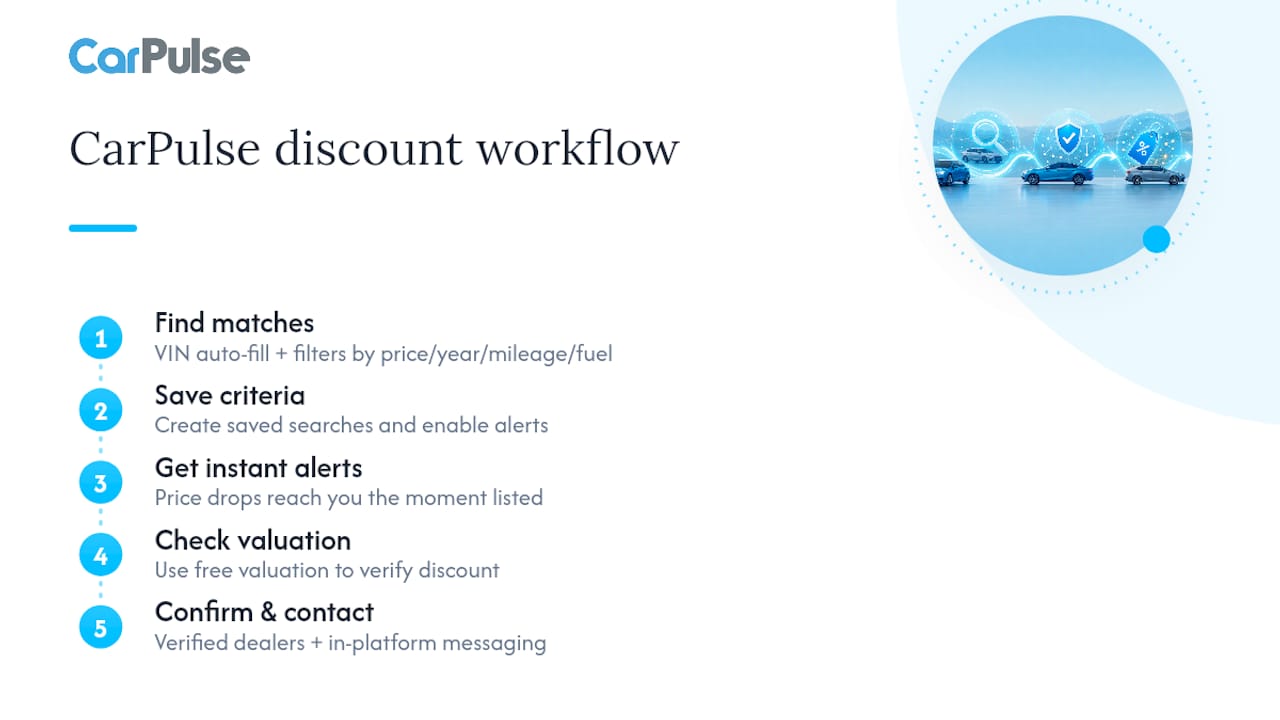
Some online car marketplaces let sellers list vehicles with VIN-based auto-fill, which pulls accurate vehicle details directly from the VIN instead of relying on a seller’s manual description. That alone cuts down on the mismatched details that make so many “deals” fall apart during inspection. Filters by price, year, mileage, and fuel type let you narrow a marketplace down to exactly the units worth your time in seconds.
Saved searches and price alerts are high-leverage tools for catching short-lived discounts before they disappear. A price drop on a car matching your saved criteria reaches you the moment it’s listed, not after someone else already called the seller. That speed matters more than any single negotiation tactic, since the best-priced units in any market window tend to move fastest.
A free valuation tool on some platforms gives you an independent number to check an advertised discount against, so you’re not relying purely on the seller’s framing of what counts as a “deal.” Working with verified dealer networks means listings where the seller’s identity and vehicle details have already been checked, cutting real risk out of the process before you ever pick up the phone.
Start with a saved search and a valuation on CarPulse, then reach out to the seller directly through the platform once the numbers check out.
What financing does to your total savings
A discounted sticker price can disappear entirely once financing terms enter the picture. Two identical cars at the same discounted price can end up costing wildly different amounts once you factor in the loan.
Interest rates and loan terms determine your real cost far more than the headline discount does. A car discounted by €1,000 but financed over a longer term at a higher rate can end up costing more overall than a full-price car financed on better terms. Before accepting any financing offer tied to a discounted car, ask for the total repayment amount, not just the monthly figure. Dealers sometimes offer a bigger sticker discount specifically because they’re making margin back on the financing side.
A few things worth checking every time:
- Compare the total cost of the loan, not just the advertised interest rate.
- Ask whether the discount is contingent on using the dealer’s financing partner, since walking away from that requirement sometimes preserves the discount anyway.
- Factor in early repayment terms if you plan to pay off the loan faster than scheduled.
- Get financing pre-approved independently before you negotiate, so you know your real leverage at the table.
A shorter loan term with slightly higher monthly payments almost always beats a longer term when you add up total interest paid, even on a car that looked like the better deal upfront.
The registration and legal costs that add up fast
The price on the listing is never the price you actually pay. Registration, transfer of ownership, and administrative fees sit on top of every purchase, discounted or not, and skipping this math is how a “great deal” turns into a disappointing one.
Buying a used car in Albania involves transfer costs tied to the vehicle’s value and age, along with standard registration fees at the point of ownership change. These figures vary based on the specific vehicle and transaction, so confirming the exact amount with the registration office or through your dealer before finalizing a purchase avoids an unpleasant surprise at the counter.
Beyond the base fees, factor in:
- Notary or documentation costs tied to formalizing the sale, particularly for private-party purchases.
- Insurance requirements that need to be active before you can legally drive the car home.
- Any outstanding fines or liens tied to the vehicle’s history, which a proper VIN check should surface before you commit to anything.
None of these costs are optional, and none of them show up in a discount percentage. Building them into your budget from the start means the number you negotiate is the number you can actually compare against other offers.
Why discounts look different depending on where you shop
Car prices in Albania don’t move uniformly across the country, and that gap is one of the most overlooked levers a buyer has.
Larger cities tend to carry more inventory and more direct competition between dealers, which usually pushes prices down through sheer competitive pressure. Smaller markets often carry less negotiating room simply because there are fewer alternative sellers nearby to use as leverage. That doesn’t mean rural listings are worse deals. It means the negotiation dynamics differ, and a buyer willing to travel for the right car often finds better pricing outside the most competitive urban markets.
Local pricing factors shift based on regional demand patterns, seasonal timing, and even which models are locally popular versus imported in smaller numbers. A model that’s common and easy to negotiate on in one city might be scarce and priced firm in another.
Filtering a national marketplace by location lets you see this pricing gap directly instead of guessing. If a car you want is priced noticeably lower two or three hours away, the travel cost is often smaller than the savings, especially on higher-value purchases.
Getting the dealer to actually move on price
Dealers expect negotiation, and the buyers who walk away with the best price are almost always the ones who show up with a specific comparison already in hand.
Bringing a verified, comparable listing to the conversation is the single strongest lever you have. Saying “I found the same model, similar mileage, listed for less across town” gives the dealer a concrete number to respond to, rather than a vague request to “do better.” Dealers have flexibility built into most listed prices specifically to leave room for this kind of negotiation.
Ask about bundled extras instead of pushing only on the price itself. A dealer reluctant to drop the number further may still throw in a service package, extended warranty coverage, or reduced fees to close the sale. That flexibility often costs the dealer less than a direct price cut, which makes it an easier “yes” to get.
Set your walk-away number before the conversation starts, and be genuinely willing to use it. Dealers can usually tell within a few minutes whether a buyer is serious about leaving if the number doesn’t work, and that read shapes how much room they’re willing to offer.
Author’s take: verify first, negotiate second
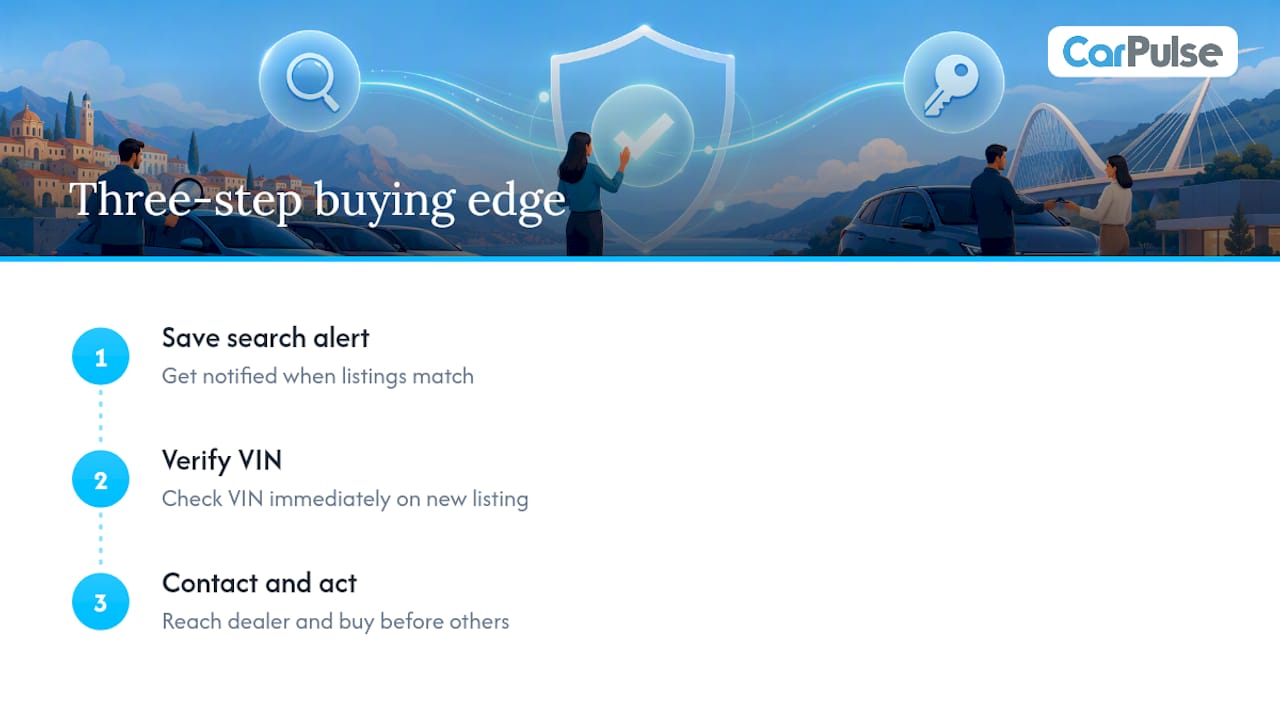
The buyers who actually save money aren’t the ones with the sharpest negotiating lines. They’re the ones who set an alert, verify the VIN the moment a listing pops up, and act before the crowd catches on. That’s the whole edge, and it’s available to anyone willing to do it consistently.
Keep watching fuel-price trends and dealership clearance announcements over the coming months. Both move faster than most buyers expect, and both create short windows where the smart money moves quickly.
— Henri
How to start hunting discounts on CarPulse today
CarPulse is built around one problem this whole guide has covered: verified information beats vague promises every time. Instead of chasing social posts and showroom banners, you filter, save, and get alerted the moment a real discount matches what you’re looking for.
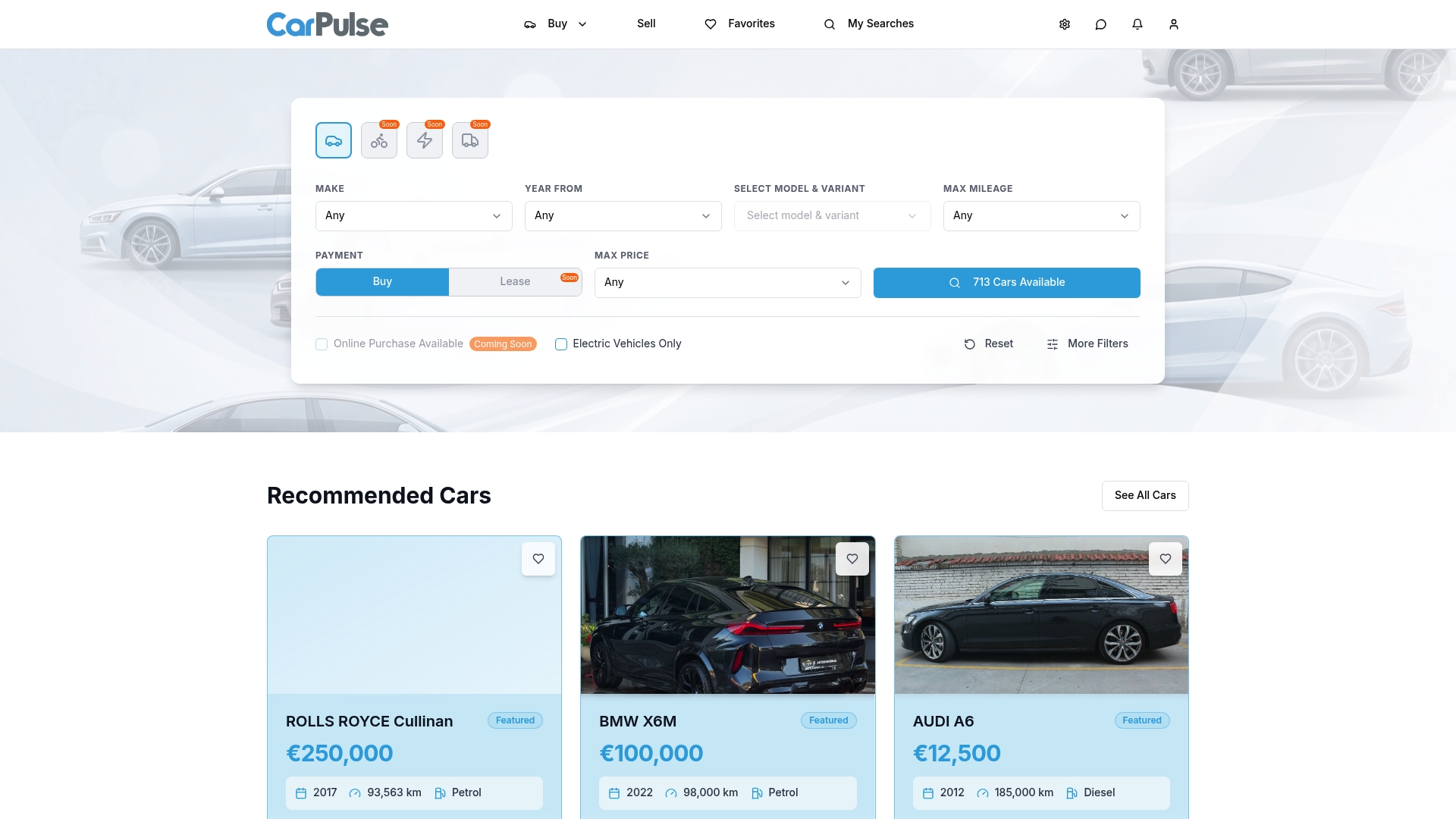
Start by opening the CarPulse marketplace and setting your filters for price, year, mileage, and fuel type. Save that search and turn on alerts so new listings and price drops land in front of you automatically, instead of relying on manual checking. Run a free valuation on any car that catches your eye to confirm the advertised discount is genuine, then reach out to the verified seller directly through the platform.
Before any money changes hands, confirm the VIN and arrange an independent inspection. That single step catches most of the problems this article warned about.
If you’ve got a trade-in that could offset the cost of your next car, the CarPulse sell page lets you list it using the same VIN-based auto-fill that makes the buying side so fast.
Sources
- Mapo: Koha e duhur për të blerë makinë — ulje deri në 42%
- SkyWeb: Nafta zbret me 15 leke, çmimi 199 lekë për litër
- NewsBomb: Konfindustria kërkoi ulje të kostove; çmimi i naftës në Shqipëri ‘nuk ka frena’, litri shitet me 219 lekë
- JobbersWorld: Reconciling the spring 2026 lubricant price surge