Guides
Car Insurance in Albania: Coverage Types and What They Cost
Car Insurance in Albania: Coverage Types and What They Cost
Every registered vehicle in Albania needs TPL (third-party liability) insurance by law, while Kasko and Minikasko stay optional add-ons that protect your own car. Siguracion makine kosto shqipëri depends mostly on five factors: your car’s engine power, your age and driving history, the city where you’re registered, the vehicle’s market value, and whether you add extras like roadside assistance or European coverage. A basic TPL policy for a small city car runs cheap; a full Kasko on a newer vehicle costs several times more.
Before you do anything else:
- Check your current policy’s expiry date. You can buy a renewal up to 15 days before it lapses, no gap required.
- Buy TPL online through an insurer or app if your car is registered in Albania. It’s mandatory regardless of how often you drive.
- Consider Kasko only if your car meets the value and age criteria insurers require. Otherwise Minikasko usually fits better.
Key Takeaways
TPL is mandatory and covers third parties only, while Kasko and Minikasko are optional add-ons that protect your own vehicle and come with real eligibility limits.
| Point | Details |
|---|---|
| TPL is non-negotiable | Every Albanian-registered car needs it by law; driving without it risks fines and impoundment. |
| Kasko has strict eligibility | Insurers often require a market value near €5,000 and a vehicle age under roughly 10 years. |
| Minikasko fills the gap | It suits older or lower-value cars that don’t qualify for full Kasko coverage. |
| Renew up to 15 days early | Buying a replacement policy before expiry avoids any coverage lapse. |
| Digital buying speeds things up | Apps now offer instant TPL purchase with installment plans, some at 0% interest. |
Table of Contents
- What Is TPL and Why It’s Mandatory
- Kasko and Minikasko: What They Add Beyond the Minimum
- How Insurers Calculate Your Premium
- Driving Abroad: Green Card and Border Insurance Rules
- Where and How to Buy Car Insurance in Albania
- What to Do After an Accident
- How to Pick the Right Policy Without Overpaying
- Frequently Asked Questions
- Sources
What Is TPL and Why It’s Mandatory
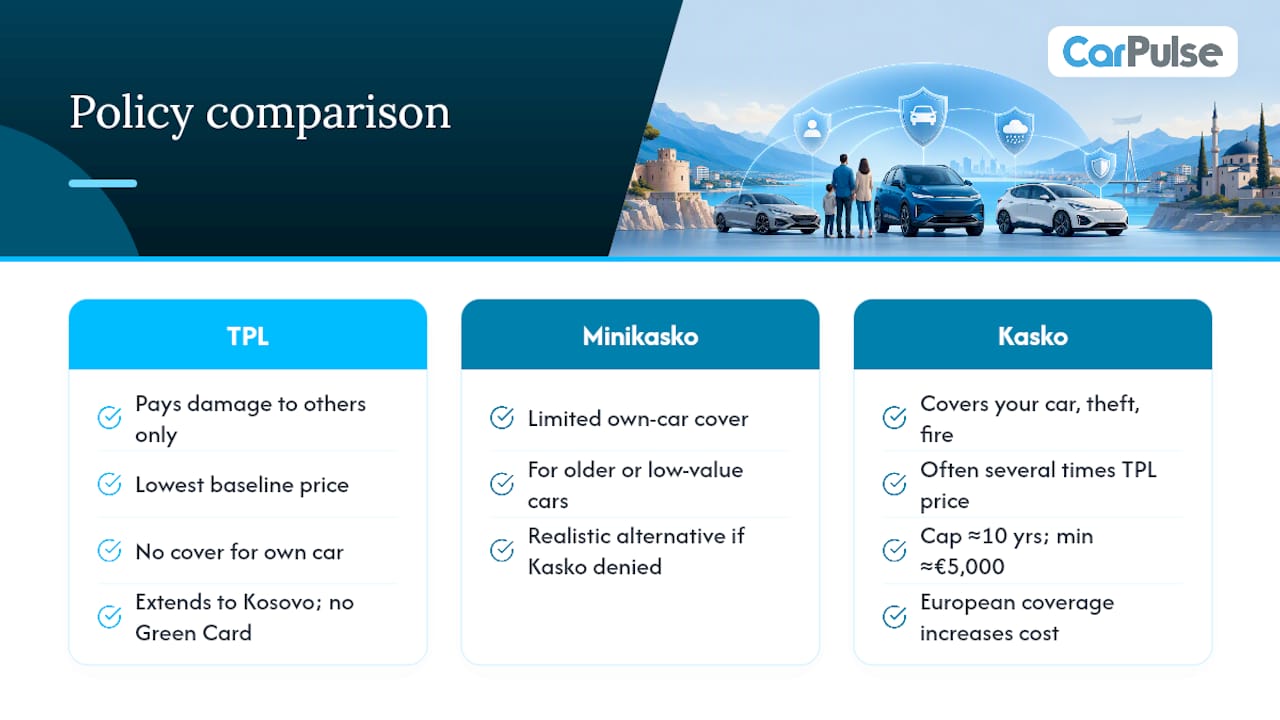
TPL stands for third-party liability, and it’s the only insurance type Albanian law actually requires. It pays for damage you cause to other people, in three categories: material damage to their vehicle or property, bodily injury, and pecuniary loss (lost income, medical bills tied directly to the accident). It does not pay a cent toward your own car.
Policies run for one year and typically cover Albania along with Kosovo, since the two countries share a common insurance zone for domestic TPL. This is a detail many drivers miss when they assume the policy stops at the Albanian border.
Skip this and the consequences are immediate. Driving without valid TPL is a legal violation that carries fines and can mean your car gets impounded at a checkpoint. Insurers licensed to sell TPL in Albania include SIGAL UNIQA, SIGMA (VIG), and others operating under the country’s insurance framework, so shopping around among registered companies is straightforward.
A few numbers worth knowing:
- TPL indemnity limits are set in Lekë and vary by insurer and policy tier, covering bodily injury, material damage, and pecuniary loss separately.
- Add-ons like AutoSOS roadside assistance and European territorial extensions are commonly sold alongside the base TPL policy, not bundled automatically.
- The standard term is one year; there’s no monthly TPL product in the Albanian market the way some countries offer.
Pro Tip: Set a calendar reminder 20 days before your TPL expires. That gives you a buffer to compare prices without risking a coverage gap on the actual expiry date.
Kasko and Minikasko: What They Add Beyond the Minimum
TPL protects other people. Kasko and Minikasko protect your car, and they work very differently from each other.
Full Kasko covers your own vehicle for accident damage regardless of fault, plus typically theft, fire, and vandalism, depending on the policy terms. It’s the closest thing to comprehensive coverage in the Albanian market. Minikasko is a scaled down version, usually covering a narrower set of risks (often theft and specific damage types) at a lower premium, with a capped payout.
The catch with full Kasko is eligibility. Most insurers won’t write a Kasko policy unless the car meets a minimum market value, often around €5,000, and falls within roughly a 10 year age window. Drive an older used car, and Kasko may simply not be offered to you, no matter how much you’d pay.
That’s exactly where Minikasko earns its place. It’s built for cars that don’t clear the Kasko bar, or for owners who want some protection without the higher premium. Some Minikasko products cap compensation at levels like 1,000,000 Lekë, a ceiling worth checking before you assume you’re fully covered.
- Full Kasko: broader protection, fault-independent, strict eligibility.
- Minikasko: partial protection, lower cost, fewer restrictions on vehicle age or value.
- Both exclude general wear, mechanical failure, and often damage from driving under the influence.
Pro Tip: Don’t buy full Kasko just because it sounds safer. If your car is older than 10 years or worth under roughly €5,000, insurers may decline it anyway, so Minikasko is the realistic option and often the smarter one financially.
How Insurers Calculate Your Premium
Your price isn’t a flat number pulled from a chart. Insurers weigh several factors, and understanding them lets you actually negotiate or shop smarter instead of accepting the first quote.
The main variables that move your premium:
- Engine size and power. Bigger engines statistically mean bigger claims, so TPL and Kasko both scale with horsepower or displacement.
- Driver age and experience. Newer drivers, especially under 25, tend to pay more across nearly every insurer.
- Claims history. A clean record earns a no-claims discount; recent accidents push your renewal price up.
- Vehicle value and age. This matters most for Kasko, where the payout ceiling is tied to what the car is actually worth.
- City or region. Urban areas like Tirana see denser traffic and higher accident rates, which insurers factor into pricing.
- Territory and add-ons. Extending coverage to Europe, adding roadside assistance, or lowering your deductible all raise the base price.
Deductibles work the way you’d expect: choose a higher deductible and your premium drops, but you pay more out of pocket if you actually file a claim. It’s a real trade-off, not a formality on the paperwork.
For rough budgeting, a small city car with a basic TPL policy sits at the low end of the cost spectrum, while a newer, higher-value vehicle carrying full Kasko with European extension and roadside assistance can run several times that baseline. Total vehicle ownership costs in Albania include insurance alongside fuel, maintenance, and taxes, so it helps to plan the premium as one line item in a bigger annual budget rather than in isolation.
If you’re insuring a car you just bought, checking essential maintenance habits for Albanian roads alongside your insurance shopping tends to catch small issues before they turn into expensive claims.
Driving Abroad: Green Card and Border Insurance Rules
Albanian TPL doesn’t automatically follow you across every border. Two documents handle the gap: Karton Jeshil (Green Card) and Polica Kufitare (border policy).
If you’re an Albanian driver heading abroad, you need the Karton Jeshil to guarantee third-party liability coverage in the countries you’re visiting. Without it, you’re driving uninsured the moment you cross into a country that requires it. Going the other direction, foreign-plated cars entering Albania need a Polica Kufitare, a border policy that fills the same role for visitors.
Validity options for border policies typically range from short trips to a full year:
- 15 days for a quick cross-border trip or transit.
- 30 to 90 days for extended travel or seasonal visits.
- Up to 1 year for drivers who regularly cross borders.
Before you travel, run through this checklist:
- Confirm your Karton Jeshil is valid for every country on your route, not just your final destination.
- Carry your vehicle registration, your national ID or passport, and the physical Green Card document.
- Buy border coverage a few days ahead of travel rather than at the crossing, since queues and paperwork delays are common at busy checkpoints.
Where and How to Buy Car Insurance in Albania
You’ve got three practical paths to buy coverage: insurer offices, authorized agents or brokers, and digital channels through bank or fintech apps. All three sell the same underlying products, TPL, Kasko, and Minikasko, but the experience differs a lot.
Walking into an insurer’s office still works fine if you want someone explaining terms face to face. Agents and brokers can be useful for comparing multiple insurers at once instead of visiting each one separately. But digital buying has genuinely changed the process for a lot of drivers. Local reporting notes that the insurance-buying experience in Albania has shifted from a paperwork burden to something far more convenient, driven largely by mobile apps.
The typical buying flow looks like this:
- Gather your vehicle registration, ID, and current policy number if renewing.
- Get a quote, either in person, through a broker, or via an app.
- Choose your coverage level and any add-ons (roadside assistance, European extension).
- Pay, either in full or through an installment plan.
- Receive your policy, often as a PDF instantly through digital channels, or on paper if bought at a physical office.
On payment, apps like Myiute now let drivers buy TPL and split the cost into 4 installments at 0% interest, which matters if you’d rather not pay a full year upfront. That installment option has also helped cut down on accidental lapses, since renewing digitally takes minutes instead of a trip to an office.
Pro Tip: If you just bought a used car through a platform like CarPulse, insure it before you drive it home, not after. A gap of even one day without TPL is a legal violation, and dealers won’t cover that risk for you.
What to Do After an Accident
The minutes right after a crash decide how smoothly your claim goes later. Stay calm, and work through this in order:
- Check for injuries first. Call emergency services if anyone is hurt, no exceptions.
- Move vehicles out of traffic if it’s safe to do so, and turn on hazard lights.
- Exchange details with the other driver: name, plate number, insurer, and policy number.
- Photograph the scene, the damage, and the position of both vehicles before anything moves.
- Call the police for anything beyond minor scrapes, since a police report often becomes required documentation for your claim.
Once you’re safe, notify your insurer as soon as possible. You’ll typically need:
- The police report (if one was filed).
- Photos of the damage and accident scene.
- Your policy number and ID.
- The other driver’s insurance details.
Response and payment timelines vary by insurer and claim complexity, but straightforward TPL claims tend to move faster than disputed Kasko claims involving fault questions. One thing worth protecting: filing small claims can chip away at your no-claims discount over time, so weigh whether a minor repair is worth handling out of pocket versus filing through insurance, especially if your deductible would eat most of the payout anyway.
How to Pick the Right Policy Without Overpaying
Matching coverage to your actual situation, rather than buying whatever an agent pushes, saves real money. Work through this before signing anything:
- List how you actually use the car: daily city driving, occasional long trips, or regular travel abroad.
- Check whether your car qualifies for full Kasko or whether Minikasko is the realistic option.
- Verify the territorial limits. Does the policy cover just Albania, or Albania and Europe?
- Confirm the deductible amount and how it affects a real claim payout.
- Ask about the claim network. Does the insurer have repair partners near you, or will you be sent across the city?
When you’re talking to an insurer or agent, ask directly:
- What’s the exact indemnity limit for bodily injury, material damage, and pecuniary loss?
- What’s excluded specifically? Ask for the exclusion list, not a summary.
- How does the claims process work end to end, and what’s the typical payment timeline?
Watch for a few red flags: vague exclusion language that nobody can explain clearly, promises of fast claims with no named local repair partners, and premiums that look suspiciously low compared to competitors offering the same coverage tier. If a quote seems too good, it usually is, and the shortfall shows up later in the fine print.
Why This Guide Exists
Buying my first policy in Albania meant sitting through jargon I didn’t fully understand, and I built this guide to spare other drivers that. Carpulse already connects buyers, sellers, and dealerships across the country, so walking readers through the next step, insuring the car they just bought or sold, felt like the natural extension of that work.
Frequently Asked Questions
What does car insurance cost in Albania?
Cost depends on coverage type, vehicle power, driver age, claims history, and city. A basic TPL policy for a small car sits at the low end; full Kasko on a newer, higher-value vehicle with European coverage costs considerably more, often several times the baseline TPL price.
Is TPL the same as full car insurance?
No. TPL only pays for damage you cause to other people or their property. It pays nothing toward repairing your own car after an accident, theft, or fire, which is where Kasko or Minikasko come in.
Can I insure an older used car with Kasko?
Often not. Most insurers cap Kasko eligibility around a 10 year vehicle age and a minimum market value near €5,000. If your car falls outside those limits, Minikasko is usually the realistic alternative.
Do I need a Green Card to drive in Kosovo?
Domestic TPL policies in Albania commonly extend to Kosovo without a separate Green Card, since the two markets share that coverage zone. Check your specific policy terms to confirm, since coverage details vary by insurer.
What happens if I drive without valid TPL?
You’re breaking Albanian law, which can mean fines and vehicle impoundment at a checkpoint. It also means you’re personally liable for any damage you cause, with no insurer covering the cost.
Can I pay for car insurance in installments in Albania?
Yes. Several digital channels, including bank and fintech apps, now offer installment plans, some with 0% interest over four payments, making the annual cost easier to manage without paying the full premium upfront.
This article is general information, not a substitute for advice from a qualified financial advisor. Consult a qualified financial professional about your own circumstances before acting on anything here.
Sources
- iute – Siguracioni i makinës (Myiute app and installment options)
- Albsig – Kasko or full Kasko: which to choose?
- SIGAL – Online motor insurance pricing and add-ons
- SIGMA VIG – Motor insurance products (TPL & cross-border)