Guides
17-Character VIN Checks Albanian Buyers Must Run with...
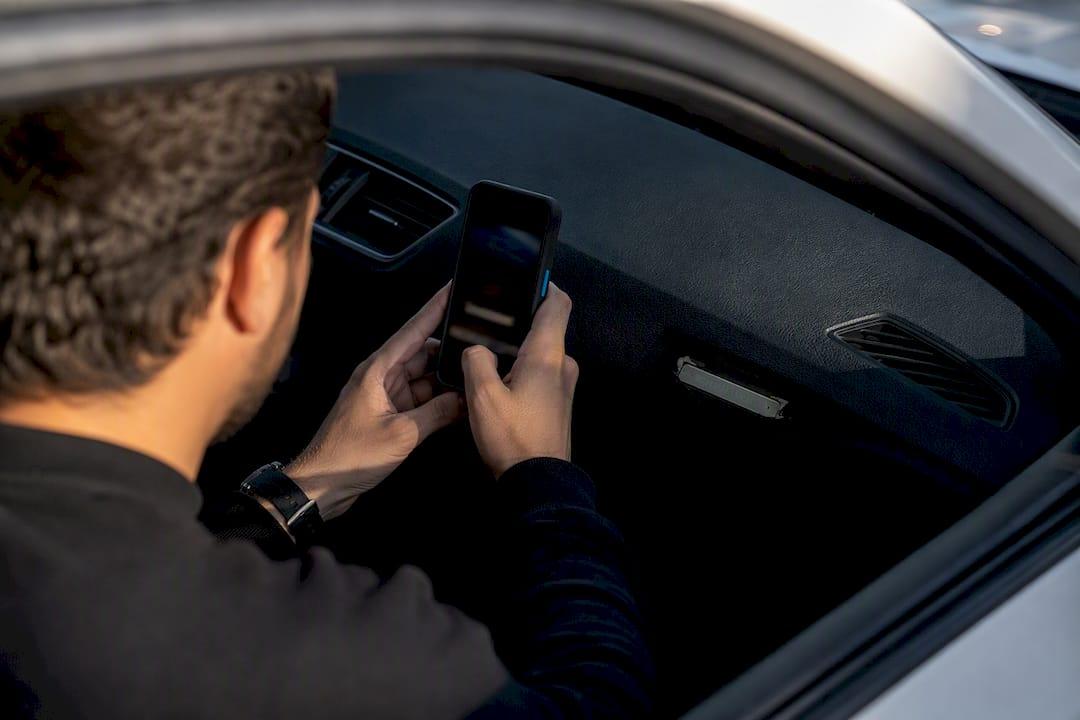
17-Character VIN Checks Albanian Buyers Must Run with CarPulse
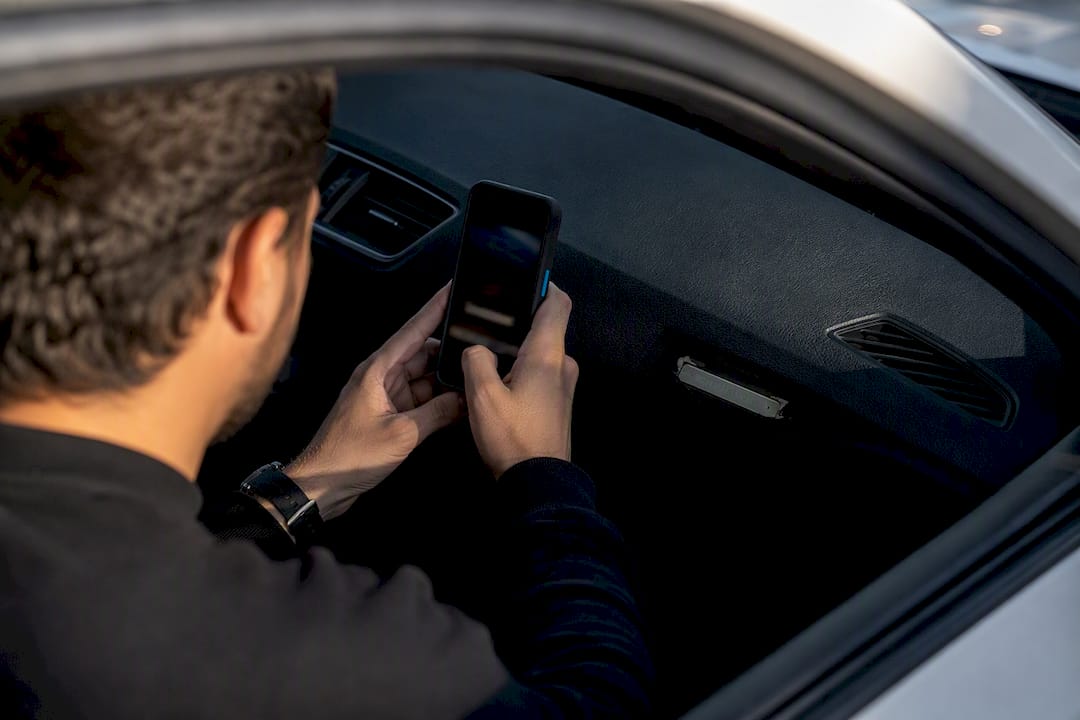
A VIN is a 17-character code stamped on every vehicle, and it’s the single most reliable tool you have for confirming a car is what the seller says it is. The three moves that matter: record the VIN exactly, decode its key sections to check make, model, and year, then run a history report before you hand over any money. If the VIN on the car doesn’t match the one on the paperwork, stop the deal until that gets explained.
TL;DR:
- Verifying the VIN across multiple locations on the vehicle and matching it with official documents is essential to detect tampering or fraud.
- Running the VIN through a standard decoder like NHTSA vPIC provides accurate manufacturer, model year, and body details, but does not reveal accident or ownership history.
- A VIN-based history report can uncover hidden risks such as structural damage, mileage rollback, or unreported ownership changes, and should be ordered close to the intended purchase time.
- If the VIN on the vehicle and on the paperwork do not match, stopping the deal and consulting authorities is the safest action to avoid legal or registration issues.
- Using a camera or trusted VIN apps to capture the code reduces transcription errors, but beware of fake or testing-only tools that generate invalid VINs.
Table of Contents
- Understanding VIN Structure: WMI, VDS, and the Check Digit
- Where to Find the VIN on the Car and in the Paperwork
- Decoding a VIN Step by Step
- Verifying Vehicle History With a VIN
- Tools and Apps for Capturing a VIN Correctly
- What to Do If a VIN Looks Tampered or Mismatched
- How CarPulse Uses VIN Data to Speed Up Listings
- A Quick Best-Practice Checklist Before You Sign Anything
- Where to Verify VIN Data and Order Reports
- Sources
- FAQ
Understanding VIN Structure: WMI, VDS, and the Check Digit
Every VIN runs 17 characters, all Latin letters and digits. Manufacturers never use the letters O, I, or Q, since they’re too easy to confuse with 0, 1, and 9 when someone is reading a plate by hand or copying it off a worn sticker, according to Vehiclehistory.
The code breaks into three readable chunks:
- Positions 1 to 3 (WMI): the World Manufacturer Identifier, telling you the maker and country of origin.
- Positions 4 to 9 (VDS): the Vehicle Descriptor Section, covering body style, engine type, and trim.
- Positions 10 to 17 (VIS): the Vehicle Identifier Section, which includes the model year and a unique serial number.
Position 9 deserves special attention. In many vehicles it functions as a check digit, a mathematically calculated value that flags transcription mistakes without needing any external database. It won’t catch a swapped VIN plate, but it will catch a typo.
Where to Find the VIN on the Car and in the Paperwork
The VIN shows up in more places than most buyers realize, and checking several locations at once is how you catch a mismatch early. Look for it in these spots:
- The driver-side door pillar, usually on a sticker visible when the door is open.
- The dashboard, viewable through the windshield from outside the car.
- The engine bay, often stamped on the block or a nearby plate.
- Under the hood near the front of the frame or on the firewall.
Common physical locations for the VIN include the driver-door pillar, the dashboard near the windshield, and the engine bay, according to VehicleHistory.eu. The same code needs to match the registration certificate and any service records the seller hands you. Before a test drive, photograph every VIN location on the car alongside the paperwork. That way you’ve got a record if something looks off later, and you’re not relying on memory.
Decoding a VIN Step by Step
Decoding a VIN takes a few minutes if you work through it in order. Skip a step and you risk missing a mismatch that would have been obvious.
- Count the characters. Confirm there are exactly 17, and check that none of them are O, I, or Q.
- Run the check digit if the vehicle’s region uses one, to catch a simple copy-paste error.
- Decode the sections. Use a tool to pull the manufacturer, model year, and assembly plant from the WMI, VDS, and VIS.
- Compare the results against the listing. Does the decoded model year match what the seller claims? Does the body style in the photos line up with what the VDS says?
For decoding itself, the NHTSA vPIC decoder is a free, official reference that works for far more than just American-market cars, since WMI codes are standardized globally. Pair it with an established VIN-history service for the ownership and accident side of things.
Pro Tip: Copy the VIN directly from a photo or the registration document and paste it into the decoder field. Retyping a 17-character code by hand is where most transcription errors happen.
Verifying Vehicle History With a VIN
A decoded VIN tells you what the car is. A history report tells you what happened to it. VIN-based history reports typically cover mileage checks, accident records, theft status, and prior ownership counts, along with open recalls and, where available, service history.
Most paid reports come with a validity window rather than lasting forever. Providers commonly set that window somewhere in the 30 to 90 day range, so order the report close to when you actually plan to inspect or buy the car, not weeks in advance.
Reading the report matters as much as ordering it. A few entries deserve extra scrutiny:
- Structural damage flags suggest the car went through a serious collision, even if the bodywork looks clean now.
- Mileage inconsistencies between service visits, especially a drop in recorded mileage, point toward a rollback.
- Registration gaps or mismatches between the report and the paperwork in front of you can mean the car changed hands, or countries, in ways the seller hasn’t mentioned.
A VIN check exists to surface exactly this kind of hidden risk, the sort that a walk-around inspection would never catch on its own, per VehicleHistory.eu. If you’re specifically worried about odometer fraud, a closer look at how to check mileage before buying walks through the warning signs in more depth.
Tools and Apps for Capturing a VIN Correctly
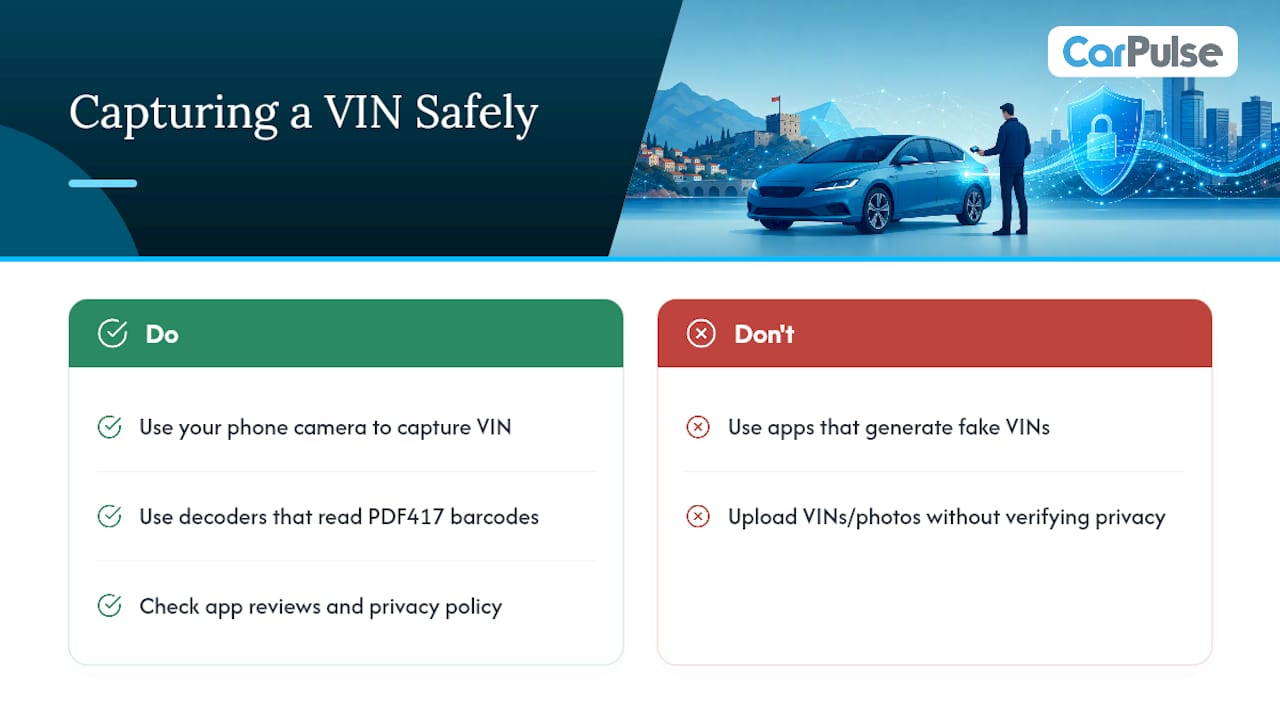
Your phone camera is the fastest way to grab a VIN without errors. Most modern VIN-decoder apps let you snap a photo and pull the characters automatically, and some can read the PDF417 barcode printed on many registration documents, which sidesteps manual typing altogether.
A word of caution: some apps on the market exist purely to generate VINs for software testing, not to decode real ones. Those generated codes are fake by design and should never be run against a history database or treated as belonging to an actual car.
Before uploading a VIN or vehicle photos to any app, check its reviews and privacy policy. You’re handing over information tied to a real vehicle, sometimes a real person’s registration details, and not every app handles that responsibly.
What to Do If a VIN Looks Tampered or Mismatched
A VIN mismatch is not a minor paperwork issue. It’s a reason to stop and ask hard questions before you go any further.
- Pause the transaction immediately. Don’t sign anything or transfer money while the discrepancy is unresolved.
- Ask the seller for provenance documents and full maintenance records that explain the vehicle’s history.
- Book an independent mechanic to inspect the plates and chassis for signs of alteration or re-stamping.
- Report suspected tampering or a stolen vehicle to local authorities rather than trying to resolve it privately.
If VINs don’t match across the vehicle and its documents, the safest move is walking away and reporting the issue, according to CarPulse. Buying a car with unresolved VIN problems can leave you holding a vehicle you can’t legally register, insure, or resell.
How CarPulse Uses VIN Data to Speed Up Listings
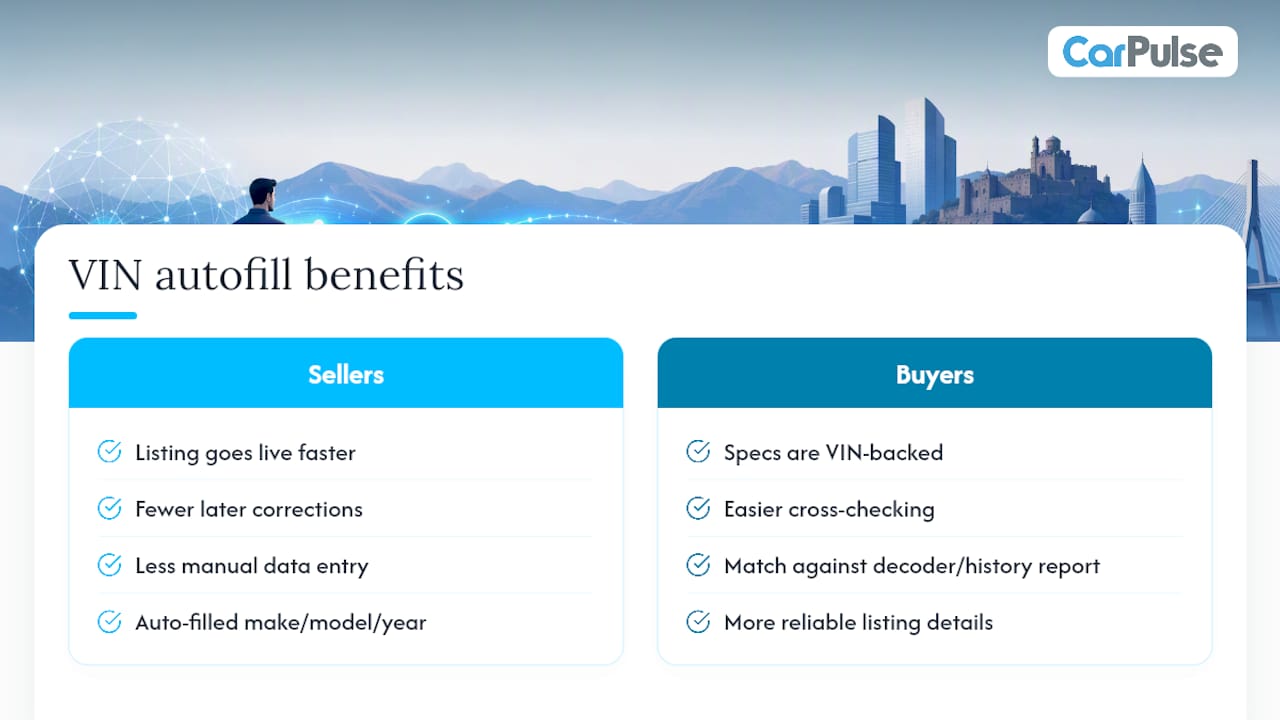
The platform’s listing process incorporates VIN checking, with autofill that pulls in vehicle specifications automatically to reduce manual data entry errors in make, model, and year fields.
For sellers, that means a listing goes live faster and with fewer corrections needed later. For buyers, it means the specs on a CarPulse listing are VIN-backed rather than typed from memory, which makes cross-checking a car’s claimed details against your own decoder or history report that much easier. It’s a small feature, but it removes one of the most common sources of listing errors on any marketplace.
A Quick Best-Practice Checklist Before You Sign Anything
Run the VIN through a decoder, then order a history report, then book an independent mechanic. Skipping any one of those three leaves a gap that the others can’t fill; a decoder tells you what the car should be, a history report tells you what happened to it, and a mechanic tells you its current physical condition. Keep clear photos of every VIN plate and every document the seller gives you, since that record is what protects you if something surfaces later. The moment a VIN doesn’t line up across the car and its paperwork, stop and resolve it before any payment changes hands; for fleet or heavy-vehicle checks, see guidance on the HGV, PSV and trailer annual test.
— Henri
Where to Verify VIN Data and Order Reports
Start decoding with the free NHTSA vPIC tool for manufacturer and WMI details. For the technical background on VIN standardization, Wikipedia’s overview is a solid reference. Order paid history reports through an established provider once you’re ready to verify ownership and accident history.
Sources
FAQ
How Long Does a VIN History Report Stay Valid?
Most paid VIN history reports carry a defined validity window, commonly 30 to 90 days depending on the provider. Order the report close to your actual inspection date rather than far in advance, since a car’s mileage and status can change in that window.
Can a VIN Legally Be Changed on a Vehicle?
No legitimate reason exists to alter a vehicle’s original VIN, and any sign of a re-stamped or replaced plate is a serious red flag. If you spot mismatched VINs on a car and its documents, the recommended step is to pause the purchase and report the issue rather than accept an explanation from the seller.
Is a Free Online VIN Decoder Accurate Enough?
A free decoder like NHTSA vPIC accurately reveals manufacturer, model year, and body details straight from the WMI, VDS, and VIS sections. It won’t tell you about accidents, mileage fraud, or ownership history, which is why a decoder and a paid history report serve different purposes.
Do I Still Need a Mechanic if the VIN Checks Out Clean?
Yes. A clean VIN decode and history report confirm the vehicle’s identity and reported past, but they can’t detect physical tampering or hidden structural damage. Combining a VIN check with an independent mechanical inspection remains the safest approach before any purchase.
Where Can I List a Car Using Its VIN?
CarPulse lets sellers list a vehicle by entering the VIN, which autofills specifications and reduces manual entry errors. Sellers can compare the Basic and Premium listing plans or browse current listings on the CarPulse marketplace to see how VIN-backed data appears to buyers.