
Guides
Rank Higher on Carpulse with VIN Verified Listings
Rank Higher on Carpulse with VIN Verified Listings

Renditja e njoftimeve is simply how a marketplace orders its vehicle listings: by price, by how recently they were posted, by mileage, by year, or by relevance to your search. The rule that matters most is this: pick the sort that matches your actual goal. Buyers chasing value should sort by price and check history; sellers chasing visibility should treat “newest” and “recently reduced” as the sorts worth winning. Platforms like Carpulse make that easier with VIN-verified listings that keep sort signals accurate.
TL;DR:
- Sorting by relevance or newest boosts visibility for listings with VIN verification, complete data, and recent updates, increasing engagement.
- Buyers should focus on specific goals and layer filters such as price or mileage to narrow results realistically and avoid zero-result searches.
- Sellers improve ranking by providing detailed, verified listings with clear photos, transparency on price notes, and honest updates rather than relying on fake urgency.
- Using saved searches with alerts helps buyers stay ahead and increases the chance of early inquiries by matching fast-moving market conditions.
- Marketplaces should incorporate price history and ‘recently reduced’ signals into relevance sorts to better reflect trustworthiness and value, not just lowest price.
Table of Contents
- How Sorting and Ranking Work on Vehicle Marketplaces
- What’s the Best Sort for Finding the Right Car Fast?
- How Should Sellers Set Up a Listing to Rank Higher?
- What Filters and Search Features Actually Help?
- How Carpulse Handles Listing Order and Discovery
- Quick Checklist for Sellers and Buyers
- Does Sort Order Change How Fast a Car Sells?
- Real Examples of Smart Sorting Moves
- What’s Actually Happening Behind the Sort Algorithm?
- Why Marketplaces Should Stop Worshipping the Lowest-Price Sort
- List Your Car on Carpulse and Get Seen by Serious Buyers
- Sources
How Sorting and Ranking Work on Vehicle Marketplaces
Every marketplace runs on a handful of sort orders, and each one rewards different behavior. Price (low to high or high to low) favors budget shoppers. Newest first rewards fresh inventory. Mileage and year sorts serve buyers with a specific spec in mind. Relevance blends your search terms with signals the platform trusts, and recently reduced highlights sellers who just adjusted price.
None of these sorts run on raw data alone. Platforms weigh a set of trust and quality signals before deciding where a listing lands:
- Field completeness — a listing with VIN, trim, mileage, and photos filled in ranks above a bare-bones post.
- Verification status — VIN-verified listings and dealer badges tend to outperform unverified ones in relevance sorts.
- Freshness — days-on-market and last-updated timestamps feed directly into “newest” and often into relevance scoring too.
- Price-history flags — a “price reduced” tag isn’t cosmetic; it’s a signal some platforms boost deliberately.
- Manual or paid boosts — some dealers pay for temporary placement, which sits alongside organic sort results.
Filters compound all of this. A buyer who filters by fuel type and transmission before sorting by price sees a much smaller, more relevant set, and platforms track those interactions to refine what “relevance” even means over time. Listings that pair a headline price with a one-line value note, like service history or one-owner status, convert better during periods of price volatility than listings showing a number with no context.
What’s the Best Sort for Finding the Right Car Fast?
Your goal should decide your sort, not the other way around. Here’s how to map the two:
- Price-sensitive shopper — sort by lowest price, then cross-check against a “below market average” tag if the platform offers one.
- Ready-to-buy-now shopper — sort by newest first, and layer in “recently reduced” to catch motivated sellers.
- Spec-driven shopper (low mileage matters more than age) — sort by mileage, then scan year as a secondary filter.
- Trust-first shopper — combine a price or relevance sort with warranty and inspection filters so unverified listings drop out entirely.
Before you commit to a sort, glance at the price-distribution histogram if the platform shows one. It keeps you from setting filters so tight you get zero results, and it shows you where your target price actually sits against the rest of the market.
Pro Tip: Save your search once you’ve dialed in a sort and filter combo. You’ll get alerts the moment a new or reduced listing matches, which beats manually re-checking a sort every day.
One nuance worth knowing: “recently reduced” doesn’t always mean desperate seller. It often just means the seller reset the price after early feedback, and “price updated” timestamps can reflect a small correction rather than a real markdown. Read the price note, not just the tag.
How Should Sellers Set Up a Listing to Rank Higher?
Ranking well starts before you ever hit publish. Field completeness is the first lever, and it’s the easiest one to pull. A VIN-based listing autofills trim, engine, and factory specs, which removes the manual entry errors that quietly tank a listing’s trust score.
Pricing transparency comes next. A bare number invites skepticism; a headline price paired with a one-line value summary defends it. Marketplace optimization guidance consistently shows that pairing price with proof, like remaining warranty or full service history, holds buyer trust better during periods when prices are moving fast.
A simple headline formula works across almost any platform:
- Lead with the price.
- Follow with a one-line value statement (“One owner, full service history, new tires”).
- Back it with three concrete proof points (mileage, inspection date, warranty status).
- Close with a clear next step (“Message to schedule a viewing”).
Photos matter more than most sellers assume. Wide, well-lit shots of the exterior, interior, and odometer reading outperform a single dashboard selfie, and metadata like alt text helps platforms categorize the listing correctly.
On freshness: update the price when the market shifts, but don’t re-list purely to fake a “just posted” timestamp. Buyers notice inconsistent history, and some platforms flag repeated re-listing as a quality issue.
Pro Tip: Skip fake urgency phrases like “won’t last long.” Replace them with something verifiable, like “inspected March 2026” or “warranty transferable.” Verifiable beats persuasive every time.
What Filters and Search Features Actually Help?
The filters that matter most, on mobile or desktop, are make, model, year, price, mileage, fuel type, and transmission. Everything past that set adds friction faster than it adds value for most shoppers.
Good marketplace design shows filter counts dynamically, so you know before you commit whether a filter combination returns three cars or three hundred. That single feature change reduced zero-result searches and increased seller leads by 6.33% in one large marketplace redesign. Undo-last-filter matters just as much. Nobody wants to rebuild five filter selections because one turned up empty.
On mobile, a sticky filter bar and tappable filter chips beat a buried settings menu every time. Progressive disclosure keeps the interface from overwhelming a shopper who just wants three filters, while still letting a power user drill into a dozen fields.
- Semantic autocomplete and typo tolerance catch “Corola” and “civik” without forcing a blank results page.
- Histogram sliders on price and mileage let you see the market shape before you narrow anything.
- Filter chips show your active selections at a glance, so you can drop one without starting over.
How Carpulse Handles Listing Order and Discovery
Carpulse builds several of these principles directly into the platform instead of leaving them to chance. VIN-based listing pulls trim, year, and factory spec automatically, which cuts down on the manual entry errors that quietly hurt a listing’s ranking on other sites.
Saved searches and alerts do the heavy lifting for buyers watching the “newest” and “recently reduced” sorts. Set the filter once, and Carpulse notifies you when a new match appears instead of asking you to re-check daily.
Filtering by make, model, year, mileage, price, and fuel type works the same way on the mobile app as it does on desktop, so a buyer scanning listings on a lunch break isn’t stuck with a stripped-down experience. Verified dealer badges and service-history fields give sellers a way to back up their price with something buyers can actually check, which tends to matter more than a lower number alone.
Quick Checklist for Sellers and Buyers
Sellers, run through this before you publish:
- Confirm the VIN pulled correct trim and spec details.
- Upload clear photos, including the odometer reading.
- Write a headline with price plus a one-line value summary.
- Attach service history if you have it.
- Double-check mileage against the odometer photo.
- Label any price change honestly (a real markdown, not a reset).
| Buyer step | What to do |
|---|---|
| Pick a goal | Value, speed, or spec match |
| Choose a sort | Price, newest, or mileage |
| Apply filters | 2 to 3 max, not a dozen |
| Check the histogram | Confirm your target price is realistic |
| Save the search | Get alerts on new or reduced listings |
A transparent price note reads something like “Priced to reflect recent brake and tire work” rather than a vague “must sell.” Specific beats persuasive here too.
Does Sort Order Change How Fast a Car Sells?
Yes, and the effect is bigger than most sellers assume. A listing that appears consistently in “newest” and “recently reduced” sorts gets seen by buyers who are actively comparing right now, not buyers browsing casually. That visibility window is short. Most of a listing’s early interest happens in the first few days after posting or after a price change, which is exactly when it ranks highest in freshness-based sorts.
Final price tends to track with how a listing performs across sorts, not just its raw price tag. A well-documented listing with service history and a clear value note often lands a similar sale price to a cheaper, thinner listing because buyers weigh trust alongside the number. A car priced fairly but shown with weak photos and no history will often sit longer and eventually see a real price cut, at which point it depends on the “recently reduced” sort to get a second wave of attention.
Sellers who ignore freshness entirely tend to fall into a slow decline: a listing drops in the “newest” sort within days, doesn’t have the price movement to trigger “recently reduced,” and quietly stops getting clicks. The fix isn’t gaming the system. It’s updating the listing honestly when something changes, whether that’s a new set of tires, an inspection, or a genuine price adjustment.
Real Examples of Smart Sorting Moves
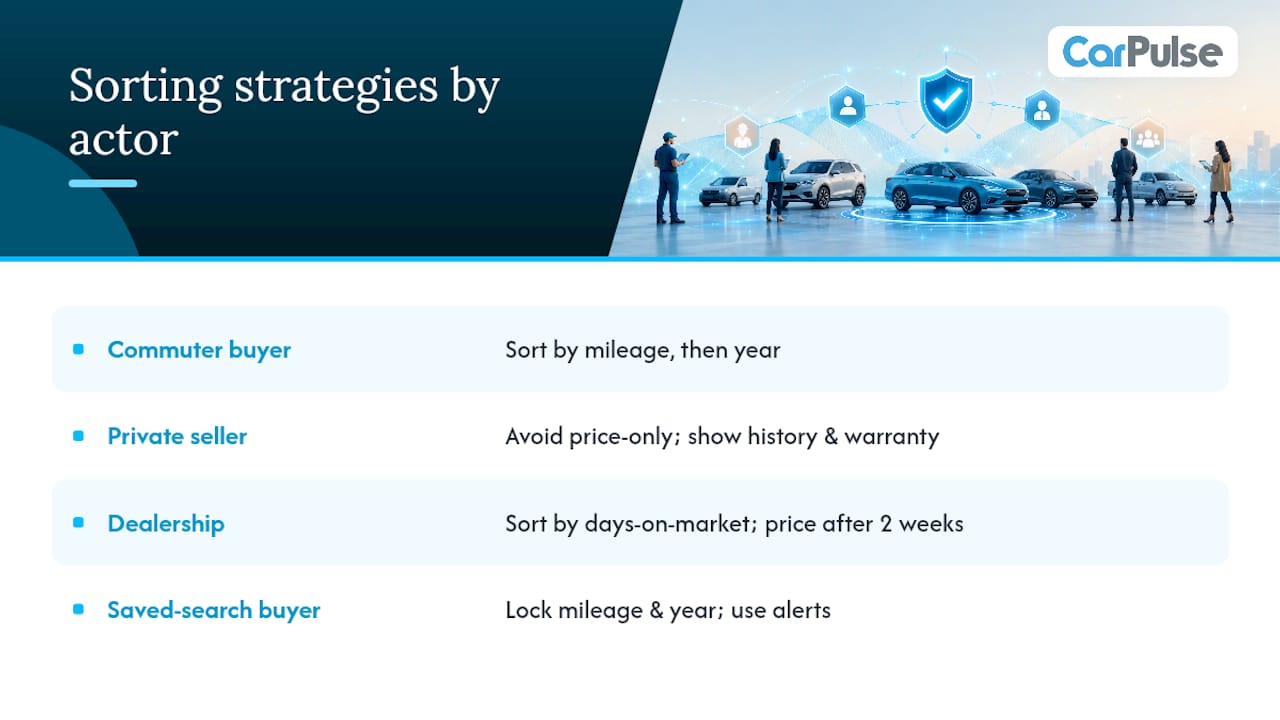
A buyer looking for a low-mileage commuter car sorts by mileage first, then narrows by year to avoid a car that’s technically low-mileage but a decade old. That two-step sort catches vehicles a single price sort would bury on page four.
A private seller with a well-maintained but higher-mileage car skips the price-only sort entirely, knowing it can’t win there. Instead, the listing leans on a full service history and a warranty transfer, aiming to win on relevance and trust filters rather than compete purely on number.
A dealership managing dozens of listings sorts its own inventory by “days on market” internally, then proactively price-adjusts anything sitting past two weeks. That keeps individual listings cycling into “recently reduced” instead of going stale in a “newest” sort they can no longer win.
A buyer cross-shopping two similar trims uses a saved search with mileage and year filters locked, then checks back through alerts rather than manually re-searching. When a matching car appears, they’re often the first inquiry, which matters more in a fast-moving local market than in a slow one.
Each of these cases shares the same logic: match your sort strategy to what you’re actually optimizing for, whether that’s speed, price, or a specific spec, instead of defaulting to whatever sort loads first.
What’s Actually Happening Behind the Sort Algorithm?
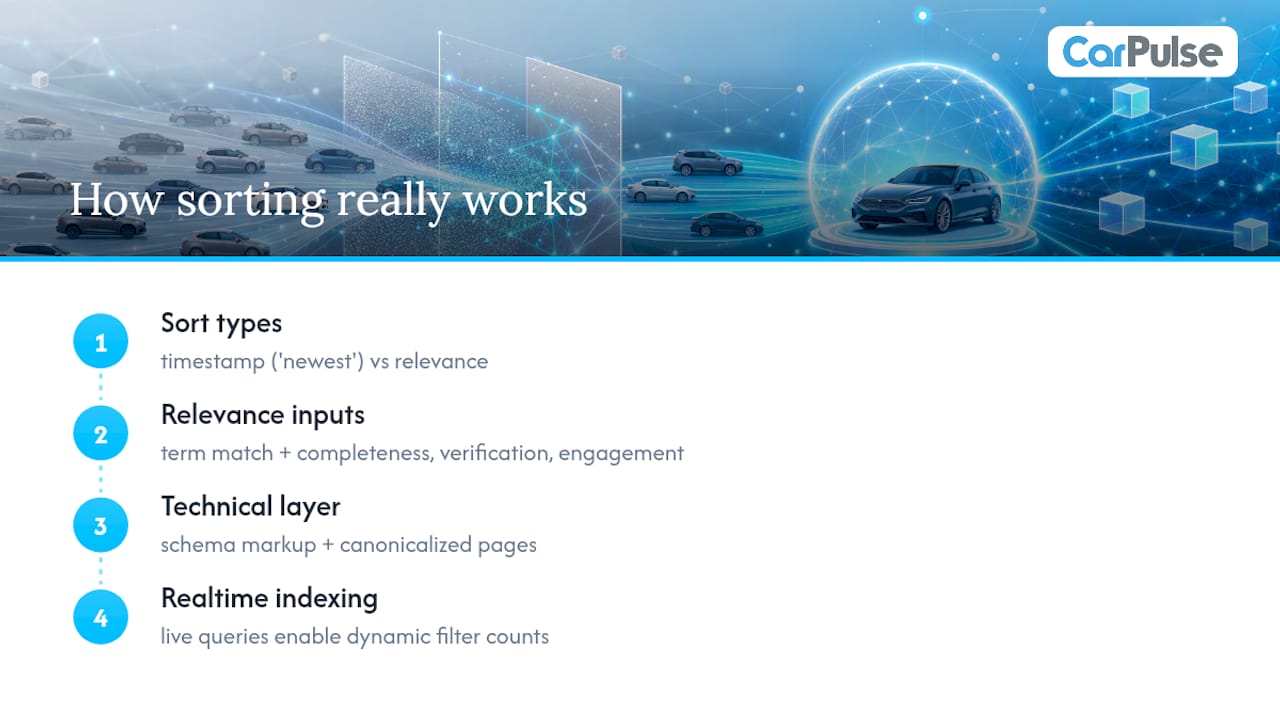
Most major listing platforms build their sort order from a mix of explicit rules and weighted scoring, not a single simple formula. A “newest” sort is straightforward: it’s a timestamp query. But “relevance,” the default on most platforms, blends search-term matching with quality signals like completeness, verification, and engagement history.
Structured data plays a bigger technical role than most sellers realize. Platforms that implement vehicle schema markup and canonicalize filtered result pages avoid duplicate-content issues while making individual listings eligible for richer search snippets outside the platform itself. That’s a technical layer buyers never see, but it affects whether a listing shows up in an external search before the buyer even lands on the marketplace.
Dynamic filter counts require real-time indexing behind the scenes. When a filter panel updates its counts instantly as you toggle options, the platform is running live queries against its inventory index rather than a cached snapshot, and design teams building this well have shown measurable drops in abandoned searches as a result.
None of this is visible to the average shopper, and it shouldn’t need to be. But it explains why two listings with the same price and mileage can rank differently: one has the structured data and freshness signals a sort algorithm rewards, and one doesn’t.
Why Marketplaces Should Stop Worshipping the Lowest-Price Sort
The biggest flaw in most vehicle marketplaces isn’t the sort options. It’s that “lowest price” still gets treated as the default, when it rewards the thinnest listings over the most trustworthy ones. A car priced low with no service history will often out-rank a fairly priced car backed by real proof, simply because the sort doesn’t weigh evidence.
My one change for marketplaces building this in 2026: surface price-history and “recently reduced” status directly inside the default relevance sort, not as a separate toggle buyers have to know exists. Carpulse and platforms like it are well positioned to test this, since VIN verification already gives them the trust data most competitors lack.
— Henri
List Your Car on Carpulse and Get Seen by Serious Buyers
Carpulse gets your listing in front of buyers who are actually filtering for what you’re selling, not just scrolling. VIN-based listing autofills your trim and spec details in seconds, which means fewer errors and a listing that ranks better on completeness from the moment it goes live.
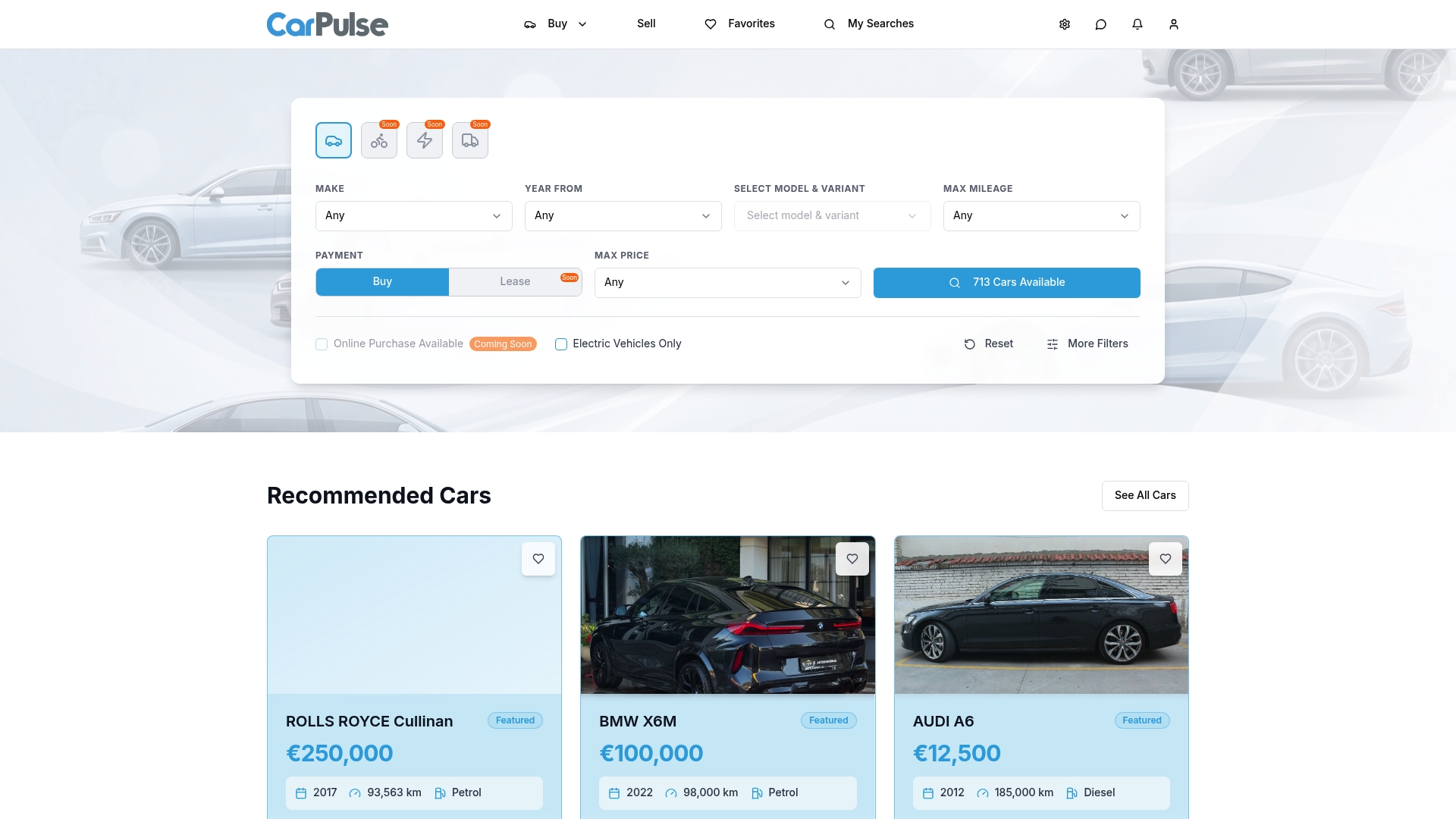
Verified dealer badges and service-history fields give your price the backup buyers are looking for, and the mobile app puts your listing in front of shoppers browsing on their phones, not just at a desktop. Buyers get the same advantage: save a search with your ideal filters, and Carpulse’s homepage will alert you the moment a new or reduced match appears.
If you’re ready to publish, head to the sell page and list your car with VIN-verified details in a few minutes. For a deeper walkthrough of photos, headlines, and pricing, the step-by-step listing guide covers the details worth getting right before you publish.
Sources
For more on the mechanics behind listing order, see pricing strategy during volatile markets, the AutoTrader search UX case study, and how filters and layout shape which cars get seen. Sellers comparing listing channels may also want tips on selling through social marketplaces.
- Vehicle Marketplace Listings in Price Volatility
- AutoTrader Search UX: Increasing Seller Leads by 6.33%
- How search, filters, and layout decide whether cars get views or ignored - DesignToCodes