
Guides
Before You Pay in Albania: Kaparo, VIN Checks and...
Before You Pay in Albania: Kaparo, VIN Checks and DRSHTRR Deadlines

Use a documented holding deposit, known as kaparo, combined with a traceable payment method, and finish the ownership transfer within the DRSHTRR deadline. Never hand over a car for an unverified full prepayment. Before any money moves, check the VIN, pull the RBS lien record, and match the seller’s ID to the ownership documents. Buyers present at DRSHTRR within 30 days of signing; sellers keep a signed copy of the contract in case that doesn’t happen.
TL;DR:
- Using a documented holding deposit known as kaparo, combined with traceable payment methods, minimizes risk and ensures ownership transfer within the DRSHTRR deadline.
- Buyers should verify vehicle identity through VIN checks, lien records, and matching ID to ownership documents before any payment, especially for high-value sales.
- Payments should be made through traceable channels like bank transfer or POS, with receipts and screenshots kept as proof; cash is risky without proper documentation.
- The kaparo deposit should specify the amount, deadline, refund conditions, inspection window, and responsibility for fees, and it must be signed and ideally notarized for larger deals.
- Disputes are often caused by unverified payments or vague agreements; detailed, written contracts and notarization prevent misunderstandings and reduce legal risks.
Table of Contents
- Payment and Pre-Sale Payment Options You’ll Actually Use in Albania
- Kaparo: How Holding Deposits Work and What Terms to Set
- The Payment and Handover Process, Step by Step
- DRSHTRR Deadlines, Fees, and Who’s on the Hook If You Skip Them
- Warning Signs That Point to Payment Fraud
- Tax Treatment of Deposits and Final Payments
- Resolving Disputes Over Deposits and Payments
- Drafting a Kaparo Agreement That Actually Holds Up
- A CarPulse Perspective on Safe Payments
- Verify First, Then Pay: What CarPulse Puts in Your Hands
- Sources
Payment and Pre-Sale Payment Options You’ll Actually Use in Albania
Every car sale in Albania comes down to a handful of payment methods, and each one carries a different risk profile. Getting the pairing of method and moment right is what separates a clean sale from a dispute six weeks later.
Cash still moves a lot of used cars in Albania, especially between private sellers who know each other or are dealing with smaller amounts. It’s fast and final, but it leaves almost no paper trail. If cash is the only option, insist on a handwritten and signed receipt that states the amount, date, vehicle VIN, and both parties’ ID numbers. Photograph the cash count and the receipt together.
Bank transfer is the safer default for anything beyond a token amount, and it’s what most verified dealerships prefer. Require the transfer reference to name the vehicle (VIN or plate), confirm the beneficiary name matches the seller’s ID exactly, and save the transaction screenshot before you leave the bank or app.
Card payment or POS is standard practice at dealerships and shows up automatically on a bank statement, which makes reconciliation simple. Always ask for the printed merchant receipt, not just a verbal confirmation.
For higher-value sales, a notary-held payment or an escrow-style arrangement gives both sides a neutral third party holding funds until conditions are met. This costs more in fees but removes the “did the money arrive in time” argument entirely.
Whatever method you choose, build a documentation trail:
- Signed sales contract with price and terms
- Transfer receipt or bank confirmation
- ID copies matched to the contract
- VIN confirmation matching the vehicle and registration
Kaparo: How Holding Deposits Work and What Terms to Set
A kaparo is a partial payment that reserves the car while the buyer finishes checks, arranges financing, or coordinates paperwork. It signals seriousness without forcing either side to complete a full, unverified transaction on the spot. Albanian sellers and buyers use it constantly precisely because it splits risk instead of dumping it all on one party.
A workable kaparo agreement should clearly spell out:
- The exact amount, written in both figures and words to avoid disputes.
- A firm deadline for the balance payment, tied to a calendar date, not “soon.”
- Refund conditions, stating clearly whether the deposit is refundable if the buyer walks away or only if the seller does.
- An inspection window, giving the buyer time for an independent mechanical check before the balance is due.
- Who covers administrative fees, since DRSHTRR filing and notary costs are often split unevenly if this isn’t agreed upfront.
A common rule of thumb is a fixed amount or roughly 5–10% of the sale price, though this is guidance, not a legal figure. For anything sizable, get the deposit receipt notarized. It costs little and removes any doubt if the deal later falls through.
Coordinate the kaparo deadline with the DRSHTRR filing window so the seller isn’t stuck legally holding a car they’ve already been paid for.
Pro Tip: Write “kaparo, subject to satisfactory inspection and clean RBS check” directly into the receipt. That one clause protects the buyer from paying full price on a car with hidden liens, and protects the seller from a buyer stalling indefinitely.
The Payment and Handover Process, Step by Step
Closing a car sale in Albania works best as a sequence, not a single moment where everything happens at once.
- Agree terms in writing. Price, kaparo amount, balance due date, and handover conditions all go into a signed document before any money changes hands.
- Verify before paying beyond the deposit. Check the seller’s ID against ownership documents, confirm the VIN matches the registration, and run the Regjistri i Barrëve Siguruese (RBS) check for liens or attachments.
- Make the payment through a traceable channel. Bank transfer or POS, with receipts and screenshots saved immediately, not “later.”
- Meet at the notary or arrange the DRSHTRR steps together. If payment is staged, put the staging in writing so there’s no ambiguity about what triggers the next payment.
- Complete the ownership transfer and hand over the keys. Only exchange keys once the agreed payment and paperwork conditions are actually met, not before.
A quick reference for what to bring to that final meeting:
- Original ID for both parties
- Signed sales contract
- Vehicle registration and circulation permit
- Proof of the balance payment
Consumer guides on buying used cars in Albania consistently flag one habit as the most common mistake: paying the full amount before documents are verified. If you want the fuller walk-through on inspections and negotiating terms before you get to this stage, CarPulse’s step-by-step buying guide covers it in more depth.
DRSHTRR Deadlines, Fees, and Who’s on the Hook If You Skip Them
The buyer must present at a DRSHTRR counter to update ownership within 30 days of the sale act, with an administrative declaration and fees due at filing. Separately, more recent notary-focused guidance points to a tighter 10-day window for updating the circulation permit when a notary verifies the sale at signing. In practice, treat the shorter window as the real target. If a notary is involved, aim for 10 days; if the sale is a straightforward DRSHTRR filing without notary verification, the 30 day rule is the legal ceiling, not a comfortable pace to work at.
Typical costs to expect:
- Ownership transfer/declaration fee (DRSHTRR cites an example around 1,500 lekë, split between service and verification charges)
- Notary fees, if used, usually higher than a simple DRSHTRR filing
- RBS lien check, generally low cost relative to the sale
Who pays what isn’t fixed by law in most cases. It’s negotiated, and buyers commonly cover the transfer fee since they’re the ones benefiting from clean registration.
If the buyer never shows up to register, the seller remains exposed to fines, tickets, or liabilities tied to the vehicle under their name. The safeguard is simple: keep a signed contract copy, and if the buyer stalls past the deadline, file a declaration of sale at DRSHTRR yourself to formally end your liability.
Use a notary when the sale value is high or either party wants a neutral verification step; a straightforward DRSHTRR filing is usually sufficient for lower-value, straightforward private sales.
Warning Signs That Point to Payment Fraud
A few patterns show up again and again in car sale scams in Albania, and they’re worth memorizing rather than relearning the hard way.
- Pressure to pay immediately, especially “before someone else takes it”
- A price noticeably below market for the make, model, and year
- A seller who refuses to meet at a bank, notary, or public office
- ID documents that don’t match the name on the registration
Run the quick checks before you send anything: VIN lookup, an RBS search for liens, an ID match, and a look for unpaid fees tied to the vehicle. If something feels off mid-transaction, stop the payment if it’s still possible, keep every receipt and screenshot, and report the situation to DRSHTRR and the police.
Pro Tip: For any sum that would hurt to lose, use a bank counter transfer instead of a mobile app transfer, or hold the payment with a notary until the paperwork clears. The extra ten minutes at a counter have saved more buyers than any amount of ID checking.
Tax Treatment of Deposits and Final Payments
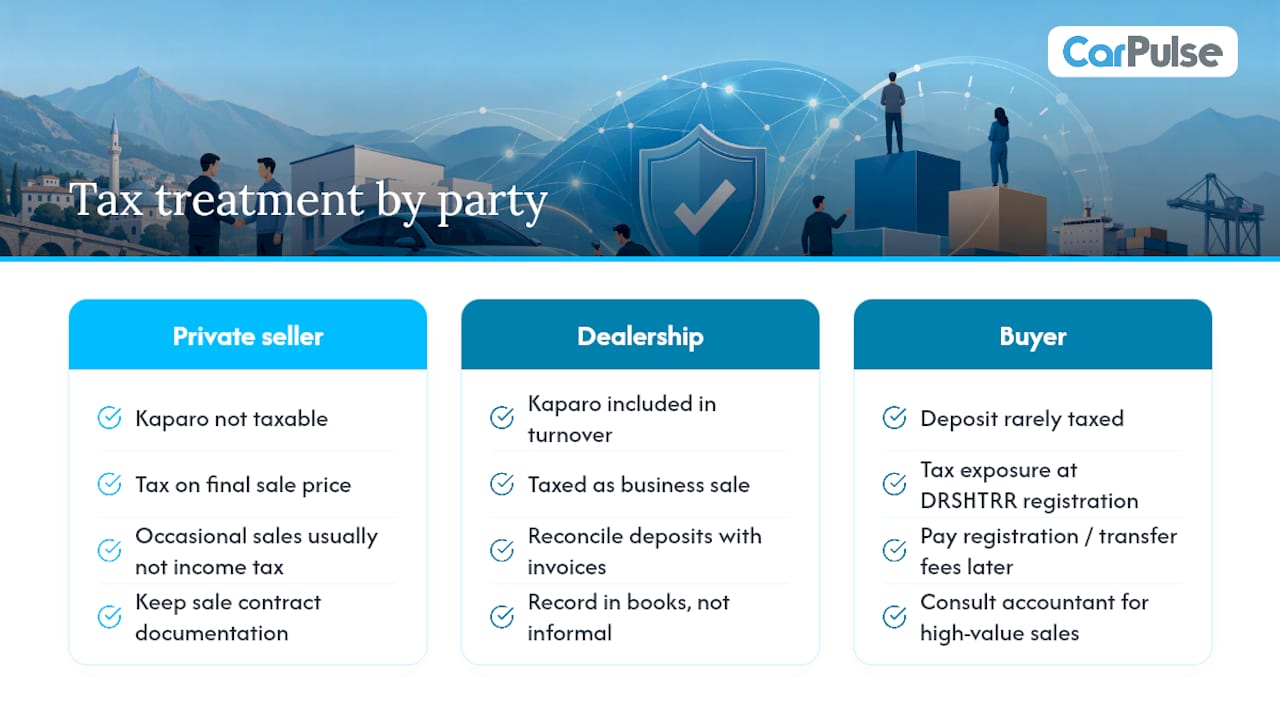
A kaparo isn’t a taxable event on its own. It’s a contractual holding payment, and Albanian tax treatment generally attaches to the completed sale, not the deposit stage. What matters for tax purposes is the final declared sale price recorded in the contract and processed through DRSHTRR.
For private individual sellers, occasional vehicle sales typically don’t trigger the kind of income tax treatment that applies to a business selling inventory. Verified dealerships are a different case entirely: a dealership selling vehicles as part of its regular business activity accounts for the sale price, including any deposits collected along the way, as part of its taxable turnover under standard business tax rules.
The practical point for both sides is documentation. A sale contract that clearly separates the kaparo from the balance payment, with dates and amounts spelled out, gives both buyer and seller a clean paper trail if a tax question ever comes up. Sellers, especially dealerships, should reconcile deposit records against final invoices rather than treating a kaparo as informal pocket money outside the books.
Buyers rarely face a direct tax obligation tied to the deposit itself. Their tax exposure, if any, tends to show up later, tied to registration fees and the ownership transfer processed at DRSHTRR rather than the payment structure used to get there. When in doubt on a higher-value sale, a short consultation with an accountant costs far less than untangling a mismatched tax record months later.
Resolving Disputes Over Deposits and Payments
Most kaparo disputes come down to one of two arguments: whether the deposit was refundable, and whether the balance deadline was actually missed. This is exactly why the written agreement matters more than any verbal understanding, no matter how confident both sides felt at the time.
The first step in any dispute is always the same: reread the signed contract. If refund conditions, deadlines, and inspection terms were spelled out clearly, most disagreements resolve without anyone raising their voice. If the language is vague, that’s the sign to talk directly with the other party before anything escalates, since a short conversation resolves far more of these than either side expects going in.
When direct conversation doesn’t work, a few structured options exist:
- Notary-mediated resolution, if the deposit was notarized at signing, since the notary can confirm the original terms and often mediate informally.
- Mediation through a neutral third party, useful when both sides still want the deal to happen but disagree on timing or conditions.
- Formal civil claim, reserved for larger sums or clear breach of contract, filed through the regular courts.
Escrow-style holding through a notary heads off most of these disputes before they start, since neither side is trusting the other’s word about when money moved or what was agreed. For smaller kaparo amounts, the cost of a formal dispute often exceeds the deposit itself, which is exactly why a clear written agreement upfront matters more than any resolution process after the fact.
Drafting a Kaparo Agreement That Actually Holds Up
A strong deposit agreement in Albania doesn’t need to be long. It needs to be specific. Vague language is where most disputes start, and it’s the easiest problem to prevent.
Start with the basics: full legal names and ID numbers for both parties, the vehicle’s VIN, plate, and registration details, and the total agreed sale price written in both figures and words. From there, the agreement needs the kaparo amount, the exact date the balance is due, and what happens if that date passes without payment.
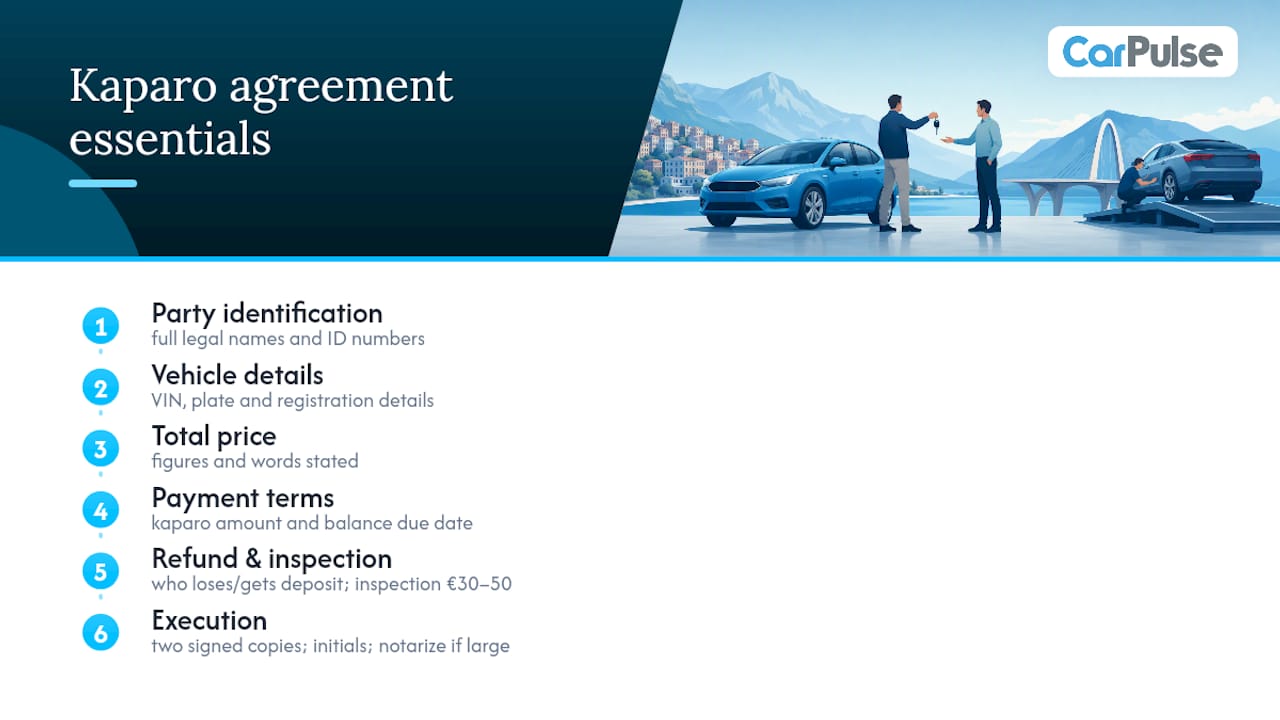
Refund terms deserve their own clear sentence, not an assumption. State plainly whether the deposit is lost if the buyer withdraws, returned if the seller withdraws, or split under specific conditions like a failed inspection. Add the inspection window explicitly. If the buyer’s independent mechanical check, typically €30–50, turns up a serious issue, the agreement should say what happens to the kaparo.
Sign two copies, one for each party, and have both parties initial any handwritten changes rather than crossing them out silently. For sales above a comfortable cash-loss threshold, get the signatures notarized. It adds a small fee but converts a private promise into a document with real legal weight if either side later disputes what was agreed. A Bulgarian guide on structuring staged payments and documentation makes a similar point that applies just as well here: the paperwork discipline at the deposit stage is what prevents arguments at the final payment stage.
A CarPulse Perspective on Safe Payments
Every dispute we hear about traces back to the same root cause: someone paid before verifying, or verified without documenting it. A documented kaparo plus a traceable transfer isn’t cautious, it’s just how a car sale should work. On CarPulse, verified dealership badges and VIN-based listings let you check who you’re actually dealing with before a deposit ever changes hands, which removes a lot of the guesswork buyers face on informal listings elsewhere.
— Henri
Verify First, Then Pay: What CarPulse Puts in Your Hands
CarPulse gives you the tools to do the verification work before any money moves. Verified dealership badges separate professional sellers from unverified listings, VIN-based listings auto-populate vehicle history and specs so you’re not taking a seller’s word for the details, and the mobile app lets you message sellers and compare listings from wherever you’re standing when a deal comes together.
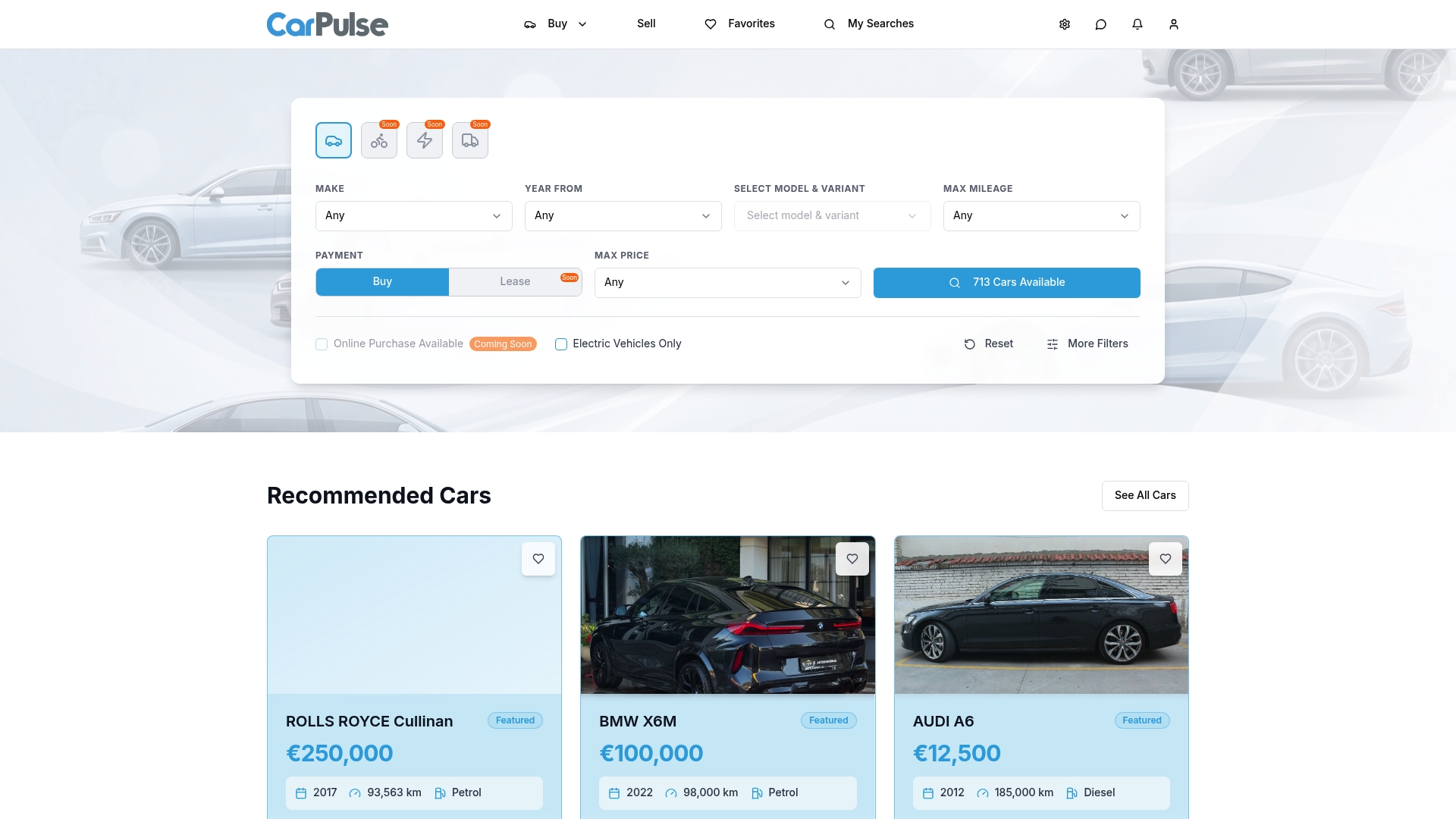
None of that replaces the steps in this guide: run the RBS check, get the kaparo in writing, use a traceable payment. But starting from a verified listing on CarPulse cuts out a meaningful chunk of the risk before you ever get to the payment stage. Browse current listings, filter by make, model, and price, and reach out to a verified seller directly through the platform to get your next car deal started on solid footing.
Sources
- Deklarimi i Shitjes së Mjetit | DRSHTRR
- Si të Blesh Makinë të Përdorur në Shqipëri — 8 Këshilla Thelbësore | Dyqani