Guides
Spot 12–24 Month Owner Flags: Use VIN to Check a Used...
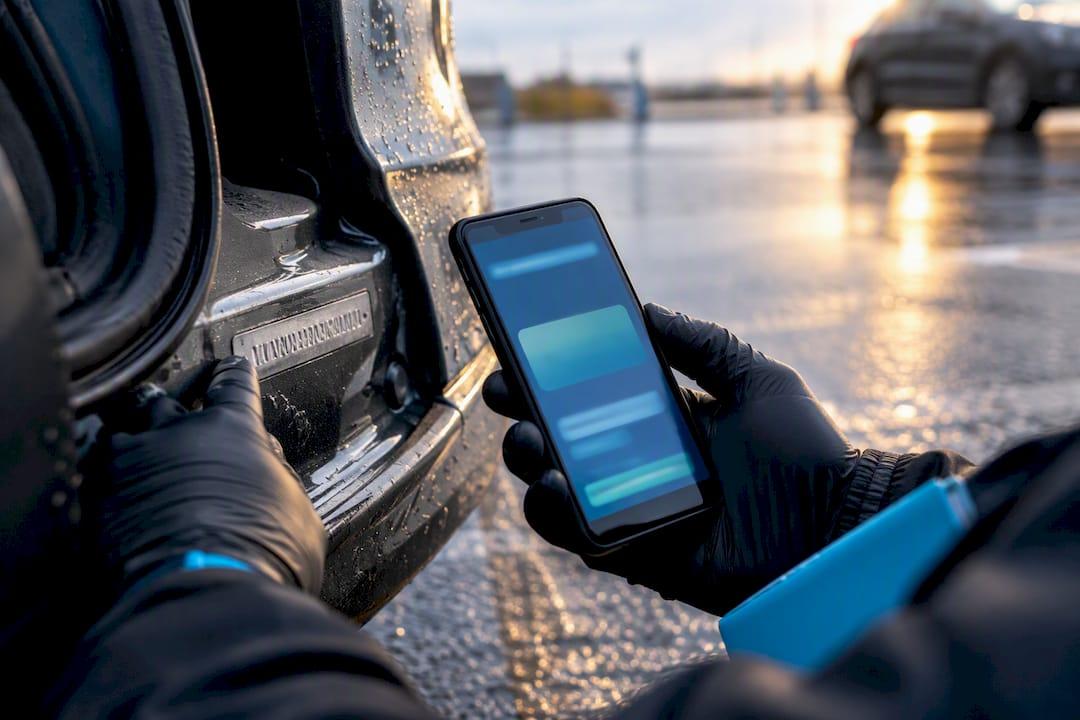
Spot 12–24 Month Owner Flags: Use VIN to Check a Used Car in Albania
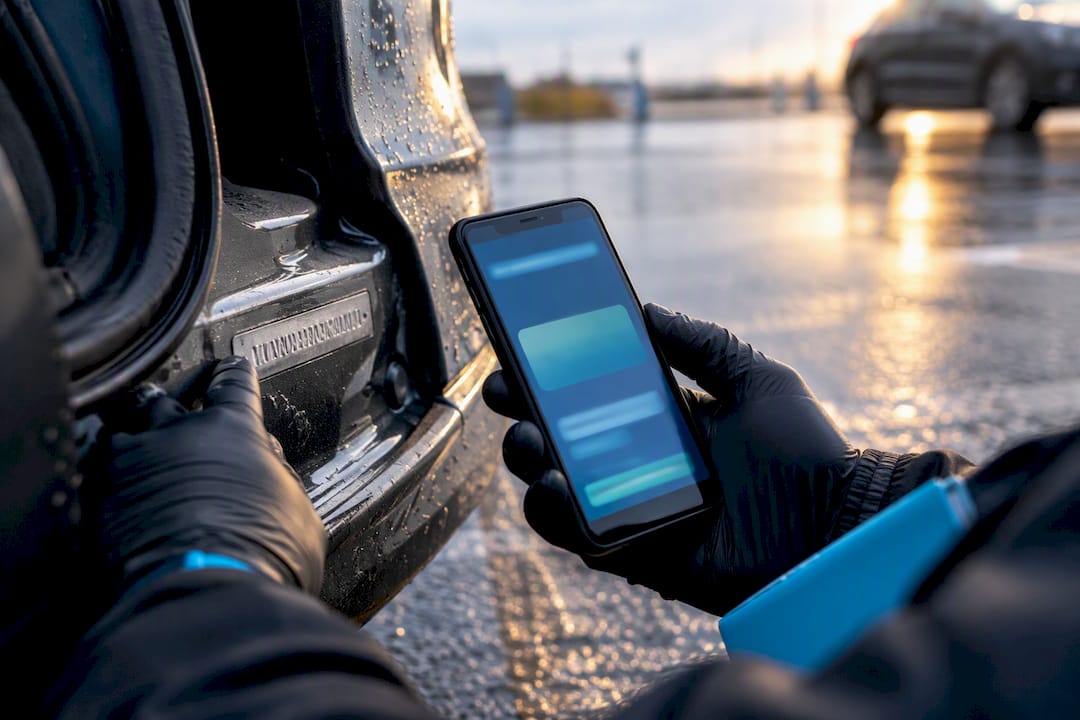
Run the vehicle’s 17-character VIN through a vehicle history report, and it will list how many previous owners the car has had, along with owner types and ownership dates. Use those facts to decide where to focus your inspection and how hard to push on price. A report is a strong starting point, not a full record, so confirm the details against seller paperwork and a professional pre-purchase inspection before you sign anything.
TL;DR:
- Multiple owners within a short span of 12 to 24 months often indicate underlying issues, even if the vehicle has a high owner count.
- Short ownership periods stacked together should prompt direct questions and professional inspection to uncover potential problems.
- Comparing service records across all owners provides more reliable condition insight than owner count alone.
- A clean, coherent ownership history coupled with documented maintenance offers a better gauge of car health than simply the number of owners.
- Always verify VIN details against seller documents and run both government and commercial reports before deciding to buy.
Table of Contents
- Quick checklist: what to prepare before you check the owner count
- Step-by-step: pull the owner count and verify what you find
- What owner count actually tells you (and where it misleads you)
- Turning your findings into questions and inspection priorities
- Why VIN checks are a starting point, not the finish line
- Check VIN Details and Browse Verified Listings on Carpulse
- Sources
- FAQ
Quick checklist: what to prepare before you check the owner count
Before you order anything, get your documentation lined up so the report you pull actually matches the car in front of you.
- Locate the 17-character VIN on the dashboard near the windshield, the driver’s door jamb, the registration card, or the insurance papers.
- Compare that VIN character by character against the seller’s paperwork. A single wrong digit returns data for the wrong vehicle.
- Decide which reports you need: a government-backed title check where one exists, plus a VIN-based history service for ownership detail.
- Photograph the VIN plate itself and keep copies of the registration, seller contact information, and any listing screenshots.
If the seller needs to be the one requesting certain records, ask now rather than after you’ve already made an offer. Sellers who resist a basic VIN check are telling you something worth hearing.
Step-by-step: pull the owner count and verify what you find
Step 1: Find and confirm the VIN. The VIN must be exactly 17 characters, using letters and numbers but never the letters I, O, or Q. Check it against at least two locations on the car (dashboard and door jamb) and against the registration document. A mismatch anywhere is a hard stop until it’s explained.
Step 2: Run a government-backed title check where one is available. This confirms title brands, such as salvage or rebuilt status, and flags major recorded events tied to the title itself.
Step 3: Run a commercial vehicle-history report. Commercial services generally provide more ownership detail than government databases alone, including owner counts and owner types, so pairing both gives you the fuller picture. A regional VIN-check service can also show previous owners and registration countries, useful for cars that may have moved across borders.
Step 4: Cross-check the details for coherence. Line up the ownership dates, registration locations, and mileage figures. Do the dates overlap oddly? Did the car register in three regions in two years? Either pattern deserves a direct question to the seller before you go further.
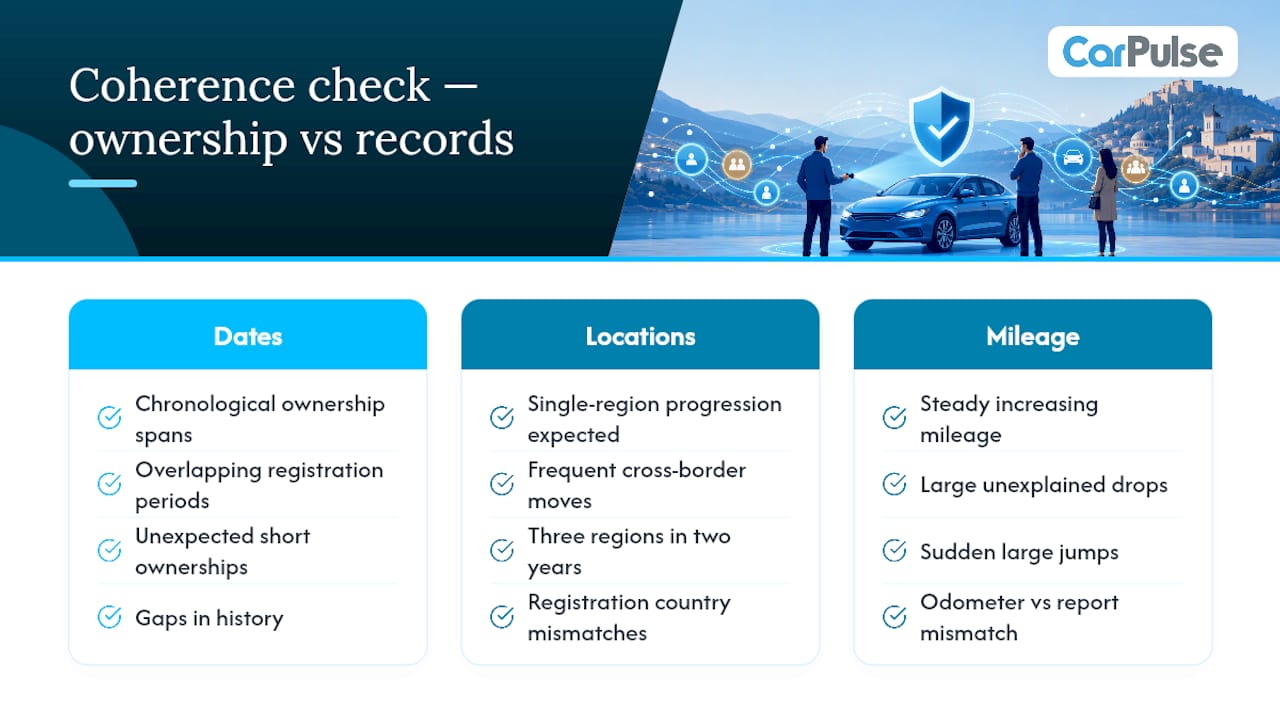
Step 5: Save everything. Download PDFs or take screenshots of every report you run, with timestamps intact. You’ll want these on hand when you negotiate or when you hand the car to a mechanic for inspection.
Pro Tip: Decode a handful of VIN fields yourself before you even order a paid report. If the model year or engine type the VIN decodes to doesn’t match what the listing claims, you’ve caught a problem for free. Guides like decoding a VIN in five steps walk through exactly which characters to check.
What owner count actually tells you (and where it misleads you)
A high owner count is a risk indicator, not a verdict on the car’s mechanical condition. Plenty of well-maintained cars pass through several careful owners; plenty of neglected ones sit with a single owner who never opened the hood for a service.
The pattern that should worry you is speed. Multiple owners cycling through in a short window, such as 12 to 24 months apiece, often means something is wrong that each buyer discovered only after driving it home. Sellers sometimes use exactly this pattern to rotate a problem car off their books before the next owner catches on.
A few practical translations:
- Fleet or rental history usually means intensive daily use, frequent short trips, and drivers with no long-term stake in the car’s condition. That history can justify a lower offer, but confirm it with actual service invoices rather than assuming the worst.
- A “one owner” claim with no service records is not automatically the safer bet. A well-documented car with three owners can be in better shape than a single-owner car nobody ever serviced.
- Short ownership spans stacked back to back deserve direct questions and, ideally, a mechanic’s eyes before you commit.
Owner count and service history work together. A car with a longer paper trail of maintenance receipts, even across several owners, tends to tell you more than the raw number on the report.
Turning your findings into questions and inspection priorities
Once you have the report in hand, use it to script the conversation with the seller and the checklist for your mechanic.
- Ask why the car was sold each time, if the report shows more than one owner. A vague or evasive answer is itself useful information.
- Ask where it was serviced and request invoices covering each ownership period, not just the current owner’s tenure.
- Compare interior wear to the owner types shown. A car reportedly driven by one careful owner should not show the wear pattern of a rental fleet vehicle.
- Check the undercarriage for evidence of flood damage or prior repair work that a report might miss entirely, since reports rely on recorded database events and won’t catch every private repair.
- Verify the odometer reading against the mileage the report logged at each recorded ownership transfer.
Pro Tip: Bring your saved report screenshots to the negotiation, not just to the mechanic. Citing a specific fact, like a 14-month ownership span or a fleet flag, gives you a concrete reason for a lower offer instead of a vague “the price feels high.”
If the report shows anything short of a clean, coherent history, insist on a paid pre-purchase inspection before you finalize anything. A thorough test drive and inspection routine paired with the report findings gives you real leverage, not just a hunch.
Why VIN checks are a starting point, not the finish line
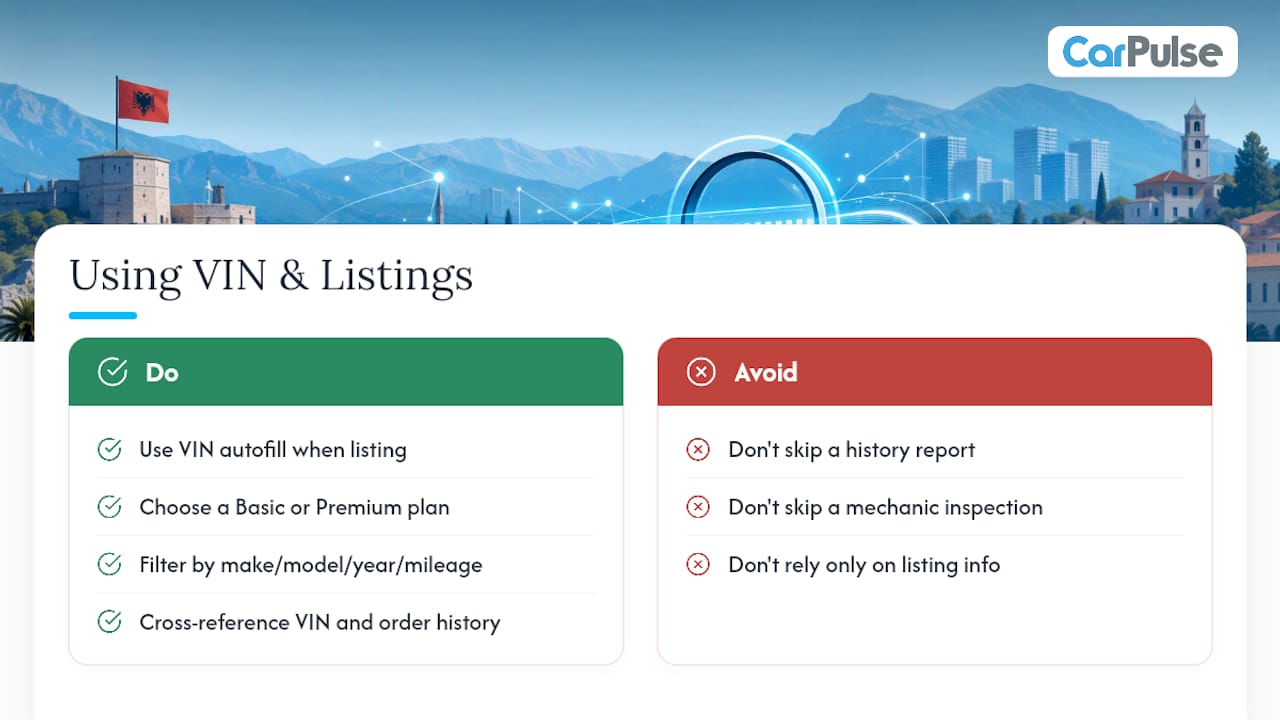
VIN-based verification aims to reduce the guesswork buyers used to rely on: a phone call, a gut feeling, a seller’s word. VIN autofill can pull verified vehicle data when a listing goes live, and a network of verified dealers can provide buyers with a baseline of ownership transparency beyond that of a random classified ad.
That said, no VIN report replaces a wrench in a mechanic’s hand. We’ve watched enough listings pass through the platform to know that owner-count data answers the “how many hands” question well and the “what condition” question only partially. Treat the report as your opening move, not your closing argument.
— Henri
Check VIN Details and Browse Verified Listings on Carpulse
Carpulse is built around the VIN, not around guesswork. When a seller lists a car, VIN autofill pulls the vehicle’s core details automatically, and buyers browsing the marketplace can look for verified-dealer listings where that ownership groundwork is already visible.
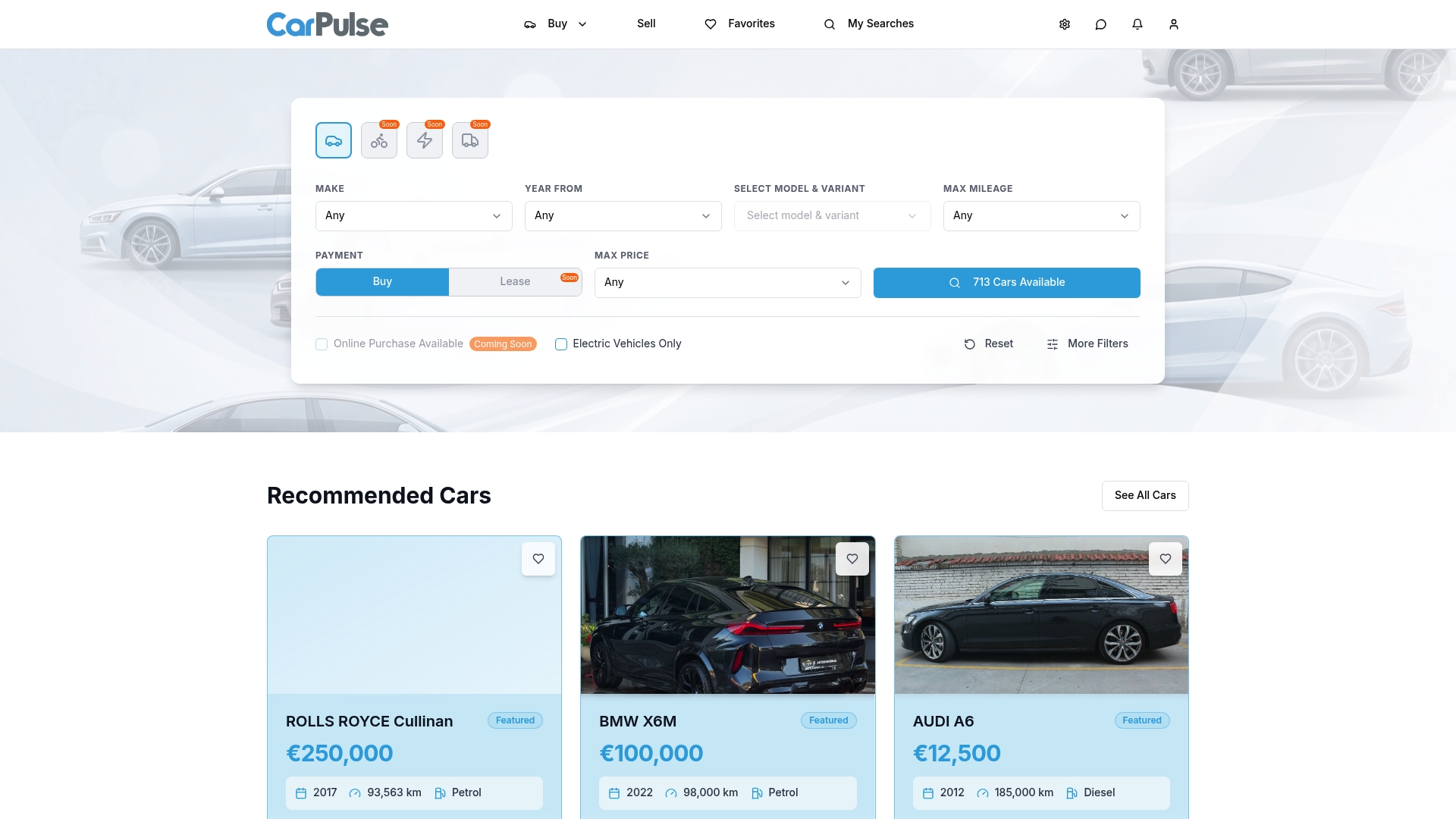
Sellers who want their listing to carry that verified weight can list under the Basic or Premium plans, starting at €14.99 per month. It offers tools built for accurate, fast listing creation. Buyers browsing categories like Volkswagen Touran listings can filter by make, model, year, and mileage while cross-referencing VIN data before ever contacting a seller. Carpulse surfaces the verified VIN information; it doesn’t replace ordering a full history report or booking a mechanic’s inspection, and we’d rather you do both than skip either.
Ready to see it in action? Browse current listings on Carpulse and check a VIN on a car you’re actually considering.
Sources
For the mechanics of reading a report, see Car and Driver’s guide to vehicle history reports and Kelley Blue Book’s overview of what these reports cover. For ownership-detail specifics, Vektracer’s breakdown of previous-owner history and VINSPY’s European VIN-check service are worth bookmarking. On the Carpulse side, start with the VIN decoding guide and the safe used car buying guide.
- How to Read a Used Car’s Vehicle History Report | Car and Driver
- Vehicle History Report: Everything You Need to Know | Kelley Blue Book
- Understanding previous owner history for used car buyers | Vektracer
- Kontrolli i VIN-it në Evropë & Historia, Odometri, Aksidentet - VINSPY
FAQ
How Many Previous Owners Is Too Many for a Used Car?
There’s no fixed number that makes a car unsafe to buy, but the pattern matters more than the count. Multiple owners within 12 to 24 months each is the red flag worth chasing down with questions and an inspection.
Can I Check Owner Count Without Paying for a Report?
Government title databases, where available, sometimes show limited ownership or title-brand data for free, but they rarely show full owner counts and types. Commercial VIN-based history services generally give you the fuller picture, usually for a fee.
Does a One-Owner Car Always Mean Better Condition?
No. A single owner with no service records can leave you with a worse car than one that passed through several owners with full maintenance history. Owner count is one signal among several, not a stand-alone guarantee.
Where Do I Find the VIN on My Car?
The 17-character VIN appears on the dashboard near the windshield, on a sticker inside the driver’s door jamb, and on the registration and insurance documents. Confirm it matches across all three before you order any report.
Does Carpulse Verify Vehicle History Directly?
Carpulse uses VIN-based autofill and works with a network of verified dealers to make ownership data easier to access when you browse listings. For a full ownership and history record, pair what you see on Carpulse with a dedicated VIN history report and a pre-purchase inspection.