Guides
Car Battery Technology Explained for Buyers and Sellers

Car Battery Technology Explained for Buyers and Sellers

TL;DR:
- A car battery’s type, age, resting voltage, CCA rating, and warranty influence its value and reliability.
- Buyers should verify these factors and ensure compatibility, especially in extreme climates or with start-stop systems.
A car battery is a 12-volt SLI (Starting, Lighting, Ignition) device that converts chemical energy into a short, high-current burst to start the engine. When you’re evaluating a vehicle on a marketplace, five facts tell you almost everything you need to know: battery type (FLA, AGM, or EFB), manufacture date, resting voltage, Cold Cranking Amps (CCA), and whether a warranty or receipt is on file.
Quick buyer/seller checklist:
- Battery type: FLA, AGM, or EFB — each has different replacement costs and compatibility requirements
- Age: Check the date code on the label; most batteries last for several years, with FLA types having a shorter lifespan than AGM types
- Resting voltage: Above 12.6 V is fully charged; below 12.0 V is a red flag
- CCA rating: Must meet or exceed the vehicle manufacturer’s spec, especially in cold climates
- Warranty/receipt: Proof of recent replacement adds real value to a listing
These details affect both reliability and replacement cost, which means they directly affect a vehicle’s fair market value.
Table of Contents
- How a 12-volt car battery actually produces electricity
- Which battery type does your vehicle actually need?
- What to check when buying a used car
- Simple tests and maintenance any owner can do
- What battery replacement actually costs, and when to pull the trigger
- EVs and hybrids: two very different batteries under the hood
- Battery safety and recycling in the U.S.
- Key Takeaways
- What Carpulse recommends for listing battery condition
- Useful sources
How a 12-volt car battery actually produces electricity
Chemical reactions between lead plates and sulfuric acid create direct current (DC) electricity. Charging the battery reverses those reactions and restores the plates to their original state.
The structure is straightforward. A standard 12-volt lead-acid battery contains six cells connected in series. Each cell produces approximately 2.1 volts, which adds up to roughly 12.6 volts when the battery is fully charged. Inside each cell, lead dioxide plates (positive) and sponge lead plates (negative) sit submerged in a sulfuric acid electrolyte solution. When the battery discharges, the acid reacts with both plate types, forming lead sulfate and releasing electrons that flow through the external circuit as electricity.
A few terms you’ll see in listings and inspection reports:
- SLI: Starting, Lighting, Ignition — the battery’s job is a short, powerful burst, not sustained output
- Electrolyte: The sulfuric acid and water solution that enables the chemical reaction
- Sulfation: When lead sulfate crystallizes on the plates after prolonged discharge; hardened sulfation permanently reduces capacity
- Stratification: Acid concentration separates by density in flooded batteries left at partial charge; it accelerates plate damage
One important distinction: SLI batteries are not designed for deep-cycle use. Repeatedly draining one below 50% accelerates sulfation and cuts its lifespan significantly. The alternator handles ongoing power once the engine is running, keeping the battery topped up between starts.
Which battery type does your vehicle actually need?
The three mainstream 12-volt types are Flooded Lead-Acid (FLA), Absorbent Glass Mat (AGM), and Enhanced Flooded Battery (EFB). Lithium-ion 12V batteries are an emerging aftermarket option but remain a niche choice for most passenger vehicles.
| Type | Maintenance | Start-Stop Compatible | Relative Cost | Best Fit |
|---|---|---|---|---|
| FLA (Flooded Lead-Acid) | Occasional water top-up | No | Lowest | Older vehicles, basic electrical loads |
| EFB (Enhanced Flooded Battery) | Minimal | Yes (entry-level) | Moderate | Light start-stop systems |
| AGM (Absorbent Glass Mat) | None | Yes (full support) | Highest | Modern vehicles, heavy electronics |
| 12V Li-ion (aftermarket) | None | Varies | Premium | Performance builds, weight-sensitive applications |
AGM batteries typically cost 40–100% more than comparable conventional lead-acid batteries — but for vehicles engineered around them, there’s no cheaper alternative that works correctly.
Vehicles with start-stop systems require AGM or EFB batteries because the engine shuts off and restarts dozens of times per trip, placing cyclic demands a standard FLA battery can’t handle. Consumer Reports testing confirms AGMs also tolerate deep discharges and harsh underhood heat better than FLA, which matters for vehicles with many electronics or frequent short trips.
Critical rule: Never downgrade battery chemistry if the vehicle was built for AGM or EFB. The charging system is often programmed for that specific chemistry, and installing a cheaper FLA can cause charging problems or shorten the replacement’s life. Upgrading from FLA to AGM is generally fine, but verify the charging system supports it first. For performance vehicles or builds with high electrical loads, resources like Underground Dynamics cover how upgraded electrical systems interact with battery selection.
What to check when buying a used car
The battery is one of the cheapest components to replace, but a failing one signals neglect. Here’s what to verify before you commit.
- Manufacture date: Look for a date code on the label (often a letter for month, number for year). A battery older than four years in a hot-climate state like Arizona or Texas deserves extra scrutiny.
- Resting voltage: With the engine off for at least two hours, a healthy battery reads above 12.6 V. Around 12.4 V indicates roughly 75% charge. Below 12.0 V is suspicious and warrants a load test.
- CCA rating: Confirm it meets the vehicle’s spec. Battery group size (Group 24, Group 48, etc.) describes physical dimensions and terminal placement, not performance — wrong group size can prevent proper fit and cable reach.
- Corrosion and leakage: White or blue-green crust on terminals, cracks in the case, or acid stains on the tray are all red flags.
- Secure mounting: A battery that rattles or shifts damages its own plates over time.
- Warranty documentation: A receipt showing a recent replacement with remaining warranty is worth real money.
Resting voltage is a quick screen, but a load test is definitive. Consumer Reports recommends testing annually after year two in hot climates and every couple of years in colder ones. A load test simulates actual starting conditions and catches a battery that reads fine at rest but collapses under demand.
Pro Tip: If you’re a seller, include the battery type, manufacture date, and any warranty info directly in your listing. Buyers who can see that detail upfront skip the negotiation argument about whether the battery needs replacing.
Simple tests and maintenance any owner can do
The fastest reliable check is a resting voltage measurement with a multimeter, followed by a professional load test when the result is borderline.
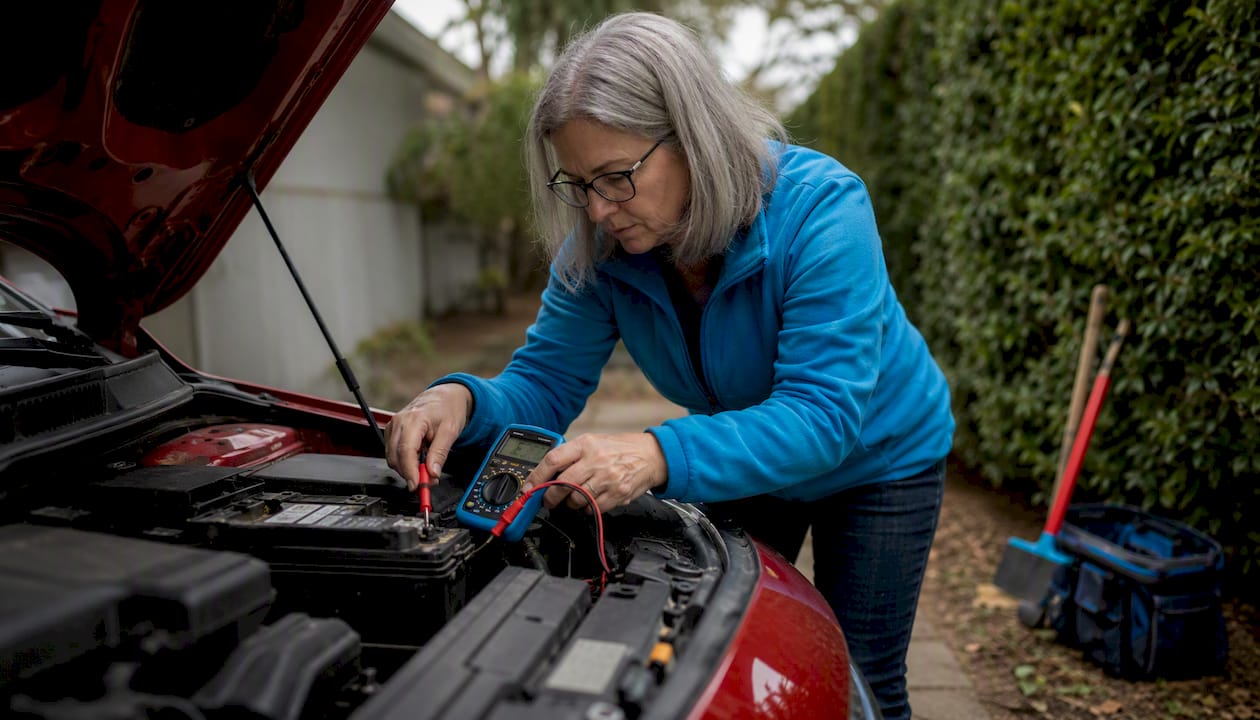
To measure resting voltage, let the car sit for at least two hours after the last drive, then touch the red probe to the positive terminal and the black probe to negative. A reading above 12.6 V means the battery is fully charged. Between 12.4 V and 12.6 V is acceptable. Below 12.2 V, book a load test before buying or selling.
CCA matters most in cold climates. At 0°F, CCA measures how many amps the battery can deliver for 30 seconds while holding at least 7.2 volts. A battery that meets its rated CCA in a shop test is genuinely healthy; one that falls short is on its way out regardless of what the resting voltage says.
Jump-starting a car once is not a crisis. Needing it repeatedly almost always means the battery needs replacement, not another jump. Heat accelerates the decline: extreme heat shortens battery life faster than cold by driving electrolyte evaporation and internal corrosion.
Maintenance differences by type: FLA batteries may occasionally need distilled water added to the cells, though modern low-maintenance designs rarely require it. AGM batteries are fully sealed and must never be opened. EFBs sit between the two and are largely maintenance-free in normal use.
Pro Tip: Reserve Capacity (RC) tells you how long the battery can power the car’s essentials if the alternator fails. It’s less visible than CCA on spec sheets but worth checking for vehicles used on long highway drives.
What battery replacement actually costs, and when to pull the trigger
Replacement cost depends on type. FLA batteries are the least expensive entry point; AGM batteries run 40–100% more by Consumer Reports’ measure; 12V lithium-ion aftermarket options sit at a premium above that.
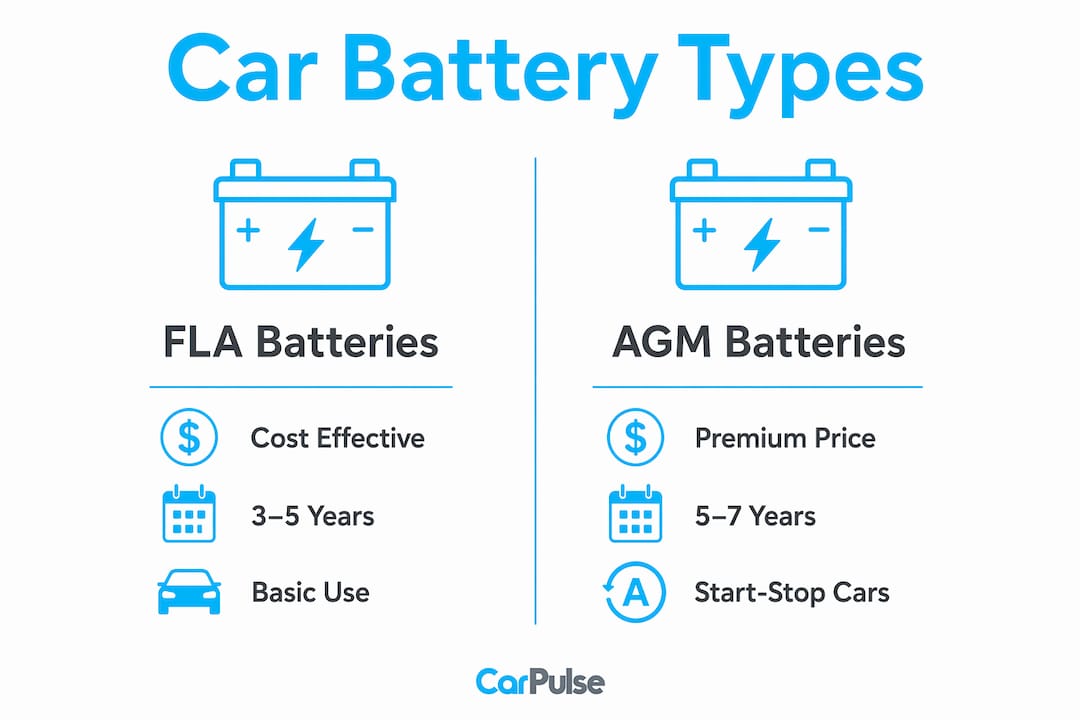
| Type | Typical Lifespan | Cost Relative to FLA |
|---|---|---|
| FLA | 3–5 years | Baseline |
| AGM | 5–7 years | ~40–100% more |
| 12V Li-ion | — | Significant premium |
Replace a battery when: resting voltage won’t recover after a full charge, it fails a load test, it requires repeated jump-starts, the case shows visible damage, or the warranty period has expired. Don’t wait for a no-start event to make the call.
If you replace the battery before selling, keep the receipt. A dated receipt with the battery brand, type, and CCA rating listed in the vehicle’s Carpulse listing removes one of the most common buyer objections and can justify a higher asking price.
EVs and hybrids: two very different batteries under the hood
EVs and hybrids use a large traction battery for propulsion and a separate smaller 12V battery for accessories and starting functions. These are completely different systems.
When reviewing an EV or hybrid listing, clarify which battery is being discussed:
- Traction battery: The high-voltage lithium-ion pack that powers the electric motor. State of health (SoH) and remaining range are the key metrics. Issues here are major value drivers and require specialist diagnostics.
- 12V auxiliary battery: Present in virtually all EVs and hybrids to run standard accessories. In EVs, it’s charged via a DC-to-DC converter rather than an alternator. Replacement is usually straightforward and similar in cost to a conventional vehicle.
- Diagnostic records: Ask for a recent battery health report from a dealer or certified shop for the traction pack. Many manufacturers provide this through their service tools.
A seller listing a hybrid or EV should state both battery conditions separately. Buyers who see only “battery good” in a listing have no idea which battery that refers to.
Battery safety and recycling in the U.S.
Car batteries contain lead and sulfuric acid. Handle them with eye protection, avoid sparks near the terminals, and recycle through certified channels — never put one in household trash.
In the U.S., most auto parts retailers (AutoZone, O’Reilly, Advance Auto Parts, Walmart Auto) accept old batteries for recycling and typically credit a core charge refund when you return the old unit with a new purchase. Municipal hazardous-waste programs also accept them. The EPA estimates that lead-acid batteries are among the most recycled consumer products in the country.
For sellers preparing a car for pickup or transport: secure the battery in its tray, avoid tilting a flooded battery (acid can spill through the vents), and disconnect the negative terminal if the vehicle will sit for an extended period before transfer.
Key Takeaways
A car battery’s type, age, resting voltage, CCA rating, and warranty documentation are the five facts that determine its value and reliability when buying or selling a vehicle.
| Point | Details |
|---|---|
| Battery type matters for compatibility | Never replace an AGM or EFB vehicle with a cheaper FLA; the charging system may not support it. |
| Age and voltage are quick screens | Batteries older than several years or reading below 12.0 V resting voltage warrant a professional load test. |
| CCA is the cold-weather spec | Confirm the CCA rating meets or exceeds the vehicle manufacturer’s spec, especially in northern states. |
| AGM costs more but lasts longer | AGM batteries cost about 40–100% more than comparable conventional lead-acid batteries, but typically last 5–7 years versus 3–5. |
| Document everything when selling | A receipt and warranty on file reduces buyer friction and supports a stronger asking price. |
What Carpulse recommends for listing battery condition
Battery condition is one of the most negotiated items in a used-car transaction, and most of that friction is avoidable.
When sellers list a vehicle, the single most useful thing they can add is a photo of the battery label showing the manufacture date and type, alongside any installation receipt. Buyers who can see that the battery is an 18-month-old AGM with two years of warranty left don’t need to factor in a $200–$300 replacement cost when making an offer. That transparency shortens the sale and reduces post-sale disputes.
From the buyer’s side: if a listing says nothing about the battery, ask directly. Request the manufacture date, battery type, and whether a load test has been run recently. A seller who can’t answer those questions may not know the car’s condition well enough to price it accurately.
Useful sources
The following sources back the technical and cost claims in this article:
- Consumer Reports — Car Battery Buying Guide: Cost comparisons (AGM vs. conventional lead-acid), testing frequency guidance, and deep-discharge tolerance data
- AAA — Car Battery Types: FLA/AGM/EFB type definitions, start-stop compatibility, and group size guidance
- Batteries Plus — How Car Batteries Work: SLI classification, sulfation mechanics, and deep-cycle distinction
- VARTA — Battery Construction and Chemistry: Technical grounding on charge/discharge cycles and plate chemistry
- Progressive Dyn: Six-cell structure and nominal 12.6 V voltage fact
- AutoZone — How Car Batteries Work: Heat vs. cold impact on battery life and failure modes
- Wikipedia — Automotive Battery: CCA definition, SLI classification, cell chemistry, and recycling context
- Continental Battery — How Does a Car Battery Work: CCA formula and alternator recharging mechanics
- RACV — Car Battery Guide: Lifespan benchmarks (FLA 3–5 years, AGM 5–7 years) and jump-start guidance (Australian market data, cited for lifespan comparison only)