Guides
Fair Market Value: Definition, Methods, and Examples

Fair Market Value: Definition, Methods, and Examples

Fair market value (FMV) is the price a willing buyer would pay a willing seller when both parties are reasonably informed, neither is under pressure to act, and the transaction happens at arm’s length in an open market. According to Investopedia, FMV represents what an asset would command in a competitive, unrestricted market. Three methods produce that estimate:
- Market approach: compare recent sales of similar assets and adjust for differences
- Cost approach: calculate replacement cost, then subtract depreciation
- Income approach: project future cash flows and discount them to present value
In Albania, FMV comes up whenever you sell property, file an inheritance declaration, or negotiate a vehicle trade-in. For cars specifically, Carpulse surfaces local, VIN-verified listings that give you the comparable sale data the market approach requires.
Key Takeaways
Fair market value is a method-driven estimate, not a single fixed number, and the quality of your comparables determines whether that estimate will hold up under scrutiny.
| Point | Details |
|---|---|
| FMV definition | The price between a willing, informed buyer and seller in an arm’s-length transaction with no compulsion. |
| Choose the right method | Use the market approach for cars and homes, cost approach for specialized assets, income approach for businesses. |
| Present a range | Show a high and low scenario rather than a single figure, especially when comparable data is limited. |
| Document contemporaneously | Save dated screenshots, appraisal reports, and a written memo on the day you conduct your research. |
| Know when to hire an appraiser | For high-value transfers, inheritance, or any filing the Albanian tax authority will review, use a certified professional. |
Table of Contents
- What is fair market value, and what assumptions does it require?
- Why does fair market value matter in practice?
- How do you calculate fair market value step by step?
- How FMV applies to real estate, stocks, and vehicles
- What factors raise or lower fair market value?
- FMV vs. fair value, market price, and book value
- How to document FMV for Albanian tax and legal purposes
- A worked example: estimating vehicle FMV using Carpulse
- An editorial perspective on FMV and Albanian car valuations
- Sources
What is fair market value, and what assumptions does it require?
The Legal Information Institute at Cornell grounds FMV in U.S. case law as the price between a willing buyer and a willing seller, each with reasonable knowledge of the relevant facts and neither acting under compulsion. That framing has been adopted widely across tax, bankruptcy, and property law because it strips away the distortions of a forced sale or an uninformed party.
Four assumptions must hold for a price to qualify as FMV:
- Willing buyer and seller: neither party is desperate or coerced
- Informed parties: both sides understand the asset’s condition, history, and market context
- Reasonable market exposure: the asset has been available long enough for the market to respond
- Arm’s-length transaction: buyer and seller have no special relationship that would skew the price
When any of those conditions breaks down, the resulting price is something else: a distress sale, a related-party transfer, or a quick-liquidation figure. None of those equal FMV.
One more thing worth understanding: FMV is a theoretical estimate, not a single immutable number. AccountingTools notes that different valuation methods and data quality will produce a reasonable range rather than one definitive price. A well-prepared valuation presents that range and explains the assumptions behind it.
Pro Tip: If you need FMV for a tax filing, court proceeding, or eminent domain claim, a written appraisal from a certified professional is almost always required. A number you calculated yourself, without documented comparables and a clear methodology, will not survive scrutiny from a tax authority or a judge.
Why does fair market value matter in practice?
Sage describes FMV as an objective benchmark used across real estate, corporate finance, insurance, and tax valuation. That objectivity is exactly why it matters: it gives both sides of a transaction a number that neither party invented.
Common situations where you need a defensible FMV estimate:
- Tax reporting: charitable donations, gifts, and inheritances all require FMV for the asset transferred; the Albanian General Directorate of Taxation expects documented values for property and vehicle transfers
- Collateral for lending: Albanian banks typically require a formal property appraisal before approving a mortgage or secured loan
- Insurance claims: your insurer pays replacement or actual cash value, both of which are anchored to FMV
- Sale negotiations: FMV sets the opening reference point; knowing it prevents you from leaving money on the table or pricing yourself out of the market
- M&A and business transfers: acquirers and their auditors require FMV for every material asset on the balance sheet
- Divorce and bankruptcy settlements: courts use FMV to divide assets equitably when the parties cannot agree
The documentation point is not optional. LegalClarity warns that unsupported estimates risk challenges from tax authorities. An Albanian tax inspector who questions a declared property value will ask for comparable sales, an appraisal report, or both. A number you wrote on a form without backup is a liability.
How do you calculate fair market value step by step?
The three accepted methods each suit different asset types. Choosing the wrong one produces a number that looks precise but is easy to challenge.
Market approach
Find recent sales of genuinely comparable assets, then adjust for meaningful differences. This is the preferred method for homes, used vehicles, and any asset with an active secondary market, because actual transaction prices are the strongest evidence of what buyers will pay.
Data to collect:
- At least three recent sales (within 6–12 months) of comparable assets
- Condition reports or inspection records for each comparable
- Adjustments for size, age, mileage, location, or features that differ from your asset
Cost approach
Estimate what it would cost to replace the asset new, then subtract accumulated depreciation. Use this for specialized equipment, one-of-a-kind assets, or new construction where few direct sales comparables exist.
Data to collect:
- Current replacement cost (supplier quotes or published price lists)
- Age and expected useful life of the asset
- Physical condition assessment to estimate effective depreciation
Income approach
Project the asset’s future cash flows, select an appropriate discount rate, and calculate present value. This is the standard method for businesses, income-producing real estate, and private-company shares where no liquid market exists.
Data to collect:
- Three to five years of historical revenue and expense records
- Normalized cash flow figures (remove one-time items)
- A defensible discount rate based on risk profile and comparable investments
SmartAsset confirms these three as the canonical methods for FMV estimation. The table below maps each to its best use case.
| Method | Best for | Required data | Typical evidence |
|---|---|---|---|
| Market approach | Homes, used cars, common goods | Recent comparable sales | MLS records, marketplace listings, auction results |
| Cost approach | Specialized equipment, new builds | Replacement cost, depreciation schedule | Supplier quotes, condition reports |
| Income approach | Businesses, rental property, private shares | Historical cash flows, discount rate | Financial statements, industry benchmarks |
Pro Tip: Never present a single-point FMV estimate when your comparable data is thin. Show a range: a low scenario using the weakest comp and a high scenario using the strongest. That range is more defensible than a false precision figure, and it signals to a reviewer that you understand the uncertainty in the data.
How FMV applies to real estate, stocks, and vehicles
Real estate
The market approach dominates residential property valuation. A licensed appraiser pulls recent sales of similar homes within a defined radius, adjusts for square footage, condition, lot size, and amenities, and arrives at a supported value. In Albania’s property market, where transaction records can be inconsistent, the quality of the comparables matters enormously. Time-on-market is also a signal: a property sitting unsold for six months in a normal market is telling you the asking price is above FMV.
Publicly traded stocks
For listed securities, FMV on a given day is simply the market price. The practical question is which price to use: opening, closing, or the average of the high and low for the day. Tax authorities in most jurisdictions accept the average of the high and low on the valuation date. Pick the date carefully, document it, and keep the source record.
Private-company shares
No market price exists, so practitioners typically use the income approach or apply a market multiple derived from comparable public companies or recent private transactions. AccountingTools notes that selecting the right discount rate and normalizing cash flows are the two most common sources of variation between practitioners. A small change in the discount rate can shift a business valuation by tens of thousands of dollars, which is why private-company FMV almost always requires a credentialed professional.
Vehicles
The market approach is standard. LegalClarity advises that recent actual sale prices of comparable local vehicles, matched by make, model, year, mileage, and condition, are more reliable than generic depreciation tables or book values. Book value is a conservative quick-sale estimate; FMV should reflect what a private buyer in your local market would actually pay.

Carpulse’s VIN-based listings and AI price estimates give Albanian sellers and buyers access to exactly this kind of local, recent transaction data. Filtering by make, model, year, and mileage on Carpulse surfaces the comparables the market approach requires, without needing to call multiple dealers.
Common pitfalls across all asset classes:
- Too few comparables (fewer than three makes the estimate fragile)
- Stale data (sales from more than 12 months ago in a moving market)
- Ignoring unique features that require upward or downward adjustments
- Confusing list price with sale price (only closed transactions count)
What factors raise or lower fair market value?
FMV is not static. The same asset can carry a materially different value six months apart depending on conditions at the time of the assessment.
Market-level factors:
- Supply and demand balance in the local market
- Interest rate environment (higher rates compress property and business values)
- Broader economic outlook and consumer confidence
- Seasonality (used car prices in Albania tend to soften in winter months)
Asset-level factors:
- Physical condition and remaining useful life
- Maintenance history and documented service records
- Uniqueness or scarcity (rare assets have thinner markets and wider value ranges)
- Title clarity and absence of liens or legal encumbrances
Transaction factors:
- Marketing exposure time (a 48-hour listing reaches fewer buyers than a 30-day one)
- Seller motivation (a seller who must close quickly accepts less)
- Transaction costs borne by one party (these shift the effective price)
ISA Appraisers caution that FMV is sensitive to data quality: small samples of poor comparables shift estimates materially. A quick plausibility check before you finalize a number: Does the figure sit within the range of recent local sales? Does it account for the asset’s current condition? Would a knowledgeable buyer agree it is reasonable?
FMV vs. fair value, market price, and book value
These terms are often used interchangeably, but they mean different things in different contexts.
- Fair market value (FMV): the hypothetical price in an open, arm’s-length market between informed, willing parties. Used by tax authorities, courts, and in property transactions. The standard reference is the IRS and U.S. tax law, though the concept is applied globally.
- Fair value: an accounting concept under IFRS and U.S. GAAP. It is the price you would receive to sell an asset (or pay to transfer a liability) in an orderly transaction between market participants at the measurement date. Fair value can include assets with no active market, using modeled inputs. FMV and fair value often produce similar numbers but rest on different assumptions.
- Market price: the actual price at which an asset last traded. For listed stocks, market price equals FMV on that day. For real estate or private assets, market price is a historical data point, not a forward estimate.
- Book value: the asset’s value on an accounting balance sheet, calculated as original cost minus accumulated depreciation. Book value rarely equals FMV because it ignores market conditions and uses historical cost.
- Liquidation value: what an asset fetches in a forced or time-constrained sale. Always below FMV because the willing-seller assumption is removed.
Practical rule: use FMV for tax filings, legal disputes, and sale negotiations. Use fair value when preparing financial statements under IFRS or GAAP. Use market price for listed securities on a specific date. Never substitute book value or liquidation value for FMV in a tax or court context.
How to document FMV for Albanian tax and legal purposes
Documentation is often as important as the number itself. A well-supported FMV that you can defend is worth far more than a precise-sounding figure with no paper trail.
Evidence to retain for any FMV determination:
- Dated screenshots or exports of comparable listings from Carpulse or other marketplaces
- Closed-sale records (not just asking prices) with dates and transaction amounts
- Appraisal reports signed by a certified professional
- Condition reports, service invoices, or inspection certificates
- A written valuation memo explaining your method, data sources, and adjustments
When to hire a certified appraiser or accountant in Albania:
- Property transfers above the thresholds set by the Albanian General Directorate of Taxation
- Inheritance declarations involving real estate or business interests
- Corporate asset transfers, mergers, or share sales
- Any dispute where a tax authority or court will review the valuation
For tax filings, present your FMV with clear dates, named sources, and a brief explanation of the method used. Albanian banks require formal appraisals for mortgage collateral; a marketplace printout alone will not satisfy a loan officer for a property transaction, though it works well as supporting evidence for vehicle values.
Wikipedia’s overview of fair market value notes that local tax authorities often have specific evidentiary thresholds or preferred documentation formats. Check with the Albanian tax authority or a local accountant before submitting a valuation for a high-stakes filing.
The Appraisal Foundation sets the professional standards and credentialing benchmarks that certified appraisers follow globally. For complex or high-value determinations, a professional who adheres to those standards gives your valuation the best chance of surviving a challenge.
Pro Tip: Save raw export files or dated screenshots from Carpulse and other market sources the same day you conduct your research. A screenshot from six months later proves nothing about what the market showed on your valuation date. Contemporaneous evidence is what makes a valuation defensible.
A worked example: estimating vehicle FMV using Carpulse
Suppose you are selling a 2019 Toyota Corolla with 85,000 km in good condition in Tirana. Here is how to build a defensible FMV estimate using Carpulse data.
Step 1: Define your search parameters
Go to Carpulse and filter by:
- Make: Toyota, Model: Corolla
- Year: 2018–2020 (one year either side to widen the comp pool)
- Mileage: 70,000–100,000 km
- Fuel type: matching your vehicle
Step 2: Collect at least three to five comparable listings
For each comp, record: asking price, mileage, year, condition notes, and the listing date. Prefer listings that show a sale or have been active for fewer than 30 days (fresh listings reflect current market sentiment).
Step 3: Adjust for differences
A rough rule is that each 10,000 km difference adjusts the price slightly for a vehicle in this segment, though local market data from Carpulse’s used-car pricing analysis will give you a more precise local figure.
Step 4: Calculate the FMV range
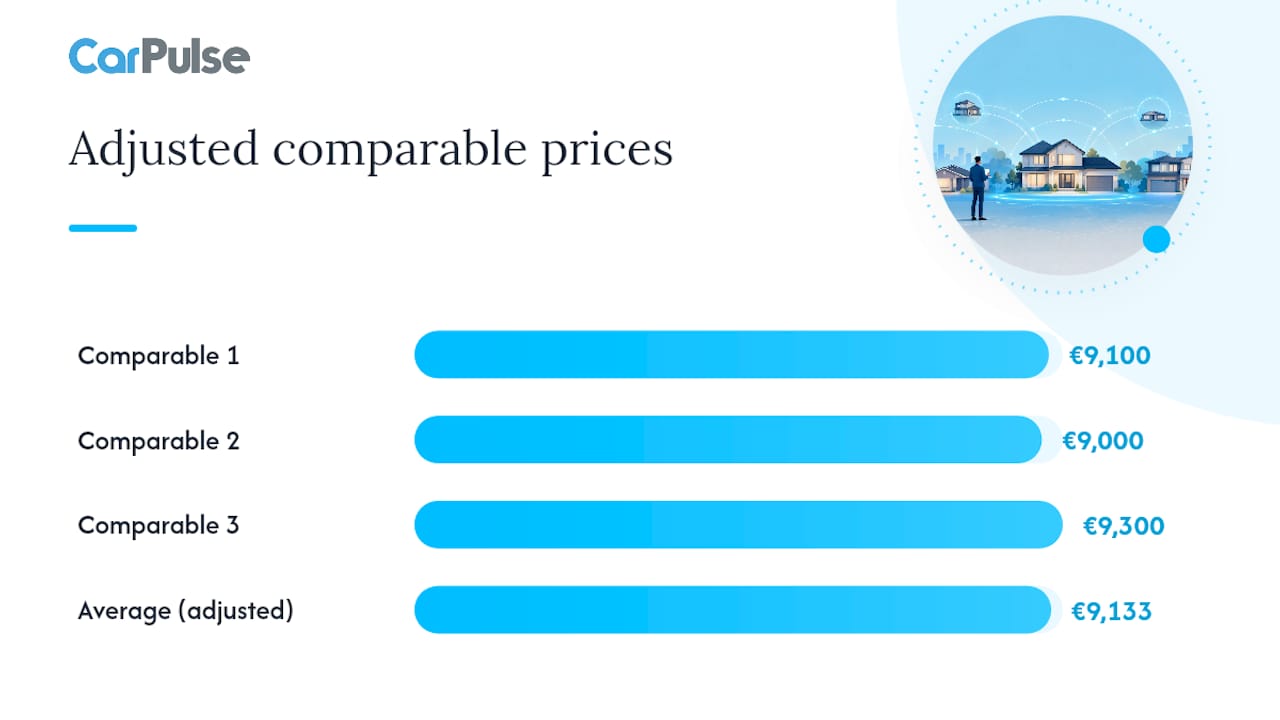
Average of adjusted prices: (€9,100 + €9,000 + €9,300) / 3 = €9,133
Present your FMV as a range: €8,900–€9,400, with the midpoint at approximately €9,100. The Carpulse AI price estimate for the same parameters serves as an independent cross-check.
Step 5: Document everything
- Save dated screenshots of each comp listing
- Note the Carpulse AI estimate and the date you retrieved it
- Write a one-paragraph memo: “FMV estimated using market approach, three local comparables sourced from Carpulse on [date], adjusted for mileage and condition differences.”
This worksheet is your evidence if a buyer, bank, or tax authority questions your number. For a buying and selling guide with additional documentation steps, Carpulse’s complete vehicle transaction guide covers the full process.
An editorial perspective on FMV and Albanian car valuations
Most people who ask “what is fair market value” are not looking for a textbook definition. They want to know whether the price they are about to accept or offer is reasonable. That is a different question, and the answer depends almost entirely on the quality of the comparables you use.
The biggest mistake Albanian sellers make is anchoring to the price they paid, not the price the current market will bear. A car bought in 2021 at peak used-vehicle prices may be worth considerably less today, regardless of how well it was maintained. FMV does not care what you paid. It cares what an informed buyer will pay right now, in this market, for this specific vehicle.
Carpulse’s VIN-based listings and AI pricing reduce the guesswork by pulling real, local data rather than generic depreciation curves. That matters because Albanian vehicle prices are shaped by factors that international book values simply do not capture: fuel type preferences, import duty history, local demand for specific brands, and seasonal patterns. A platform with local transaction depth gives you a starting point that is already calibrated to your market.
That said, no marketplace tool replaces a certified appraiser when the stakes are high. For a vehicle worth €5,000, a well-documented Carpulse comp set is probably sufficient. For a commercial fleet, an inheritance dispute, or a corporate asset transfer, bring in a credentialed professional. The cost of a proper appraisal is almost always smaller than the cost of a tax challenge or a failed negotiation.
Sources
These sources cover FMV from legal, accounting, and practical angles. Use the first group for definitions and legal grounding; use the second for Albanian-specific guidance.
Internationally recognized standards and primers:
- Fair Market Value (FMV) — Investopedia
- What Is Fair Market Value (FMV) for Tax Purposes? — LegalClarity
- fair market value | Wex | US Law | LII / Legal Information Institute
- The Appraisal Foundation
For Albanian-specific guidance:
Recommended
- Pse të Blini Makina të Verifikuara? Besueshmëri, Vlerë… | CarPulse Albania
- Makina në Shitje: Udhëzuesi i Plotë Blerje/Shitje në… | CarPulse Albania
- Çfarë ndikon në çmimet e makinave të përdorura në Shqipëri? | CarPulse Albania
- Çmimet e Makinave të Përdorura në Shqipëri: Faktorët Kyç… | CarPulse Albania