Guides
Certified Pre-Owned Vehicles: What You Need to Know

Certified Pre-Owned Vehicles: What You Need to Know

A certified pre-owned (CPO) vehicle is a used car that has been inspected, refurbished, and backed by the original manufacturer with an extended warranty. Think of it as the middle ground between buying new and rolling the dice on a random used car. CPO vehicles typically meet strict eligibility requirements before they qualify:
- Age: Usually within the program’s specified age limit
- Mileage: Generally within the program’s specified mileage limit
- Inspection: Multi-point checks covering up to 300 inspection points by factory-trained technicians
- Condition: Must pass refurbishment standards; any failing components get repaired or replaced
- Title history: Clean title required, no salvage or flood damage
- Warranty: Extended coverage from the manufacturer, often including powertrain and bumper-to-bumper protection
- Perks: Many programs add roadside assistance, trip interruption protection, and loaner vehicle access during repairs
What separates a CPO car from a standard used car is not just the inspection. It is the manufacturer standing behind the vehicle with a real warranty, the same way they back a new car off the lot.
How does a certified pre-owned car differ from a regular used car?
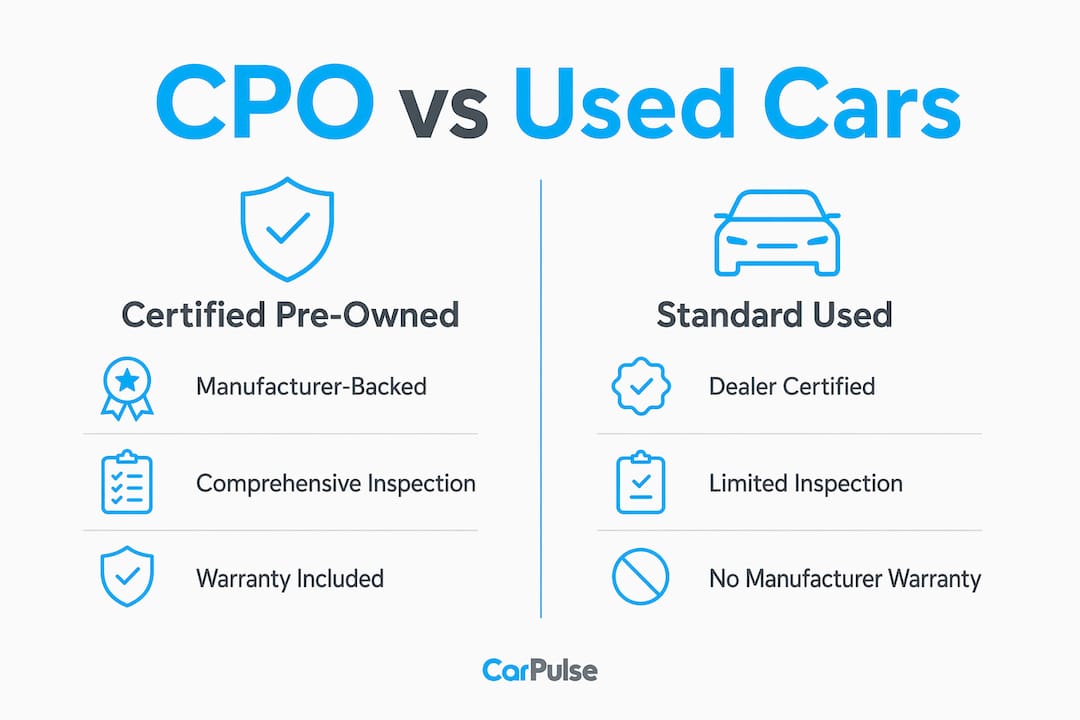
The gap between a CPO vehicle and a standard used car is wider than most buyers expect. Here is where the real differences land:
- Inspection rigor: A regular used car may get a quick lot check. A CPO vehicle goes through a structured multi-point inspection by technicians trained to the manufacturer’s own standards.
- Warranty: Standard used cars are typically sold as-is, or with a short dealer warranty. CPO vehicles carry manufacturer-backed extended coverage.
- Manufacturer backing: Only franchised dealerships can certify vehicles under an official automaker program. A private seller or independent lot cannot offer true CPO status.
- Eligibility filters: Not every used car qualifies. Only about 30–40% of used inventory qualifies for CPO certification based on the program’s age, mileage, and condition criteria.
- Price: CPO vehicles cost more. Kelley Blue Book estimates the premium at about 1.8% over a comparable non-certified used car.
- Transparency: CPO buyers receive signed inspection documentation. Standard used car buyers usually get nothing beyond the seller’s word.
- Transferability: Some CPO warranties transfer to a second owner; most standard used car warranties do not.
The core distinction is accountability. A manufacturer-backed CPO program puts the automaker’s name on the vehicle’s condition. A regular used car puts that responsibility on no one.
What are the real benefits of buying a certified pre-owned vehicle?
The strongest argument for CPO vehicles is reliability. Consumer Reports data shows that CPO cars average 14% fewer problems than other used cars. That gap reflects the inspection and refurbishment process, not just marketing.
Beyond reliability, CPO programs stack on benefits that standard used cars simply cannot match:
- Extended warranty coverage: Powertrain protection is standard across most programs; many also include bumper-to-bumper coverage for a defined period or mileage
- Roadside assistance: Flat tire help, towing, and emergency fuel delivery are common inclusions
- Trip interruption protection: If your car breaks down far from home, many programs cover hotel and meal costs
- Loaner vehicle access: During covered repairs, many manufacturers provide a loaner so you are not stranded
- Special financing: Manufacturer-backed financing on CPO vehicles can rival new-car rates, sometimes beating what you would get on a standard used car loan
- Vehicle history report: Most programs include a CARFAX or AutoCheck report as standard
Statistic callout: Consumer Reports’ analysis found CPO vehicles had approximately 14% fewer problems than other used cars, supporting the case that certification produces measurably better vehicles.
The financial picture is more nuanced than the sticker price suggests. A CPO vehicle that costs a few hundred dollars more upfront but avoids one major repair can easily come out ahead over three years of ownership.
What does the CPO certification and inspection process actually involve?
The inspection process is where CPO programs earn their credibility, or fail to. A genuine manufacturer-backed program puts vehicles through a structured review that covers mechanical, safety, and cosmetic components. Here is what that typically looks like:
- Multi-point inspection: Factory-trained technicians check up to 300 individual points, covering the engine, transmission, brakes, suspension, electrical systems, tires, and interior
- Eligibility screening: Vehicles must meet the program’s age and mileage requirements
- Title verification: A clean title is non-negotiable. Salvage, flood, or lemon-law buyback histories disqualify a vehicle automatically
- Refurbishment: Any component that fails inspection gets repaired or replaced before certification is granted, not after the sale
- Technician sign-off: The inspection checklist is signed by the technician who performed it, creating a documented record
- Documentation package: Buyers receive the signed checklist, vehicle history report, and warranty terms in writing
- Franchised dealership requirement: Only authorized dealerships can certify vehicles under a manufacturer’s official program. Independent lots and private sellers cannot
Pro Tip: Ask to see the actual signed inspection checklist before you agree to purchase. A dealer running a legitimate CPO program will hand it over without hesitation. Reluctance to share that document is a warning sign.
The distinction between a manufacturer program and a dealer-only certification matters more than most buyers realize. A dealer can call any car “certified” without meeting any external standard. The manufacturer’s name on the program is what creates enforceable accountability.

How much more does a certified pre-owned car actually cost?
The price premium for CPO vehicles is real but smaller than many buyers assume. Kelley Blue Book puts the average CPO markup at about 1.8% over a comparable non-certified used car. On a $25,000 vehicle, that works out to roughly $450. On a $40,000 vehicle, closer to $720.
| Factor | CPO Vehicle | Standard Used Car |
|---|---|---|
| Average price premium | Premium over non-CPO vehicles | Baseline |
| Warranty included | Yes, manufacturer-backed | Rarely, or as-is |
| Inspection documentation | Signed multi-point checklist | None standard |
| Roadside assistance | Typically included | Not included |
| Special financing available | Often, at new-car rates | Standard used-car rates |
| Dealer gross per unit | — | Baseline |
The dealer gross figure is worth understanding as a buyer. CPO vehicles generate more profit per sale, which means there is room to negotiate. The 1.8% premium is an average, not a floor. Buyers who come in with fair market value data from tools like Kelley Blue Book or similar pricing resources tend to pay less than those who accept the sticker.
Total cost of ownership is the more honest comparison. A standard used car that needs a transmission repair in year two can easily cost more than the CPO premium would have been. The warranty is not just a perk; it is a hedge against the unpredictability that comes with any used vehicle.
Tips for buying a certified pre-owned car without getting burned
CPO programs are not all created equal, and the label alone does not guarantee protection. These steps help you buy with confidence:
- Verify the program is manufacturer-backed: Ask specifically whether the certification comes from the automaker’s official program. Dealer-only or third-party certifications vary widely in quality and may offer far less protection
- Request the signed inspection checklist: The technician-signed document tells you exactly what was checked and what was repaired. Do not accept a summary brochure in its place
- Pull the vehicle history report independently: Even with a CPO program, run your own CARFAX or AutoCheck search using the VIN to cross-reference what the dealer provides
- Read the warranty terms carefully: Know the coverage period, mileage limits, what is excluded, and whether the warranty transfers if you sell the car
- Check transferability: Some CPO warranties are non-transferable, which can affect resale value if you plan to sell before the coverage expires
- Compare with an independent inspection: For non-CPO used cars you are considering as alternatives, a pre-purchase inspection by an independent mechanic typically costs $100–$200 and provides similar peace of mind
- Negotiate the price: CPO pricing is negotiable. Use fair market value tools to anchor your offer, not the sticker price
Pro Tip: Cross-reference the CPO vehicle’s asking price against current market data before you walk into the dealership. Buyers who arrive with pricing research consistently negotiate better outcomes than those who rely on the dealer’s framing of the “certified” premium.
One more thing worth knowing: not all CPO warranties are transferable from one owner to the next. If you buy a CPO vehicle from a private seller rather than a franchised dealership, confirm whether the remaining warranty coverage follows the car or stays with the original buyer.

Common misconceptions about certified pre-owned vehicles
The CPO label carries real weight when it is backed by a manufacturer. When it is not, it can be nearly meaningless. These are the misunderstandings that cost buyers money:
- “All certifications are the same.” They are not. Only official manufacturer-backed programs provide comprehensive, enforceable protections. A dealer-certified car may have passed a 20-point checklist written by the dealer.
- “CPO means the car is perfect.” Certification means it met the program’s standards at the time of inspection, not that it will never need repairs. The warranty covers future issues; it does not eliminate them.
- “The sticker price is fixed.” CPO pricing is negotiable, and dealerships generate higher margins on CPO units, which means there is room to move.
- “Private sellers can offer CPO vehicles.” They cannot. Authentic CPO status requires a franchised dealership authorized by the manufacturer.
- “Younger or lower-mileage always means better.” A well-maintained 6-year-old vehicle that qualifies for CPO certification can be a stronger buy than a 3-year-old car sold as-is with no inspection history.
- “The lowest upfront price is the best deal.” Research from CDK Global shows that younger buyers especially tend to focus on sticker price while underestimating the long-term value of warranty coverage and reduced repair risk.
Statistic callout: Consumer Reports found that CPO vehicles averaged 14% fewer problems than other used cars, a figure that directly challenges the assumption that any used car carries the same risk profile.
The education gap is real. Dealers who walk buyers through a side-by-side comparison of CPO versus non-CPO total costs tend to close more sales and generate fewer post-purchase complaints. For buyers, that same comparison is worth doing before you sign anything.
Key Takeaways
A certified pre-owned vehicle backed by the original manufacturer offers measurably better reliability, documented inspection standards, and warranty protection that a standard used car cannot match.
| Point | Details |
|---|---|
| CPO definition | A manufacturer-backed used car, generally less than 7 years old and under 80,000 miles, inspected to strict standards. |
| Reliability advantage | CPO vehicles have fewer problems than other used cars, per Consumer Reports analysis. |
| Price premium | CPO cars generally cost more than comparable non-certified used vehicles. |
| Verification matters | Only franchised dealerships can issue authentic manufacturer CPO status; dealer-only certifications vary widely. |
| Negotiation is possible | CPO pricing is not fixed; use market pricing tools to negotiate rather than accepting the sticker price. |
The CPO market rewards buyers who do their homework
Most car buyers treat CPO certification as a binary: either the car has it or it does not. The smarter frame is to ask who is standing behind it. A manufacturer-backed program with a signed 300-point inspection checklist and a transferable powertrain warranty is a fundamentally different product from a dealer-stamped “certified” sticker on a car that passed a visual walk-around.
The 1.8% price premium is not the number worth obsessing over. The more interesting question is what a single major repair costs relative to that premium. Transmissions, timing chains, and electrical systems do not care whether you saved $400 at purchase. The warranty does.
There is also a buyer psychology issue worth naming. Focusing narrowly on the lowest sticker price is a pattern that CDK Global’s research specifically flags among younger buyers, and it is exactly the mindset that makes a non-CPO used car feel like a win right up until the first repair bill. The CPO model works because it shifts some of that risk back to the manufacturer, which is the party with the most information about how that vehicle was built and what it needs to keep running.
For buyers in the Albanian market, Carpulse’s verified car listings give you a starting point for comparing vehicles with documented histories, which is the same principle that makes CPO programs valuable anywhere: transparency before the purchase, not surprises after.
The bottom line is that CPO vehicles are not for every buyer or every budget. But for anyone who wants the economics of a used car without the full uncertainty of buying one blind, a manufacturer-backed CPO program is the most structured protection available short of buying new.