Guides
Why Consider Lease Options for Cars: Buyers & Sellers Guide

Why Consider Lease Options for Cars: Buyers & Sellers Guide

TL;DR:
- A vehicle lease option allows buyers to lock in a purchase price while giving sellers upfront income and flexibility. It is distinct from a lease-purchase, which legally obligates the buyer to buy, and requires clear contract language to avoid legal risks. Buyers should thoroughly verify vehicle history, negotiate key terms, and consult professionals before entering such agreements.
A vehicle lease option is a practical way for U.S. car buyers and sellers to lock in flexible use now while preserving an agreed path to a future sale. Buyers get time to repair credit and hedge against price increases; sellers collect an upfront option fee and steady monthly income. Per National Association of Realtors guidance, a lease option gives the buyer a right to purchase, not an obligation, which is the critical legal distinction.
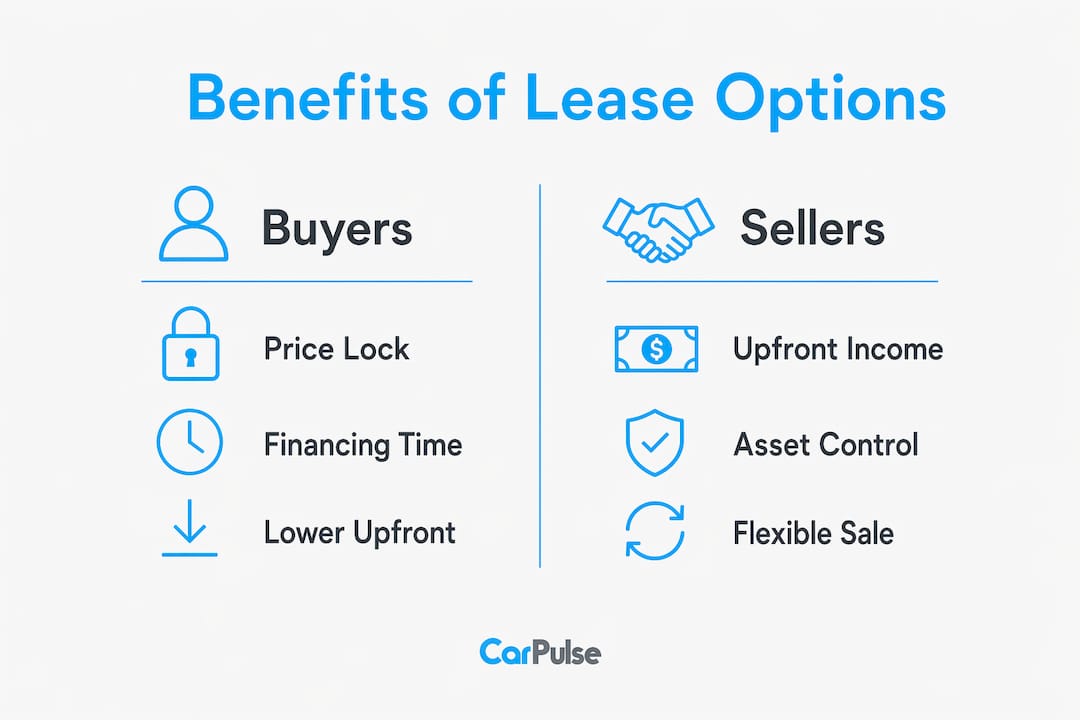
For buyers, the top reasons to consider a lease option:
- Lock in today’s purchase price against future price increases
- Use the lease term to improve credit before applying for financing
- Drive the vehicle before committing to buy it
For sellers, the core advantages:
- Collect a nonrefundable option fee upfront
- Earn premium monthly payments during the term
- Keep the asset and fee if the buyer walks away
Bottom line: A lease option makes the most sense for buyers who need time to qualify for conventional financing, and for sellers with hard-to-move inventory who want income while waiting for the right buyer. Skip it if you can secure standard financing today or if you’re genuinely unsure whether you want the car.
Table of Contents
- What exactly is a lease option, and how does it differ from a lease-purchase?
- How a vehicle lease option works from signing to expiry
- Concrete benefits for buyers and sellers
- Risks and downsides you need to know
- Contract terms to negotiate before you sign
- How to calculate whether a vehicle lease option is a good deal
- Practical steps before and during a vehicle lease option
- When to avoid a lease option and what to use instead
- Key Takeaways
- The lease option gap most buyers miss
- Useful sources and where to find state-specific rules
What exactly is a lease option, and how does it differ from a lease-purchase?
A lease option combines two agreements: a standard vehicle lease and a separate option contract that grants the buyer the exclusive right to purchase the car at a fixed price within a defined window. The buyer is not obligated to buy. A lease-purchase, by contrast, legally binds the buyer to complete the purchase at the end of the term. That single word difference, “option” versus “purchase,” changes everything about your exit rights.

Courts and regulators sometimes reclassify poorly drafted agreements. Per CapRateCity’s investor guide, a contract that looks like seller financing or a disguised sale can trigger regulatory exposure and void the protections both parties expected. State law varies significantly across the U.S., so what works in Texas may not hold in California.
Pro Tip: Insist the contract explicitly labels itself a “lease with option to purchase,” includes a standalone option clause with a clear exercise deadline, and spells out exactly how the option fee is treated (refundable, nonrefundable, or credited toward the purchase price). Never sign a document that uses “lease-purchase” language when you intend a lease option.
How a vehicle lease option works from signing to expiry
- Negotiate terms. Buyer and seller agree on the option fee, monthly payment, any rent credit, the fixed strike price, and the option exercise window. Both parties sign the lease and a separate option agreement.
- Pay the option fee. The buyer pays an upfront, typically nonrefundable fee. Option fees in vehicle lease options are usually 1–5% of the purchase price, consistent with rent-to-own real estate norms.
- Take possession and make monthly payments. The buyer drives the car and pays monthly rent. A portion may be credited toward the purchase price if the contract specifies a rent credit.
- Maintain the vehicle and insurance. The contract should spell out who handles routine maintenance, repairs, and insurance coverage throughout the term.
- Track the option exercise window. The buyer monitors the deadline and begins financing prep well before it arrives, typically 60–90 days out.
- Exercise or walk away. At or before the deadline, the buyer either secures financing and closes the purchase at the agreed price, or declines and forfeits the option fee. The seller retains the fee and the vehicle.
Seller checklist during the term: document option fee receipt, confirm title and registration remain in your name, track any rent credits owed, and have a re-listing plan ready if the buyer does not exercise.
Concrete benefits for buyers and sellers
Buyer benefits
- Price hedge. Locking the strike price protects against market appreciation, especially relevant for collectible, low-production, or high-demand vehicles where values can climb quickly.
- Credit repair runway. A buyer who recently went through a job loss or medical event can use a 12–24 month term to rebuild their credit score before applying for a conventional auto loan.
- Try before you buy. Unlike a standard purchase, you live with the car daily before committing. Long commutes, family needs, and fuel costs all become clear before you’re locked in.
- Lower upfront cash. No large down payment on day one. The option fee is usually 1–5% of the purchase price, which is much smaller than a conventional down payment.
Seller benefits
- Nonrefundable option fee. Sellers keep this fee if the buyer walks, turning a stalled asset into immediate income.
- Premium monthly payments. Sellers can often charge above-market rent during the term, since the buyer is paying for the exclusive purchase right.
- Asset retention. If the buyer declines, the seller still owns the vehicle and can re-list or re-option it.
When the benefit is strongest: rapidly depreciating models favor shorter lease terms (under three years) to avoid long-term maintenance and resale burdens. Collectible or classic vehicles, where values hold or rise, are better candidates for locking a price via a lease option.
Risks and downsides you need to know
Buyer risks
- Loss of option fee. If you can’t secure financing or change your mind, the fee is gone. Treat it as a sunk cost from day one.
- Paying above market. If vehicle values drop during the term, you’re still bound to the original strike price. Market changes can leave you overpaying.
- Unclear maintenance responsibility. Ambiguous contracts create disputes over who pays for repairs. A buyer who assumes the seller covers major repairs and is wrong faces an expensive surprise.
- Disguised sale risk. A poorly drafted contract can be reclassified by a court, stripping the buyer of option-holder protections.
Seller risks
- Below-market sale. If the vehicle appreciates significantly, the seller is locked into the original price.
- Default and repossession costs. If the buyer stops paying and won’t return the vehicle, recovery can be expensive and time-consuming.
- Legal misclassification. A contract that reads like a conditional sale rather than a true option can create regulatory exposure, particularly if there’s an existing lien on the vehicle.
Contract terms to negotiate before you sign
Every vehicle lease option contract should cover these terms clearly:
| Term | What to nail down |
|---|---|
| Option fee | Amount, nonrefundable status, and whether it credits toward purchase price |
| Rent credit | Exact dollar amount per month credited, and conditions for forfeiture |
| Fixed purchase price | Locked strike price or a clear pricing formula tied to an index |
| Term length | Start date, end date, and exercise window (e.g., 30 days before expiry) |
| Inspection rights | Buyer’s right to a professional inspection before signing and at exercise |
| Title and registration | Confirm seller retains title; buyer’s registration and plate responsibilities |
| Default and termination | What triggers default, cure periods, and remedies for each party |
| Insurance | Who carries liability, comprehensive, and collision coverage |
| Maintenance | Clear split between routine maintenance (buyer) and major repairs (seller or shared) |
Red flags in contract language: vague “as-is” clauses with no inspection right, missing exercise deadlines, and any language that calls the agreement a “conditional sale” rather than a lease with an option.
Negotiation tips: ask for the option fee to be escrowed by a neutral third party, push for a financing contingency that extends the exercise window if your loan approval is delayed, and request that rent credits be documented monthly in writing.
How to calculate whether a vehicle lease option is a good deal
Run this quick check before signing:
| Variable | Your number |
|---|---|
| Option fee (nonrefundable) | $X |
| Monthly payment × term months | $Y |
| Total rent credits earned | $Z |
| Net cost to purchase (strike price minus credits) | $A |
| Projected market value at term end | $B |
If A is less than B, the deal likely favors the buyer. If B has dropped below A, you’re better off walking and losing only the option fee rather than closing at a bad price.
Short example: Option fee of $1,500, monthly payment of $600 for 24 months ($14,400 total), rent credit of $100/month ($2,400 total), strike price of $22,000. Net purchase cost: $22,000 minus $2,400 = $19,600. If the car’s market value at month 24 is $21,000, the buyer saves roughly $1,400 versus buying at market, even after accounting for the premium monthly payments.
Pro Tip: The inflation hedge only works if the vehicle holds or gains value. For high-depreciation models, run the numbers assuming a 15–20% value drop over the term before deciding whether locking the price actually helps you.
Practical steps before and during a vehicle lease option
- Run a VIN history check. Use a platform like Carpulse that integrates VIN-based vehicle history to surface accidents, title issues, and odometer discrepancies before you commit.
- Get a professional inspection. An independent mechanic’s report protects both parties and gives the buyer leverage to negotiate price or walk away cleanly.
- Confirm title status and lien search. Verify the seller holds clear title. An existing lender lien can complicate or void the option.
- Escrow or document the option fee. Have a neutral party hold the fee, or at minimum get a signed receipt that specifies its nonrefundable status and credit treatment.
- Spell out insurance and maintenance in writing. Verbal agreements dissolve in disputes. Every responsibility needs a line in the contract.
- During the term: keep payment records. Document every payment and rent-credit accrual. Disputes at exercise time are almost always about missing records.
- Start financing prep early. Apply for auto loan pre-approval at least 60–90 days before the option exercise deadline. Credit issues take time to resolve.
- Consult an attorney and CPA. State rules on option fee treatment, sales tax at exercise, and contract classification vary. A one-hour legal review is cheap insurance.
When to avoid a lease option and what to use instead
A lease option is not always the right tool. Here’s a quick comparison:
- Traditional financed purchase: Best when you already qualify for a competitive loan rate and know you want the car. No option fee, no premium rent, lower total cost if you’re creditworthy today.
- Standard lease: Better for buyers who want predictable payments, mileage caps, and no obligation to buy. Leases offer predictable monthly payments and avoid resale hassle, but give you no path to ownership.
- Short-term rental or subscription: Right for buyers who need a car for under six months or who are genuinely uncertain about the model. No commitment, but no equity either.
Use a lease option when: you need time to qualify for financing, you want to lock a price in a rising market, or you’re a seller with inventory that isn’t moving through conventional channels.
Avoid it when: you can secure conventional financing now at a reasonable rate, you’re unsure you want the specific vehicle, or the contract terms are vague and the seller won’t negotiate.
Sellers should prefer a straight sale when the market is strong and they can close quickly. A lease option delays liquidity and introduces default risk.
Key Takeaways
A vehicle lease option gives buyers a right to purchase at a locked price while giving sellers upfront income and asset retention if the buyer walks.
| Point | Details |
|---|---|
| Lease option vs. lease-purchase | A lease option is a right to buy, not an obligation; a lease-purchase binds the buyer to complete the sale. |
| Option fee is nonrefundable | Buyers should treat the option fee as a sunk cost unless the contract explicitly states otherwise. |
| Run the numbers before signing | Compare net purchase cost (strike price minus rent credits) against projected market value at term end. |
| Inspection and VIN check are non-negotiable | Always get a professional inspection and a VIN history report before signing any lease option agreement. |
| Legal and tax review matters | State rules on option fees, sales tax, and contract classification vary; consult an attorney and CPA before signing. |
Before signing any vehicle lease option, verify the car’s history and condition through Carpulse’s VIN-based listings and AI pricing tools, then confirm the contract terms with a qualified attorney and CPA for your state.
The lease option gap most buyers miss
Most articles on lease options focus on the price-lock benefit and stop there. The real edge, for both buyers and sellers, is in the contract language, not the concept.
Buyers who enter a lease option without a financing contingency are gambling. If your credit isn’t ready at the exercise deadline, you lose the option fee and walk away with nothing. The fix is simple: negotiate a 30-day extension clause tied to a documented loan application. Almost no template contract includes this by default, and almost no buyer thinks to ask for it.
For sellers, the underappreciated risk is the lien problem. If you still owe money on the vehicle when you sign a lease option, your lender’s due-on-sale clause may technically be triggered by the option agreement itself. That’s a legal exposure most sellers discover only when something goes wrong.
The practical takeaway: treat a lease option with the same diligence you’d give a cash purchase. Run the VIN check, get the inspection, escrow the option fee, and have an attorney review the contract before you sign. The flexibility a lease option offers is only as good as the paperwork behind it.
Useful sources and where to find state-specific rules
- National Association of Realtors: Lease-Option Purchases — authoritative distinction between lease option and lease-purchase, with legal cautions
- Investopedia: Lease Option Definition — mechanics, option fee treatment, and cross-industry applications
- Marketopia: Leases 101 — practical overview of lease terms, vehicle-specific features, and lessee/lessor considerations
- Wealthvieu: Rent-to-Own Guide — option fee ranges, rent credit mechanics, and inflation-hedge framing
- CapRateCity: Lease Options Investor Guide — contract structure, reclassification risk, and parallel-agreement model
Suggested search strings for state-specific rules:
"lease option vehicle law [your state]""option fee treatment auto [your state]""rent-to-own car contract [your state] attorney"
State rules on option fee taxation, contract classification, and consumer protections differ materially. Consult a licensed attorney and CPA in your state before signing. This article is general information, not legal or financial advice.