Guides
Why Consider Car Age Before Buying a Used Car
Why Consider Car Age Before Buying a Used Car
TL;DR:
- Car age impacts material degradation and maintenance needs beyond what mileage reveals.
- Buying a 3 to 5-year-old vehicle offers the best balance of depreciation, safety, and reliability.
Most buyers shopping for a used car zero in on mileage and price, then stop there. But understanding why consider car age as a separate factor entirely changes what you’ll find under the hood. Age drives a category of wear that miles simply cannot explain: degraded rubber seals, tired wiring insulation, oxidized brake fluid, and tires that crack from the inside regardless of tread depth. This article breaks down how car age affects depreciation, reliability, and maintenance costs, and what you actually need to know before signing anything.
Table of Contents
- Key takeaways
- Why consider car age: the depreciation side of the equation
- How age degrades your car beyond the odometer
- Mileage versus age: reading both together
- Practical steps for assessing age risks before you buy
- Older vs. newer cars: weighing the real trade-offs
- My take on what most buyers get wrong about car age
- Find your next car on Carpulse
- FAQ
Key takeaways
| Point | Details |
|---|---|
| Age and mileage are different | Mileage tracks mechanical wear; age tracks material degradation on seals, fluids, and wiring. |
| Depreciation sweet spot | Cars aged 3 to 5 years offer the best value after the steepest initial depreciation curve has passed. |
| Low mileage does not mean low risk | A low-odometer older car still needs age-related maintenance on tires, batteries, and fluid systems. |
| Inspection is non-negotiable | Vehicle history reports and professional inspections reveal age-related issues that an odometer reading cannot. |
| Balance four variables | Age, mileage, condition, and price must all make sense together for a sound purchase decision. |
Why consider car age: the depreciation side of the equation
New cars are notoriously bad financial instruments. A new car loses roughly 20 to 30 percent of its value within the first year, with the sharpest drop occurring the moment it leaves the dealership lot. By year three, total depreciation often reaches 40 to 50 percent. That loss belongs to the original buyer. When you purchase that same car at three to five years old, you inherit the remaining value at a dramatically lower entry price.
The depreciation curve does not continue falling at the same rate forever. Around years five to six, the rate of value loss flattens considerably. This is the financial sweet spot most savvy used car buyers target. You get a car that is still mechanically sound in most cases, with modern enough technology to be practical, at a price that reflects someone else absorbing the brutal early depreciation hit.
Beyond year six or seven, depreciation flattens further but a new variable enters the picture: maintenance costs begin to climb. The car costs you less upfront, but you are likely to spend more keeping it running well. Understanding this tradeoff is core to the importance of car age as a purchase factor.
| Vehicle age | Typical depreciation | Primary cost concern |
|---|---|---|
| 0 to 2 years | 30 to 50% of original value lost | Purchase price |
| 3 to 5 years | Loss slows, strong value window | Balance of price and reliability |
| 6 to 10 years | Minimal further value loss | Maintenance and age-related repairs |
| 10 years or older | Largely stabilized | Repair frequency and parts availability |
Pro Tip: If budget is your primary concern, target cars in the 3 to 5 year range from brands with strong long-term reliability records. You avoid the brutal first-wave depreciation while still getting a car with years of manageable use ahead of it.
How age degrades your car beyond the odometer
Here is what most buyers miss entirely. Mileage tells you how hard a car has worked. Age tells you how long the materials inside it have been subjected to heat cycles, UV exposure, oxidation, and time. Those are completely different stresses on completely different components.

Rubber is the most obvious casualty. Hoses, seals, gaskets, and bushings are all rubber-based, and rubber degrades due to oxygen and UV exposure over time regardless of how few miles the car has driven. A ten-year-old car with 40,000 miles on it may have brittle coolant hoses ready to crack on a hot day. That risk does not appear in the odometer reading at all.
Battery chemistry also degrades with age, not just use. Brake fluid absorbs moisture from the air over years, lowering its boiling point and reducing braking effectiveness. Wiring insulation becomes brittle and can cause intermittent electrical faults. These are all time-based failures, and age increases the risk of component failures that mileage simply cannot predict.
The reliability gap widens considerably in vehicles between five and ten years old. Some remain rock solid. Others develop cascading problems. The difference almost always comes down to maintenance history, not just the calendar year. You can learn more about what maintenance items matter most for roads like Albania’s by reviewing age-related wear items that intensify over time.
Key age-related components to assess on any used car:
- Coolant and brake fluid: Both absorb contaminants over time. Check service records for flush intervals.
- Tires: Even with good tread, tires older than six years need replacement due to rubber compound breakdown.
- Battery: Most car batteries last four to six years regardless of mileage. Verify the manufacture date.
- Rubber hoses and belts: Inspect for cracking, stiffness, or visible wear, especially in engine bay hoses.
- Wiring and seals: Age-related brittleness here often shows up as minor electrical gremlins before becoming major failures.
Pro Tip: Ask the seller for the full service history, not just the most recent receipts. A car with consistent fluid changes, tire replacements at appropriate intervals, and documented belt replacements is exponentially lower risk than a car with spotty or missing records, regardless of how clean it looks.
Mileage versus age: reading both together
The debate over whether mileage or age matters more misses the point. They measure entirely different things, and you need both to make an informed judgment.
Mileage correlates with wear on mechanical consumables: brake pads, clutch plates, shock absorbers, and engine components like piston rings and valve seals. High-mileage cars may have had these parts replaced once or twice already, which is not necessarily a problem if the work is documented. What mileage does not tell you is anything about the material condition of age-degraded components.
KBB advises looking beyond model year and odometer readings because older cars with careful, consistent maintenance may outperform newer, neglected vehicles in real-world reliability. A 2014 Toyota with 90,000 well-documented miles and a full service history can be a smarter buy than a 2020 model from a seller who cannot produce a single receipt.
Here is a practical framework for reading both figures together:
- Check the math: Divide total mileage by the car’s age in years. Around 10,000 to 15,000 miles per year is typical for most drivers. Significantly less may mean the car sat unused for periods, which is actually harder on age-sensitive components.
- Identify the use pattern: Highway miles are gentler on engines than city miles. A long-distance commuter car at 120,000 miles may be in better mechanical shape than an urban car at 60,000 with constant short trips.
- Cross-reference with condition: Look at the interior, undercarriage, and paint. These tell you how the car was treated daily and give visual clues that support or contradict what the numbers suggest.
- Pull the history report: A vehicle history report reveals hidden deterioration and skipped services that no odometer reading can expose. Accidents, ownership changes, and service gaps all appear here.
Understanding how age affects used car prices in your specific market helps you calibrate what a fair combined mileage-and-age price looks like for the model you are considering.
Practical steps for assessing age risks before you buy
Knowing what to know about car age is one thing. Translating that knowledge into a pre-purchase checklist is what actually protects you.
Start with the tires. Check the manufacture date, which is stamped on the tire sidewall as a four-digit code. The first two digits are the week, the last two are the year. Tires should be replaced six years after manufacture regardless of remaining tread. A tire manufactured in 2017 with deep tread is still a safety risk in 2026. Budget for replacement immediately if the dates are past the threshold. You can review the six-year tire rule and why rubber compound aging makes this a firm guideline, not just a suggestion.
Prioritize service records over seller reassurances. Any seller can describe a car as well-maintained. The records either prove it or they do not. Look specifically for fluid change intervals, belt replacements, and any documented age-related work. Deferred age-related services can trigger costly repairs immediately after purchase.
Budget for an independent inspection. For any car over five years old, a pre-purchase inspection by a mechanic you trust is money well spent. It costs roughly $100 to $150 in most markets and can reveal rust, fluid leaks, worn mounts, and other age-related issues that do not show up during a test drive.
Age-related budget items to factor into your total ownership cost:
| Maintenance item | Typical replacement trigger |
|---|---|
| Tires | Every 6 years regardless of tread |
| Battery | Every 4 to 6 years |
| Coolant flush | Every 5 years or per manufacturer spec |
| Brake fluid flush | Every 2 to 3 years |
| Timing belt | Age and mileage combined per manufacturer |
| Rubber hoses and seals | Inspection-based, typically 8 to 10 years |
The average vehicle on US roads is now around 13 years old, which means maintenance budgeting for age-related items is more relevant than ever. Treat these costs as expected, not surprising. Building them into your total cost of ownership calculation prevents buyer’s remorse.
Older vs. newer cars: weighing the real trade-offs
The benefits of older cars come down to price. You spend less upfront, and if the vehicle has been well maintained, you can get reliable transportation at a fraction of new-car cost. The trade-offs are real though, and should not be minimized.
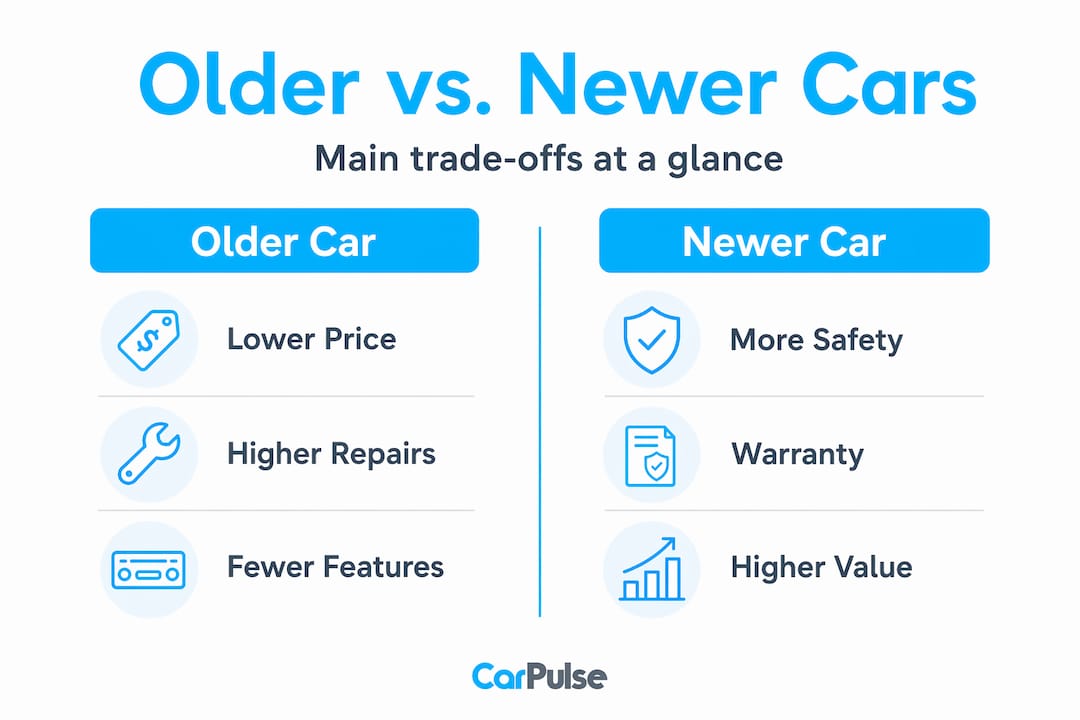
| Factor | Older car (7 or more years) | Newer car (3 to 5 years) |
|---|---|---|
| Purchase price | Significantly lower | Higher |
| Depreciation risk | Minimal further loss | Some remaining depreciation |
| Safety technology | May lack modern features | More current ADAS and safety systems |
| Maintenance cost | Higher, age-related items | Lower, often under warranty |
| Warranty coverage | Typically none | Possible remaining manufacturer warranty |
Newer cars carry factory warranties, modern safety systems, and the peace of mind that comes with fewer unknowns. They also depreciate faster from your purchase date. The car age impact on value runs in both directions. For a newer car, it means your asset loses value quickly. For an older car, that loss has largely already happened.
The smart approach is not to pick a side. It is to evaluate age, mileage, condition, and price as a package. A perfectly maintained eight-year-old car with documented service history, fresh tires, and a clean inspection report is often a better decision than a five-year-old car with unknown history and deferred maintenance.
My take on what most buyers get wrong about car age
I have looked at enough used car listings and heard enough post-purchase horror stories to say this clearly: most buyers treat age as a secondary filter, something they check after mileage and price. That is backwards.
In my experience, the most expensive surprises almost always come from age-related failures. Someone buys a 12-year-old car with 65,000 miles, assumes the low odometer means low risk, and then spends the first year replacing every rubber component in the engine bay plus the battery, all coolant hoses, and eventually a thermostat housing that cracked from age and heat cycling. None of that showed up in the mileage number.
What I have learned is that maintenance records tell you far more than the odometer ever will. A seller who hands you a folder of receipts is showing you something genuinely valuable. One who says “I always took good care of it” but cannot produce a single document is showing you something too.
The buyers who come out ahead are the ones who treat this as a multi-variable equation. Age, mileage, maintenance continuity, condition, and price all have to make sense together. When low mileage does not eliminate age-related failures, you need the inspection and the history report to fill the gap. Skip either one on an older car and you are gambling, not buying.
There is real value in older vehicles. You just have to know exactly what you are looking at before you commit.
— Henri
Find your next car on Carpulse
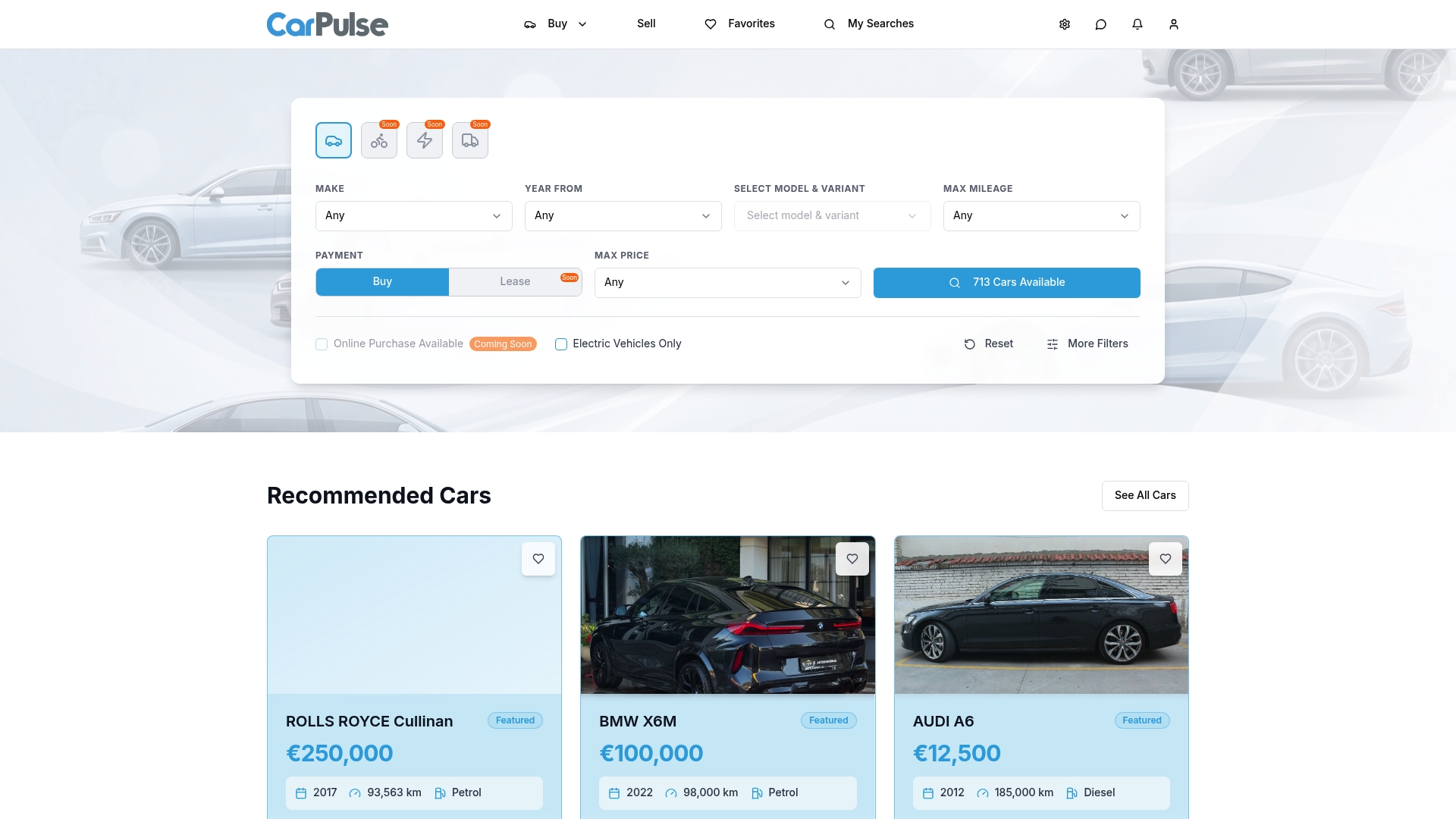
Carpulse is Albania’s largest car marketplace, and it is built specifically to help you filter by the variables that actually matter: year, mileage, price, fuel type, and condition. Whether you are targeting that 3 to 5 year sweet spot to avoid early depreciation or hunting for a well-maintained older vehicle with service history documentation, you can browse verified car listings and compare options side by side. Verified dealerships and private sellers both list through the platform, giving you access to a wide selection with seller accountability. If you are on the selling side, you can list your car on Carpulse using VIN-based listing that populates details automatically. Download the Carpulse app on iOS or Android and take the search with you.
FAQ
Why does car age matter beyond mileage?
Age causes material degradation in rubber seals, hoses, tires, wiring, and fluids regardless of how many miles the car has driven. A low-mileage older car can still require significant age-related maintenance.
What is the best age range to buy a used car?
Cars aged 3 to 5 years typically offer the best value. The steepest depreciation has already occurred, but the vehicle is still modern enough to have current safety features and manageable maintenance needs.
How does car age affect insurance costs?
Older cars generally cost less to insure because their market value is lower, reducing comprehensive and collision coverage costs. However, some insurers factor in increased mechanical risk for very old vehicles, which can offset those savings.
Should I always get an inspection on an older car?
Yes. For any car over five years old, a pre-purchase inspection by an independent mechanic is strongly advised. It surfaces age-related issues like cracked hoses, fluid leaks, and worn mounts that a test drive will not reveal.
How do I check if tires are too old?
Look for a four-digit code on the tire sidewall. The first two digits indicate the week of manufacture and the last two indicate the year. Replace any tires manufactured more than six years ago, regardless of remaining tread depth.
Recommended
- Udhëzues: Blerja e sigurt e një makine të përdorur në… | CarPulse Albania
- Provë me Makinë të Përdorur: Udhëzues i Plotë për Shqipërinë | CarPulse Albania
- Si të provoni një makinë të përdorur: udhëzues i plotë… | CarPulse Albania
- Blej Makina në Shqipëri: Udhëzuesi i Plotë | CarPulse.al | CarPulse Albania