
Guides
Car Lease Termination: A Practical Guide for Buyers and Deal
Car Lease Termination: A Practical Guide for Buyers and Dealers

Car lease termination means ending a vehicle lease before its scheduled end date. The moment you decide to exit early, three things should happen immediately: pull out your lease agreement and read the early-termination clause word for word, call or write your lessor to request a formal payoff statement, and note any disclosures required under the Consumer Leasing Act. That sequence matters because the lease’s own formula governs what you owe — not an estimate, not a phone quote.
What you’re likely facing once you start that process:
- Early-termination charge: calculated per the lease formula, often several thousand dollars
- Disposition fee: typically a few hundred dollars for vehicle remarketing
- Deficiency balance: the gap between payoff and any insurance or trade-in credit
- Possible mileage or damage penalties: assessed at vehicle return
Pro Tip: Request the payoff statement in writing, not just verbally. A written statement locks in the figure and gives you something to dispute if the final bill differs.
Table of Contents
- What does the Consumer Leasing Act require about early termination?
- What are your real options for ending a lease early?
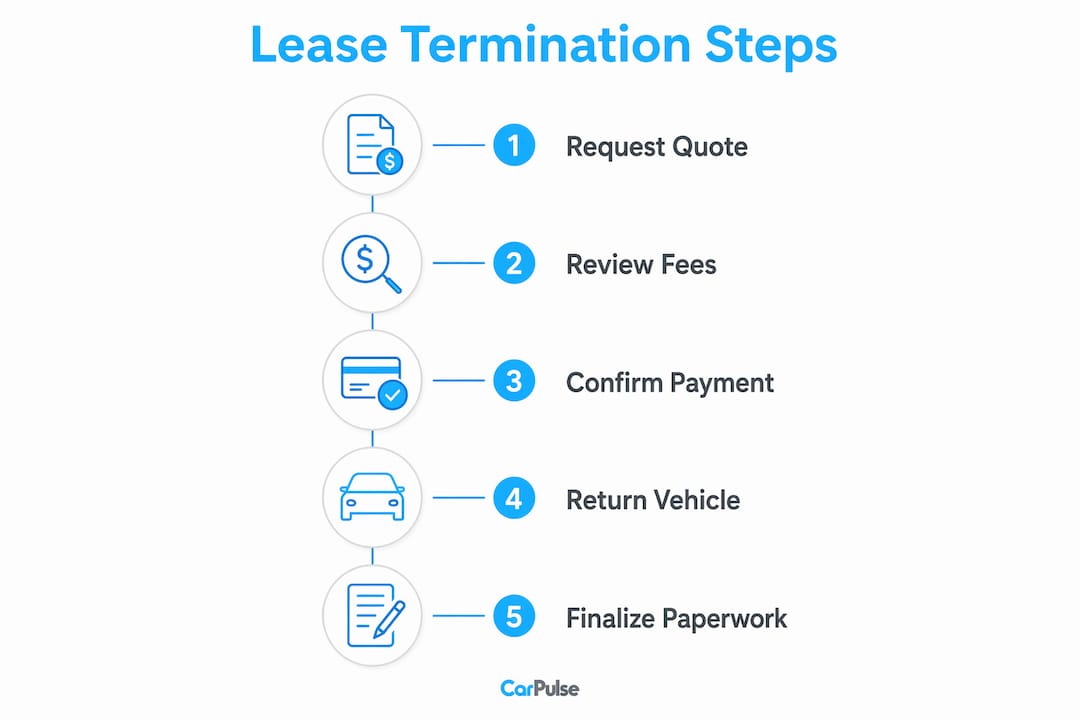
- How to terminate a lease early: a step-by-step checklist
- What happens when a lease ends involuntarily?
- How are early-termination fees calculated, and how long does the process take?
- What should dealers do when acquiring a returned leased vehicle?
- How can you reduce the cost of ending a lease early?
- Key Takeaways
- The part most guides skip
- Carpulse helps you list and research leased vehicles
- Useful sources and further reading
What does the Consumer Leasing Act require about early termination?
Under the Consumer Leasing Act, lessors must disclose how early-termination charges are calculated before you sign. That disclosure must describe the formula or method used to compute the charge, and explain how unearned rent charges are credited back to you. This is federal law, not a lender courtesy.
What the disclosure must include:
- The termination formula or a plain-language description of the calculation method
- How unearned rent (the finance portion of remaining payments) is rebated
- Any fees that apply regardless of when you terminate
Two calculation methods appear most often: the actuarial (constant-yield) method and a precomputed schedule. The actuarial method credits more interest back to you early in the lease; a precomputed schedule may credit less. The method used affects your payoff meaningfully, so confirm which one your lease uses before you do any math.
The practical takeaway: your lease document is the primary legal instrument. Regulatory disclosures increase your confidence that the lender’s math is correct — but you still need to verify each line item against the formula in your contract.
What are your real options for ending a lease early?
Three practical paths exist: lease transfer/assumption, early buyout, and voluntary surrender. A dealer trade-in is a variant of surrender with a partial offset. Each carries a different cost profile and credit impact.
| Exit Option | Up-Front Cost | Credit Impact | Time to Complete | Paperwork Burden | Deficiency / Gap Risk |
|---|---|---|---|---|---|
| Transfer/assumption | transfer fee generally under a few hundred dollars | Low (obligation transfers) | 2–6 weeks | Moderate (lessor approval, new lessee credit check) | Low |
| Early buyout | Full residual + fees | None (you own it) | 1–2 weeks | Low | None |
| Voluntary surrender | Remaining payments + disposition + deficiency | High (negative mark) | 1–3 weeks | Low | High |
| Dealer trade-in | Varies (equity offset) | Moderate | 1–2 weeks | Moderate | Moderate |
Transfer/assumption is usually the cheapest exit when your lessor allows it. You find someone to take over your lease; they pass a credit check; the lessor approves the swap. Transfer fees typically run from tens to a few hundred dollars, far less than the cost of surrendering outright. Third-party lease-takeover platforms can help you find a transferee, but they add their own listing and success fees on top of the lessor’s administrative charge — factor those in before you list.
Early buyout makes sense when the vehicle’s market value exceeds the contract residual. You pay the buyout price, own the car, and can sell it privately. No deficiency, no disposition fee.

Voluntary surrender is the most expensive option in most cases. You return the car, but you still owe the early-termination charge plus any deficiency between the vehicle’s wholesale value and your remaining balance. It hits your credit report hard.
Sample payoff components (what drives the termination number):
| Line Item | What It Represents |
|---|---|
| Remaining scheduled payments | All payments left on the lease |
| Unearned rent credit | Interest rebate for paying off early |
| Disposition fee | Remarketing/administrative charge |
| Excess mileage charge | Per-mile penalty ($0.15–$0.30/mile over limit) |
| Damage charges | Assessed at vehicle inspection |
| Security deposit credit | Refunded or applied against balance |
How to terminate a lease early: a step-by-step checklist
Follow this sequence to avoid surprises and protect yourself if a dispute arises later.
- Read the early-termination clause in your lease before you call anyone. Know the formula.
- Contact your lessor in writing — email or certified letter — to request a formal, itemized payoff statement.
- Ask about transfer/assumption explicitly. Not all lessors advertise it; some require you to ask.
- Compare your three options using the payoff figure: transfer vs. buyout vs. surrender. Run the numbers.
- Inspect the vehicle yourself before returning it. Fix minor damage (chips, small dents) if the repair cost is less than the likely damage charge.
- Document mileage and condition with timestamped photos on the day of return.
- Confirm all fees and taxes in writing before signing anything or making a payment.
- Get a final closing statement after the vehicle is returned and all charges are settled. Keep it permanently.
A few timing notes: payoff quotes are typically valid for 10–30 days, so don’t let one expire before you act. Security deposit refunds usually follow within 30–60 days of final settlement. If you’re pursuing a transfer, allow extra time for the new lessee’s credit approval — the whole process commonly takes two to six weeks depending on the path you choose.
Pro Tip: If financial hardship is driving the decision, call the leasing company before you miss a payment. Some lessors have discretionary accommodation programs that can defer payments or restructure terms temporarily.
What happens when a lease ends involuntarily?
Involuntary termination covers total loss, theft, and the death of the lessee. In all three cases, the lease does not simply disappear.
- Total loss or theft: your insurance pays the vehicle’s actual cash value, which is almost always less than the lease payoff. The deficiency balance — the gap between what insurance pays and what you owe — remains your responsibility unless you have gap coverage.
- Death of the lessee: leases generally do not cancel on death. The estate or cosigner remains liable for the remaining obligation unless the contract explicitly states otherwise.
- Gap coverage: if your auto insurance policy or the lease itself includes gap coverage, it pays the deficiency. Check your declarations page now, not after a loss.
Pro Tip: Request your insurer’s settlement statement as early as possible after a total loss. The sooner you have that figure, the sooner you can calculate the deficiency and determine whether gap coverage closes it.
How are early-termination fees calculated, and how long does the process take?
The final termination amount combines the adjusted lease balance plus disposition, damage, mileage, taxes, and unpaid charges, minus credits like your security deposit. Your lease must disclose the calculation method.
Typical process timeline:
- Request payoff statement (Day 1) — valid for 10–30 days
- Evaluate options and arrange transfer, buyout, or surrender (Days 3–14)
- Vehicle inspection and return (Days 7–21)
- Lessor processes paperwork and issues final statement (Days 14–42)
- Security deposit refund or deficiency demand issued (Days 30–60)
The payoff statement should itemize every component. If a line item looks wrong, ask for the calculation in writing and compare it to the formula in your lease. Errors happen, and you have the right to dispute them.
What should dealers do when acquiring a returned leased vehicle?
Dealers must verify payoff numbers, confirm title transfer conditions, and estimate reconditioning costs before listing. Acquiring a lease return without doing that math first is how dealers end up upside-down on a unit.
- Obtain the payoff statement directly from the lessor, not from the seller. Confirm the figure is current.
- Confirm lien release timeline: title transfer can take two to four weeks after payoff clears. Don’t promise a buyer a clean title before you have it.
- Inspect for lease-related penalties: excess mileage and wear charges affect your true acquisition cost.
- Estimate cost-to-resell: include reconditioning, any remaining disposition fees, and whether the unit goes to auction or your lot.
- Verify required disclosures: some states require disclosure of prior lease history on a used vehicle listing.
Carpulse’s VIN-based listing tool auto-populates vehicle data from the VIN, which reduces listing errors on returned lease vehicles where spec details matter for pricing. Verified dealer accounts on the platform also signal buyer trust from the first click.
Pro Tip: Factor the disposition fee and any potential deficiency into your acquisition offer before you commit. Document every communication with the lessor in writing — post-sale disputes over undisclosed charges are far easier to resolve when you have a paper trail.
How can you reduce the cost of ending a lease early?
Transfers and negotiated buyouts almost always cost less than voluntary surrender. That’s the starting point for any cost-reduction strategy.
- Confirm transfer eligibility first. Not all lessors allow it; verify in writing, not by assumption.
- Explore lease-transfer platforms to find a transferee faster, but compare total fees (platform + lessor) against your other options before committing.
- Request a hardship accommodation if you’re behind or about to fall behind. Lessors sometimes offer payment deferrals that buy time without triggering full early-termination charges.
- Get an independent appraisal if you suspect the lessor’s wholesale valuation is low. A higher realized value means a smaller deficiency.
- Consider waiting it out. If only three to four months remain on the lease, paying through to the end is often cheaper than paying early-termination charges plus a disposition fee.
Rolling negative equity into a new lease or loan to escape early is tempting but costly. You’re not eliminating the debt; you’re hiding it inside a new contract and paying interest on it for years.
Key Takeaways
Early lease termination triggers legally disclosed charges calculated by the formula in your lease — reading that formula before you act is the single most important step.
| Point | Details |
|---|---|
| Read the lease first | The termination formula in your contract governs what you owe — not a phone estimate. |
| Transfers beat surrender | Transfer fees ($75–$500) are far lower than full early-termination and deficiency charges. |
| Involuntary termination still costs | Insurance rarely covers the full payoff; gap coverage closes the deficiency. |
| Document everything | Timestamped photos, written payoff statements, and a final closing statement protect you from post-return disputes. |
| Carpulse for dealers | Carpulse’s VIN-based listings and verified dealer accounts help dealers list returned lease vehicles accurately and build buyer trust. |
The part most guides skip
Most early-termination articles treat the Consumer Leasing Act disclosure as a formality and move straight to the fee table. The disclosure is actually your most useful tool. If a lessor’s payoff calculation doesn’t match the method described in your lease, you have a documented basis to dispute it — and lessors know that. The practical power of reading your lease isn’t just knowing what you owe; it’s knowing when the number is wrong.
The other thing worth saying plainly: voluntary surrender is almost never the right move if you have any alternative. The credit damage is real, the deficiency can follow you for years, and the lessor’s wholesale valuation of your vehicle will almost always be lower than what you’d get from a private sale or a negotiated buyout. Surrender is the path of least resistance, not the path of least cost.
Carpulse helps you list and research leased vehicles
If you’re a dealer or private seller handling a returned leased vehicle, the hardest part after settling the payoff is getting the listing right. Inaccurate specs, missing history, or unclear condition notes slow down the sale and erode buyer trust.
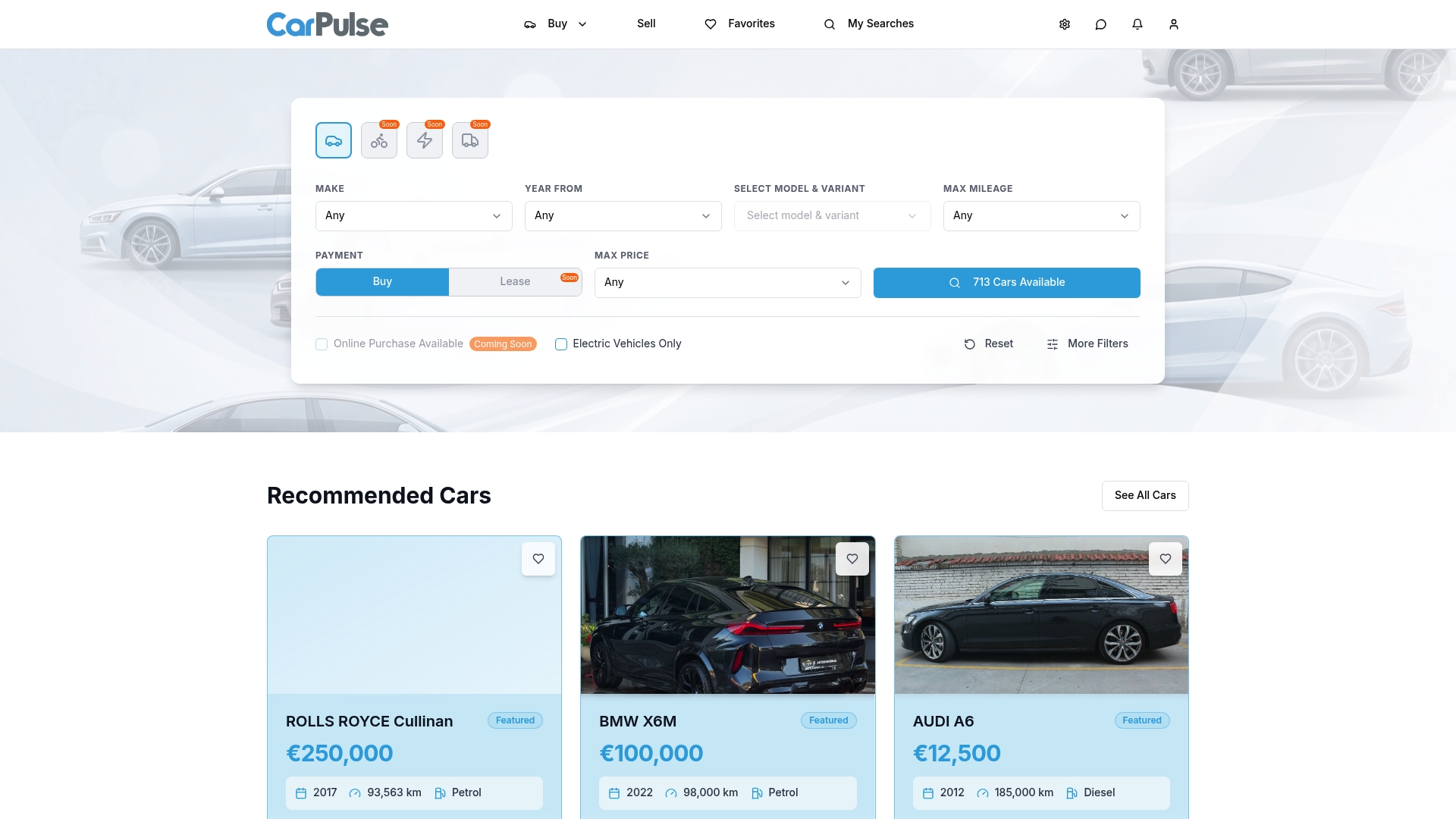
Carpulse’s VIN-based listing tool pulls vehicle data automatically the moment you enter the VIN, so you’re not manually entering trim levels or engine specs on a car you’ve had for 48 hours. Verified dealer accounts signal legitimacy to buyers browsing the marketplace. And if you need context on vehicle financing options before deciding whether to buy out or resell, Carpulse’s guides cover the mechanics in plain language.
Ready to list a returned leased vehicle or find a buyer? Browse the Carpulse marketplace and get your listing live today.
This article is general information, not legal or financial advice. Confirm current rules and your specific lease terms with a qualified professional or your lessor before making any termination decision.
Useful sources and further reading
- Consumer Leasing Act — Early Termination Disclosure (Federal Reserve)
- Involuntary Termination and Insurance (Federal Reserve)
- Early Termination Fees and Disclosures (LegalClarity)
- Canceling a Car Lease: Options and Penalties (LegalClarity)
- Turning In a Lease Early (Chase)
- How to Get Out of a Car Lease (Forbes Advisor)
- Getting Out of a Car Lease (Progressive)
- Early Lease Termination Explained (LeaseWorld)
Keep your original lease agreement and every written payoff statement. Those two documents are your primary evidence if any charge is disputed after the vehicle is returned.