Guides
What Is an Online Purchase Agreement for Car Buyers

What Is an Online Purchase Agreement for Car Buyers

TL;DR:
- An online vehicle purchase agreement, backed by the E-SIGN Act, is a legally binding contract requiring explicit electronic consent. It must include VIN, total price, contingencies, and a signed handover receipt to ensure enforceability. Using clickwrap acceptance, verified VIN auto-population, and escrow protections significantly reduce post-sale disputes.
An online purchase agreement is a legally binding contract that records every term of a vehicle sale executed through a website or app. Under the federal E-SIGN Act, electronic signatures and records carry the same legal weight as ink on paper, provided the buyer had a clear opportunity to review the terms and gave explicit, documented consent. For vehicle transactions, that means a clickwrap acceptance — an affirmative click or checkbox — is the standard courts expect, not a buried footer link.
Table of Contents
- Why does an online purchase agreement matter for car buyers and dealers?
- What must every vehicle online purchase agreement include?
- How do electronic acceptance and e-signatures work for vehicle contracts?
- What contingencies should a car purchase agreement cover?
- How does a purchase order or invoice differ from a purchase agreement?
- Practical tips before signing an online vehicle purchase agreement
- What U.S. state-level issues should buyers and dealers check?
- How do modern marketplaces use VIN-based auto-population to reduce errors?
- Before you sign: a quick checklist for online vehicle purchases
- Key Takeaways
- The purchase agreement is the only document that actually protects you
- Authoritative sources and further reading
Why does an online purchase agreement matter for car buyers and dealers?
The agreement is the single source of truth for the sale. When a dispute surfaces — say, a buyer discovers undisclosed body damage at delivery — the contract determines who bears the cost, what the remedy is, and how quickly it must be resolved. Without a written agreement, both sides argue from memory.
Here is why having one in writing matters:
- VIN and vehicle specs lock in exactly what was sold, preventing substitution or spec disputes.
- Total price and taxes prevent surprise fee additions after the buyer has committed.
- Inspection and financing contingencies give the buyer a legal exit if the car fails inspection or financing falls through.
- Delivery and handover protocol establishes condition at the moment of transfer, which is critical for hidden damage claims.
- Warranty or as-is status tells the buyer exactly what post-sale recourse they have.
Consider a common scenario: a buyer purchases a used SUV online, pays a deposit, and drives three hours to pick it up. At delivery, the front bumper has fresh damage not visible in the listing photos. If the purchase agreement includes a delivery receipt clause requiring a VIN-matched condition report at handover, the buyer has a documented basis to demand a repair credit or walk away with the deposit returned. Without that clause, the dispute stalls.
What must every vehicle online purchase agreement include?
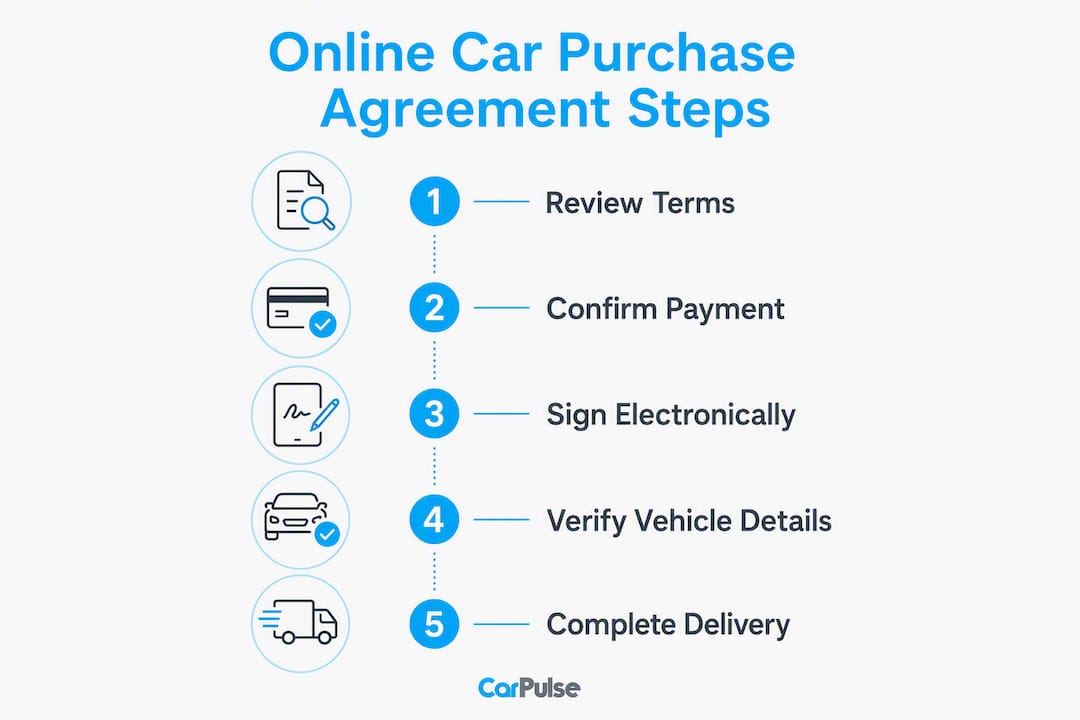
Certain items are non-negotiable for a vehicle contract. Missing even one of them can make the agreement unenforceable or leave a party with no remedy.
Vehicle identity and condition
- Year, make, model, trim, color, and VIN
- Current odometer reading (federal law requires odometer disclosure on most transfers)
- Known defects or damage disclosures
Financial terms
- Total purchase price, itemized
- Taxes, registration fees, documentation fees, and any dealer add-ons listed separately
- Deposit amount, how it is held, and conditions for return or forfeiture
- Payment schedule if not a single lump sum
Contingencies and title
- Financing contingency language with a clear deadline
- Inspection contingency with a defined window and remedy
- Title transfer obligations and lien release confirmation
- Registration responsibilities (buyer vs. seller)
Post-sale terms
- Warranty coverage or explicit “as-is” disclaimer — understanding what an as-is sale means before signing protects buyers from unexpected repair costs
- Delivery date, location, and handover receipt requirement
- Dispute resolution method and governing state law
Pro Tip: Look for contingency language that names a specific cure period (e.g., “seller has five business days to remedy a failed inspection item”) and a defined deposit-return mechanism. Vague language like “subject to inspection” with no remedy attached is nearly unenforceable.
For high-value transactions, purchase agreements that include payment schedules, contingencies, and dispute-resolution clauses are what separate a binding contract from a simple invoice.
How do electronic acceptance and e-signatures work for vehicle contracts?
Electronic acceptance is fully valid under the E-SIGN Act when two conditions are met: the user had a genuine opportunity to review the terms, and their consent was explicit and recorded. The medium — phone, tablet, desktop — does not affect enforceability. What matters is how the terms were presented.

Clickwrap vs. browsewrap
Clickwrap agreements require an affirmative action — checking a box, clicking “I Agree” — before the transaction proceeds. Courts consistently uphold them. Browsewrap agreements, where terms sit in a footer link and acceptance is assumed by site use, are far weaker. Courts often find them unenforceable, particularly when the user had no clear notice.
For a vehicle sale, the stakes are too high to rely on browsewrap. Dealers and marketplaces should require affirmative acceptance before taking any deposit.
What a solid audit trail looks like:
- Timestamped record of when the buyer accepted the terms
- Version of the agreement that was active at acceptance
- Copy of the signed agreement delivered to both parties
- Evidence of identity or payment authorization tied to the acceptance event
The FTC’s guidance on online commerce adds a transparency layer: material terms — price, fees, cancellation rights — must be clearly disclosed before the buyer commits, not buried in fine print after payment.
What contingencies should a car purchase agreement cover?
Contingencies define the buyer’s walk-away rights and the seller’s obligations. A contract without them is essentially a final sale with no exits, which is a serious risk for a $15,000–$50,000 asset.
Common contingencies:
- Pre-delivery inspection by a buyer-chosen mechanic
- Financing approval within a stated number of days
- Clear title and lien release confirmation before funds transfer
- Odometer disclosure matching the listing
- Emissions or safety compliance where state law requires it
How remedies typically work:
- Inspection failure: Seller has a defined cure period to repair or adjust the price. If unresolved, buyer receives deposit back in full.
- Financing denial: Buyer provides written denial from lender within the contingency window; contract terminates and deposit is returned.
- Title problem: Seller must clear the lien or defect within an agreed timeframe. If they cannot, the contract terminates without penalty to the buyer.
- Odometer discrepancy: Buyer may rescind the contract or negotiate a price adjustment based on the actual mileage.
A financing denial handled contractually is straightforward when the language is clear. The buyer submits the lender’s denial letter, the contingency period has not expired, and the deposit returns within a stated number of days. Without that clause, dealers sometimes treat deposits as non-refundable regardless of the reason.
How does a purchase order or invoice differ from a purchase agreement?
A purchase order or invoice often records intent or payment, but it is not the full legal purchase agreement. Confusing the two is one of the most common mistakes buyers make in online vehicle transactions.
| Document | Typical purpose | Contingencies | Signatures required | Binding? |
|---|---|---|---|---|
| Purchase order (PO) | Initiates the sale; records buyer intent and deposit | Rarely included | Often unsigned or one-party | Partial — may bind deposit only |
| Invoice | Records payment or amount owed | None | Usually none | Payment record only |
| Purchase agreement | Full contract governing the sale | Yes — inspection, financing, title | Both parties required | Yes — full legal obligation |
Many marketplaces send an order confirmation email the moment a buyer clicks “purchase.” That email is not the purchase agreement. For title transfer and registration, most states require a separately signed contract. Always verify whether the platform’s confirmation step constitutes the binding agreement or whether a follow-up document is required.
Practical tips before signing an online vehicle purchase agreement
A short pre-sign checklist prevents the most common disputes. Run through it before you click “I Agree” on anything.
Do:
- Verify the VIN against the physical vehicle or a vehicle history report
- Request a full copy of the signed agreement before or immediately after signing
- Confirm who currently holds the title and whether any liens are recorded
- Use escrow or a dealer-held deposit account for larger transactions to protect deposit funds.
- Verify the dealer’s license number through your state’s motor vehicle authority
Don’t:
- Wire funds directly to a private seller without escrow protection
- Accept verbal promises about repairs or included accessories — get them in writing
- Sign without a defined inspection window, even for a “certified” vehicle
Red flags that should pause any signing:
- No VIN listed or VIN that does not match the vehicle description
- Vague delivery terms with no date or location
- Inspection window of less than 24 hours
- Price breakdown that changes between the listing and the contract
- No electronic signature record or timestamped acceptance
Pro Tip: For any transaction above $5,000, ask the dealer or marketplace to hold the deposit in a designated escrow or trust account until the contingency period clears. A bill of sale is a useful companion document but does not replace the full purchase agreement.
What U.S. state-level issues should buyers and dealers check?
Post-sale obligations vary significantly by state, and those differences affect timing, cost, and paperwork requirements. Federal law governs e-signature validity; state law governs everything that happens after the contract is signed.
Check by state:
- Title transfer process and the number of days allowed to complete it
- Whether the state requires an original wet signature on the title assignment or accepts electronic transfer
- Lien recording rules and how quickly a lien release must be filed
- State-specific lemon law protections and whether they apply to used vehicles
- Implied warranty rules for dealer sales (many states prohibit “as-is” disclaimers for dealers in certain circumstances)
- Motor vehicle agency requirements for out-of-state purchases
State DMV requirements for title and registration frequently require original or specifically formatted title assignments that online steps alone cannot replace. Texas, for example, requires a completed Form 130-U for every vehicle title transfer, regardless of whether the sale was conducted online.
Pro Tip: Before finalizing any online vehicle purchase, visit your state’s DMV website or call the motor vehicle agency directly. Ask specifically whether an electronically signed purchase agreement satisfies title transfer requirements or whether a notarized document is needed.
How do modern marketplaces use VIN-based auto-population to reduce errors?
VIN-based auto-population and clear clickwrap acceptance steps materially reduce post-sale disputes. When a seller enters a VIN on a platform like Carpulse, the system automatically pulls year, make, model, trim, and engine data from the vehicle database. That eliminates the most common source of specification errors: manual entry mistakes.
What this means in practice:
- The purchase agreement is pre-populated with verified vehicle data, reducing the chance of a mismatch between listing and contract
- Title paperwork reflects the correct VIN from the start, speeding up registration
- Both buyer and seller have a consistent record that matches the physical vehicle
Pro Tip: Always ask the marketplace for the versioned, signed contract and the handover delivery receipt that includes the VIN and a condition description. That receipt, signed at delivery, becomes a contract addendum and is your primary evidence in any post-delivery dispute.
Carpulse’s VIN-based listing process automatically populates vehicle details, which means the data that flows into the purchase agreement starts from a verified source rather than a seller’s memory.
Before you sign: a quick checklist for online vehicle purchases
Use this before accepting any online vehicle purchase contract, whether you are a private buyer or a dealer.
- VIN confirmed and matches the physical vehicle or history report
- Full price breakdown reviewed: base price, taxes, fees, and add-ons itemized
- Inspection contingency present with a defined window and remedy
- Financing contingency included with a clear deadline and deposit-return terms
- Title status confirmed: no open liens, title in seller’s name
- Delivery date, location, and handover receipt requirement stated
- Signed copy of the agreement requested and received
- Governing state law and dispute resolution method identified
- Dealer license or seller identity verified
- Escrow or deposit protection confirmed for transactions above $5,000
Key Takeaways
An online purchase agreement is legally binding under the E-SIGN Act when the buyer gives explicit, documented consent and the agreement includes VIN, full price, contingencies, and a signed delivery receipt.
| Point | Details |
|---|---|
| Legal enforceability | E-SIGN Act makes electronic vehicle contracts valid; clickwrap acceptance is the enforceable standard. |
| Clickwrap over browsewrap | Affirmative acceptance before payment is far stronger in court than a footer link. |
| Non-negotiable elements | VIN, total price, taxes, contingencies, title transfer terms, and as-is or warranty status must all be present. |
| Escrow for deposits | Use escrow or dealer-held accounts for transactions above $5,000 to protect deposit funds. |
| Delivery receipt matters | A signed handover receipt with VIN and condition notes is your primary evidence for post-delivery disputes. |
The purchase agreement is the only document that actually protects you
Most buyers focus on the price negotiation and treat the contract as paperwork. That is the wrong order of priorities. The agreement is where your rights live. A great price on a car with a vague or missing inspection contingency can cost you far more than you saved if the vehicle has undisclosed problems.
The marketplace practices that matter most are not cosmetic. VIN auto-population, versioned signed agreements, and mandatory clickwrap acceptance before any money moves are not just conveniences. They are the mechanisms that make a contract defensible. Platforms that skip those steps are transferring risk onto buyers and dealers who probably do not realize it.
The signed delivery receipt deserves more attention than it gets. Most disputes about hidden damage or missing equipment come down to one question: what was the condition of the vehicle at the moment it changed hands? A receipt signed by both parties at delivery, with the VIN and a condition description, answers that question. Without it, both sides argue from photos and memory.
Authoritative sources and further reading
These sources cover the legal framework, contract standards, and marketplace practices referenced throughout this article.
- E-SIGN Act (Public Law 106–229) — The federal statute that grants legal validity to electronic signatures and records in U.S. commerce, including vehicle sales.
- FTC guidance on online advertising and marketing — Covers transparency and disclosure requirements for online sellers, including material terms that must be presented before a buyer commits.
- Legal Information Institute — Contract — Cornell Law’s plain-language overview of contract formation, offer, acceptance, and consideration as they apply to purchase agreements.
- Goodwin Law — online contract enforceability — Analysis of recent court decisions on clickwrap vs. browsewrap enforceability.
- ICC Model Online B2C General Conditions of Sale — International Chamber of Commerce guidance on pre-contractual disclosures and consumer protections that online sellers should adapt to their jurisdiction.
- Texas DMV — title and registration — Example of state-level title transfer requirements; check your own state’s motor vehicle agency for local rules.
- Carpulse vehicle marketplace — Browse verified listings with VIN-based auto-population, or list your vehicle using Carpulse’s guided seller flow.
This article is general information, not legal advice. Confirm current rules with your state’s motor vehicle authority or a qualified attorney before completing a vehicle transaction.
Recommended
- Blerja Online e Makinave në Shqipëri: Rritje EV 12% në 2026 | CarPulse Albania
- Blerja e Makinave Online në Shqipëri: Rritja e EV-ve 2026 | CarPulse Albania
- Blerja e makinave online në Shqipëri: Rritje 12% e EV në… | CarPulse Albania
- Blerja online e makinave në Shqipëri: 12% rritje e EV në… | CarPulse Albania