
Guides
Calculate Albania's 20% VAT on Used Cars Before You Wire...
Calculate Albania’s 20% VAT on Used Cars Before You Wire Money
If you import a used car into Albania, expect to pay 20% TVSH on the customs value, not necessarily the price on your invoice. Customs can and does adjust that value using reference bulletins when your paperwork looks thin. The one big exception: new electric cars clear at 0% TVSH, a policy still active since 2020. Everything else, from private sales to dealer invoices, gets taxed the same way at the border.
TL;DR:
- Customs will adjust the taxable value based on market reference bulletins, often applying a floor price higher than the invoice for used cars.
- New electric cars are exempt from VAT at customs since 2020, but only if proper documentation proves their “new” status with low mileage and first registration.
- The 20% VAT applies to the customs value, which includes the invoice price plus freight, insurance, and accessories, and is calculated at the border regardless of seller type.
- Preparing thorough documentation, such as original invoices, payment proof, and vehicle history, significantly reduces the risk of disputes and delays during customs clearance.
- Buyers from private sellers or EU dealers must still pay VAT, as import VAT rules are not affected by local invoice or margin schemes, only valid export and zero-rating paperwork can exempt from VAT.
Table of Contents
- Tvsh Për Makina Të Përdorura: The Legal Basis and Taxable Base
- How Does Customs Set the Reference Value for Used Cars?
- What Exceptions Exist to Used Car VAT Rules?
- How Do You Calculate TVSH on an Imported Used Car?
- What Documents Do You Need for Customs Clearance?
- Buying From a Private Seller vs. a Dealer: What Changes?
- What CarPulse Buyers Should Know Before Importing
- Where to Verify Current TVSH Rules
- Why the Real Risk Isn’t the 20% Rate
- Sources
Tvsh Për Makina Të Përdorura: The Legal Basis and Taxable Base
Albania’s standard VAT rate applies at 20% on imports, cars included, and that figure comes straight from the Drejtoria e Përgjithshme e Tatimeve. The tricky part isn’t the rate. It’s the base you multiply it against.
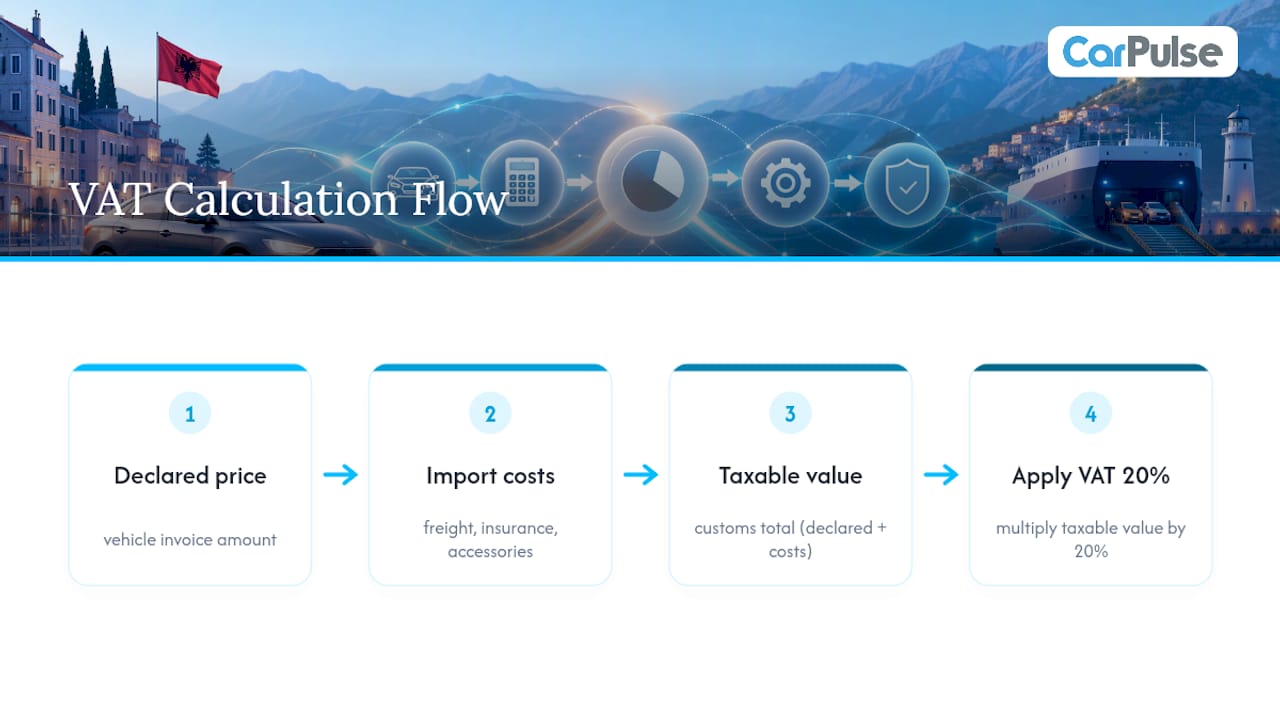
TVSH is calculated on the customs (taxable) value, not whatever number sits on your purchase receipt. That taxable value typically bundles the vehicle’s declared price with freight, insurance, and any accessories or associated costs tied to getting the car to Albania. If your invoice omits shipping or handling fees that customs believes belong in the total, expect those added back in before the 20% gets applied.
Responsibility for paying rests with the importer, meaning the person or clearing agent physically bringing the car through customs. Tatime’s own guidance makes clear this liability isn’t something you can privately contract away. Even if a seller abroad promises to “handle the tax,” the legal obligation sits with whoever declares the vehicle at the Albanian border.
How Does Customs Set the Reference Value for Used Cars?
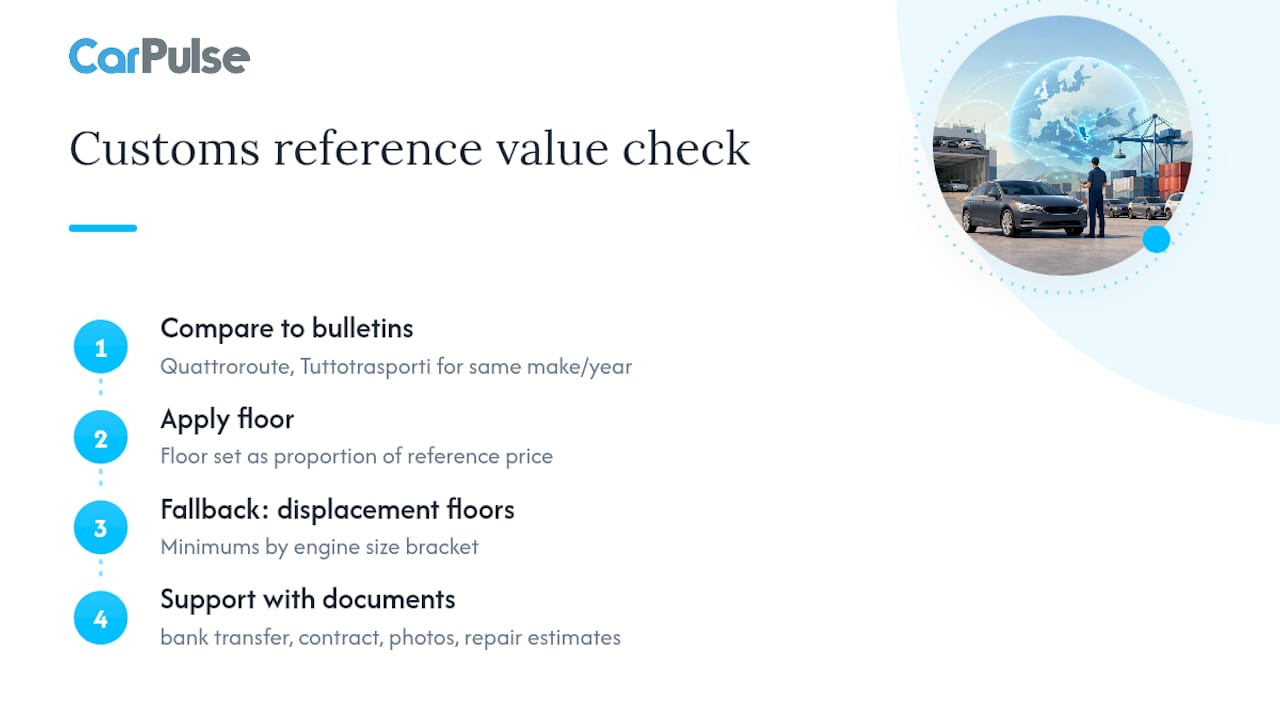
This is where most buyers get an unpleasant surprise. Albanian customs doesn’t just take your word for what the car cost. Officers cross-check declared prices against market reference publications like Quattroroute, a widely used Italian vehicle pricing bulletin, alongside similar sources such as Tuttotrasporti.
When your invoice comes in noticeably lower than what these bulletins list for a comparable make, model, year, and mileage, customs applies a floor. Recent guidance set that floor at a proportion of the reference price, higher than a previous threshold, according to coverage on the new clearance tariffs. Practically, that means even a legitimately cheap purchase, a car with hail damage or a salvage history, can get taxed as if you paid closer to full market price.
If no direct reference exists for your specific vehicle, customs falls back on minimum floor values organized by engine displacement category. A 1.6 liter diesel gets slotted into its own bracket regardless of condition or mileage.
Your best defense is documentation. Bank transfer records, the original sales contract, and photos or repair estimates showing why the car sold below market value all strengthen your case if customs flags the declaration for review. Buyers who show up with only a handwritten receipt rarely win that argument.
What Exceptions Exist to Used Car VAT Rules?
New electric passenger vehicles get a real break: since 2020, Albania has exempted them from TVSH at customs entirely, a policy the Drejtoria e Përgjithshme e Doganave credits with boosting EV imports. The catch is proving “new” status. Customs will want documentation confirming low mileage and a first registration date that supports the claim, so don’t assume a lightly used EV automatically qualifies.
Don’t confuse this with EU dealer margin schemes, either. Some EU countries let dealers charge VAT only on their profit margin for used vehicles, a mechanism explained in UK guidance on the margin scheme. That system governs sales within the EU. It has no bearing on what you owe Albanian customs. If a dealer claims the car is “VAT free” because of a margin scheme, get the export documentation in writing, because Albanian customs will still assess TVSH on import unless proper zero-rating paperwork accompanies the vehicle.
How Do You Calculate TVSH on an Imported Used Car?
Here’s a worked example using round numbers so you can follow the math on your own purchase.
- Start with the invoice price. Say you’re buying a used sedan in Germany for €8,000.
- Add freight and insurance. Shipping and marine insurance run roughly €600, bringing your subtotal to €8,600.
- Check against the reference value. If Quattroroute lists comparable cars at €11,000, the customs floor sets your minimum taxable base at a set proportion of the reference price, slightly above your actual cost.
- Convert to Lek. Using an exchange rate of roughly 100 Lek per euro (rates fluctuate, so check the Bank of Albania’s daily rate), €8,800 becomes approximately 880,000 Lek.
- Apply the 20% TVSH rate. That gives you a VAT bill of 176,000 Lek.
- Add remaining costs. Registration fees, customs administrative charges, and any inspection fees stack on top of the VAT figure, so budget separately for those.
Local tools like the AutoPazar customs calculator let you plug in engine size and estimated value for a quick estimate before you commit to a purchase. For a fuller breakdown of total landed costs when importing specifically from Germany, CarPulse’s guide on importing from Germany walks through country-specific paperwork quirks worth knowing before you wire any money.
What Documents Do You Need for Customs Clearance?
Show up with incomplete paperwork and you invite a reassessment. The core documents customs expects:
- Original invoice or sales contract showing the agreed price
- Bill of lading or transport documentation proving how the car reached Albania
- Proof of payment, ideally a bank transfer record rather than cash receipts
- Vehicle registration and ownership documents from the country of origin
- Export deregistration papers if the seller’s country requires them
Once the car arrives, customs inspects the vehicle and paperwork, sometimes granting provisional release while final value assessment continues. If you disagree with the assessed value, you can formally request a reassessment or appeal, though this takes time and usually requires additional comparables.
Pro Tip: Gather more evidence than you think you need before you ship the car, not after. A VIN history report, timestamped bank transfer confirmations, and even screenshots of comparable listings at time of purchase give you a paper trail that’s much harder for customs to dispute than a bare invoice.
CarPulse’s guide on safely buying a used car in Albania covers additional verification steps worth running before you finalize any purchase abroad.
Buying From a Private Seller vs. a Dealer: What Changes?
The scenario you’re in changes what to watch for, even though the 20% rate itself doesn’t move.
Buying from a private seller abroad means you, the importer, pay TVSH at the border. Private sellers typically don’t charge VAT on their side, so don’t expect an invoice with tax already included, and don’t assume that absence means you’re exempt.
Buying from a VAT-registered EU dealer can get confusing. The invoice might show a net price, a price with local VAT baked in, or a margin-scheme price. None of that changes your Albanian obligation. Unless the dealer provides proper export and zero-rating documentation, budget for TVSH on the full customs value regardless of what the invoice says.
Non-EU imports historically carry additional duties beyond VAT, but for most buyers the 20% TVSH on customs value remains the immediate, unavoidable cost to plan around first.
CarPulse’s guide to buying a used car in Albania breaks down these scenario differences in more detail if you’re weighing multiple purchase sources.
What CarPulse Buyers Should Know Before Importing
Preparing accurate paperwork before you ship a vehicle beats fighting a reassessment after it lands; for detailed practical steps and legal responsibilities, see how to import a classic car to the U.S., finish paperwork first. Some online marketplaces provide VIN-based listing data giving buyers a documented vehicle history that mirrors what customs wants to see: confirmed mileage, registration timeline, and ownership record.
Before agreeing to any purchase, ask the seller for the full invoice, export paperwork, and, where available, a VIN history report. Buyers who arrive at customs with that trio in hand tend to clear faster and dispute assessed values less often than those relying on a single handwritten receipt. CarPulse’s export and import guide for cars from Italy shows what a complete document set looks like in practice.
Where to Verify Current TVSH Rules
Check the Tatime VAT page and Dogana’s EV exemption notice before importing. Rules shift, and official pages catch changes faster than secondhand summaries. CarPulse’s used car buying guide rounds out the practical side.
Why the Real Risk Isn’t the 20% Rate
The rate is fixed, published, and easy to look up. What catches people off guard is the base it’s multiplied against, and that’s the part conventional advice glosses over.
That’s not how it works in practice. Buyers who skip building a paper trail, bank transfers, comparable listings, condition photos, are the ones who end up disputing assessments for weeks after the car already sits in a customs yard.
If there’s one thing worth prioritizing over everything else in this guide, it’s this: treat documentation as part of the purchase price, not an afterthought. A car that’s €500 cheaper but comes with zero paper trail can cost you more in delays and reassessment risk than one bought at fair market value with a clean invoice and transfer record.
— Henri