Guides
Low mileage cars: boost reliability and resale value
Low mileage cars: boost reliability and resale value
TL;DR:
- In Albania, low-mileage cars under 100,000 km are highly valued for reliability and resale, but condition and service history matter most. Fewer kilometers generally mean less wear on vital components, reducing future repair costs, though prolonged inactivity can pose hidden risks. Buyers should prioritize maintenance records and thorough inspections over odometer readings alone to ensure accurate assessments.
When buying a used car in Albania, most people focus on whether the engine “sounds right” or whether the price fits the budget. But here’s the thing: a well-maintained exterior and a smooth test drive can mask thousands of euros in future repair bills. Low mileage vehicles retain higher resale value due to less wear and greater perceived longevity, which means your decision at the dealership today shapes both your ownership experience and what you can sell the car for tomorrow. This guide gives you a clear, evidence-based framework for finding, evaluating, and choosing a low-mileage vehicle in the Albanian market.
Table of Contents
- What is considered low mileage in Albania?
- The reliability advantage: Why fewer kilometers matter
- Resale value: How low mileage maximizes your return
- Maintenance history vs. mileage: What matters more?
- Hidden risks: When low mileage isn’t always best
- Our take: the real value of low mileage in Albania
- Find low mileage cars on CarPulse
- Frequently asked questions
Key Takeaways
| Point | Details |
|---|---|
| Lower risk of repairs | Low-mileage cars are less likely to have worn parts, reducing breakdown risk. |
| Higher resale value | Cars with fewer kilometers keep more of their value when you sell in Albania. |
| Pay a premium, get reliability | You may pay more for low mileage, but the peace of mind typically justifies the cost. |
| Maintenance over mileage | A documented service history can sometimes matter more than the odometer number. |
| Beware storage damage | Ultra-low mileage from long-term storage can mean hidden issues—always check thoroughly. |
What is considered low mileage in Albania?
With myths aside, let’s clarify what exactly counts as low mileage in the Albanian used car market.
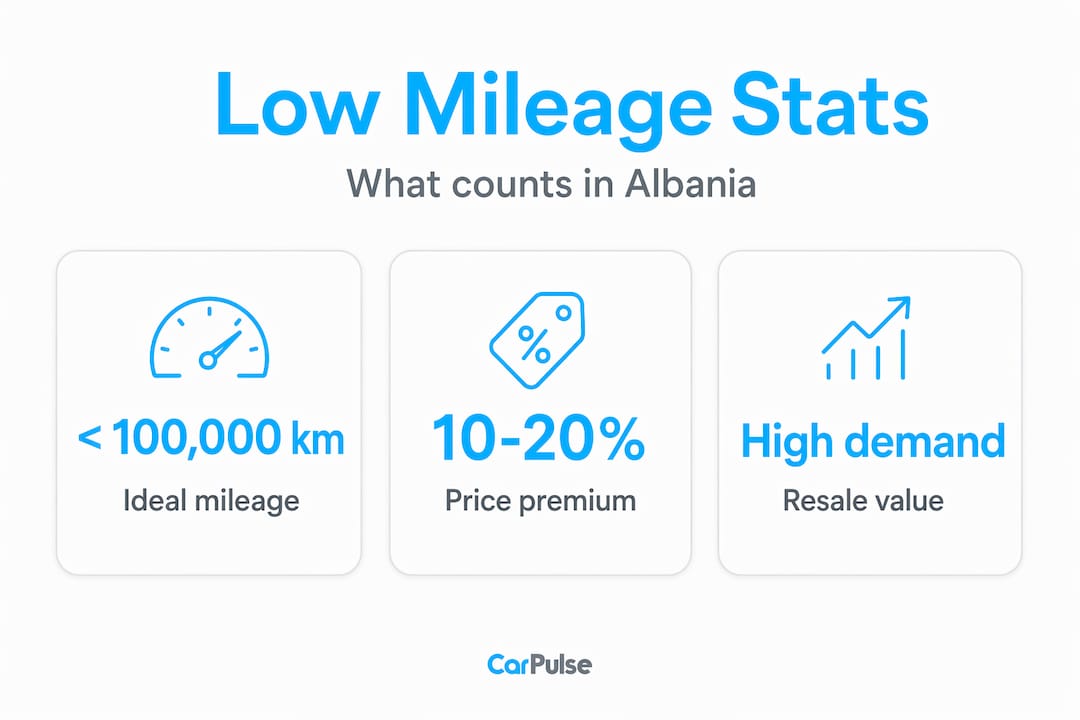
In most European markets, “low mileage” typically means a car has traveled fewer than 150,000 kilometers. But in Albania, the practical benchmark sits lower. Most Albanian buyers and dealers treat under 100,000 km as the sweet spot for mainstream models. For premium or luxury vehicles, that threshold drops even further, often to 80,000 km or less.
Why does Albania differ from, say, Germany or Italy? Three main reasons: road conditions, import habits, and buyer psychology. Albanian roads, particularly outside Tirana, put more stress on suspension and drivetrain components than comparable European highway driving does. A car with 120,000 km of Albanian road use has absorbed far more mechanical punishment than one with the same odometer reading from Western Europe. That reality shapes how buyers here evaluate mileage numbers.
Albania also imports a large share of its used vehicles from Germany, Italy, and Japan. Used car price factors like import origin, service history, and accident records all feed into the mileage story. A Japanese import with 85,000 km of urban highway driving often commands a higher price than a similarly aged Italian car with the same reading, precisely because Albanian buyers understand that context matters.
Here’s a quick reference for low-mileage expectations by vehicle segment:
| Vehicle segment | Low mileage threshold | Ideal sweet spot |
|---|---|---|
| Compact / economy cars | Under 100,000 km | 50,000 to 80,000 km |
| Mid-size sedans | Under 120,000 km | 60,000 to 90,000 km |
| SUVs and crossovers | Under 130,000 km | 70,000 to 100,000 km |
| Luxury vehicles | Under 80,000 km | Under 60,000 km |
| Diesel workhorses | Under 150,000 km | 80,000 to 120,000 km |
The models Albanian buyers favor most also shape how mileage is interpreted. Popular models like the Toyota Corolla and Mercedes E-Class are known for reliability even at higher mileage, but low mileage enhances resale, making them competitive even against newer German alternatives. When you’re looking at a Corolla with 70,000 km, you’re buying years of worry-free driving. That peace of mind is baked into the price, and rightly so. When buying a used car safely in Albania, mileage is the first filter, not the last.
The reliability advantage: Why fewer kilometers matter
Now that you know what qualifies as low mileage, let’s break down how fewer kilometers translate into genuine mechanical reliability.
Every kilometer a car travels wears something. It sounds obvious, but most buyers don’t think about which parts are affected and how quickly. Low mileage indicates less wear on engine, transmission, and suspension, leading to higher reliability and lower repair risk. In practical terms, that means fewer surprise bills.
Here’s how the kilometers stack up against your wallet:
- Engine wear begins from the first ignition. By 100,000 km, piston rings and valve seals show measurable wear. Under 80,000 km, most engines are still well within their peak operating window.
- Transmission stress accumulates with every gear change and every hill climb. Automatic transmissions in particular are expensive to rebuild, easily running 600 to 1,200 euros for a full overhaul.
- Suspension components including ball joints, shock absorbers, and control arm bushings absorb every pothole and rough road. Albanian roads accelerate this wear significantly. Low-mileage vehicles have simply hit fewer of them.
- Brake systems wear proportionally to use. Rotors and calipers on a 60,000 km vehicle are almost always in better shape than the same parts on a 180,000 km one, even if the latter has had one recent replacement.
- Cooling and fuel systems degrade with heat cycles. Fewer kilometers means fewer heat cycles, which translates directly to a longer lifespan for radiator hoses, fuel injectors, and water pumps.
“A low-mileage car is not just a newer-feeling car, it is a statistically safer financial bet. You’re buying fewer unknown repair events before they happen.”
Low-mileage cars carry a 10 to 20% price premium in the Albanian market. Think of that not as an extra cost but as pre-paid insurance. For a car priced at 8,000 euros, a 15% premium means paying 9,200 euros. If that extra 1,200 euros saves you from one major transmission repair, you’ve already broken even before the first year ends. When you stack reliability across three to five years of ownership, the math shifts heavily in favor of the lower-mileage vehicle.
Pro Tip: Even if the odometer reads impressively low, don’t skip a pre-purchase inspection (PPI). Infrequent use creates its own set of problems. Garage rot, degraded rubber seals, and flat-spotted tires are all common on cars that sat for long stretches between drives. Low usage is not the same as good condition. For fuel-efficient cars with complex hybrid systems, this is especially true.
Resale value: How low mileage maximizes your return
Reliability is only part of the equation. A low-mileage car also means more money in your pocket down the road. Here’s how.
Albanian buyers are notoriously mileage-sensitive. When you list a car for sale and it sits under 100,000 km, the pool of interested buyers is larger and offers come in faster. Low mileage boosts resale precisely because buyers trust the odometer as a shorthand for overall vehicle condition, even when that trust is imperfect.

Look at how depreciation plays out differently across mileage brackets:
| Mileage bracket | Typical annual depreciation | Resale demand in Albania |
|---|---|---|
| Under 80,000 km | 8 to 10% per year | Very high |
| 80,000 to 130,000 km | 12 to 15% per year | High |
| 130,000 to 180,000 km | 18 to 22% per year | Moderate |
| Over 180,000 km | 25%+ per year | Low |
Low-mile cars are 10 to 20% pricier to buy, but they also hold their value far longer. In Albania’s diesel market specifically, that premium reaches the higher end of the range because buyers factor in ongoing fuel savings over the life of ownership. A low-mileage diesel that gets 20 km per liter is genuinely worth more than a high-mileage version of the same car, even at a premium price. You can explore key used car pricing factors to understand what else drives those numbers up or down.
Models that command the strongest resale premium when mileage is low:
- Toyota Corolla (under 80,000 km): Commands top resale in its class, consistently.
- Mercedes E-Class (under 100,000 km): Buyers pay significantly more for a clean, low-km example.
- Volkswagen Golf (under 90,000 km): One of Albania’s most traded vehicles; low km examples sell within days.
- BMW 3 Series (under 80,000 km): High demand but buyers are very sensitive to mileage given repair costs.
- Skoda Octavia (under 120,000 km): A practical family car where low km translates directly into higher asking prices.
The pattern is consistent: the more expensive a car is to repair, the stronger the mileage premium. Albanian buyers have learned this the hard way, and it drives decision-making at every price point.
Maintenance history vs. mileage: What matters more?
Low mileage is great, but it’s not everything. For some buyers, the right service history can outweigh the odometer reading.
This is where nuance separates smart buyers from impulsive ones. Maintenance history often matters more than raw mileage. A well-maintained Toyota with 160,000 km can be a far safer buy than a neglected version of the same model sitting at 70,000 km. The engine on the high-mileage car has been fed clean oil and timely service. The low-mileage one may have spent years on degraded fluids and skipped intervals.
Experts note that for reliable brands like Toyota and Honda, documented high-mileage examples are sometimes a cheaper and smarter buy than low-mileage alternatives from less reliable manufacturers. That’s a real trade-off worth understanding.
When you inspect any used car, these are the records you absolutely need to check:
- Oil change history: Regular changes, ideally every 10,000 to 15,000 km, indicate an owner who took care of the engine.
- Timing belt or chain replacement: A missed timing belt service can destroy an engine in seconds. Confirm it was done on schedule.
- Brake and fluid servicing: Brake fluid absorbs moisture over time and should be replaced regularly. Neglected fluid is a safety and cost issue.
- Transmission service records: Especially critical for automatics, where fluid and filter changes are often skipped by careless owners.
- Cooling system maintenance: Radiator flushes and thermostat replacements prevent overheating, which is one of the most destructive events an engine can experience.
Pro Tip: A full, stamped maintenance booklet adds more real-world value than any “fresh import” sticker. Importers often use the “fresh import” angle to distract buyers from the absence of a service record. If there’s no booklet, ask for alternative proof. If there’s neither, treat that as a serious red flag regardless of what the odometer says. A guide for first-time buyers covers this in detail for the Albanian context.
Hidden risks: When low mileage isn’t always best
To round things out, let’s consider the other side: when low mileage can actually be a red flag if you’re not careful.
It seems counterintuitive. How can fewer kilometers be a problem? The answer lies in what happens to a car that sits unused for long periods. Long-term garaging creates its own category of risk: dried-out seals, battery failure, degraded brake fluid, and rusted rotors from moisture exposure. These issues won’t show on a visual inspection and won’t appear on the odometer, but they can cost real money to fix.
Consider a car that’s been parked in a garage for three years with only 40,000 km on the clock. On paper, it sounds ideal. In reality, the rubber fuel lines may have cracked internally, the brake pads may have fused lightly to the rotors, and the battery is close to dead. Tires, even unused ones, have a lifespan measured in years rather than kilometers, and a 6-year-old tire with low tread wear is still a safety concern. You can learn more about risks of prolonged storage to understand how inactivity affects a vehicle over time.
Warning signs to watch for when viewing a very low-mileage vehicle:
- No continuous service history: Long gaps between oil changes suggest the car sat idle.
- Stiff or cracked rubber seals: Check door seals, engine bay hoses, and suspension boots.
- Uneven tire wear or old date codes: Tire date codes (the last four digits of the DOT number on the sidewall) reveal when the tire was manufactured. Anything over six years is suspect.
- Corrosion in unexpected places: Rust on brake rotors, calipers, or underneath the chassis indicates extended sitting.
- Battery warning signs: A weak crank or electrical glitches suggest a battery that has been repeatedly drained from non-use.
- Interior odors: Musty smells can indicate moisture intrusion from sitting in a poorly ventilated space.
“Always value proof of upkeep over mileage alone. The odometer tells you how far a car has traveled, but the service records tell you how it was treated along the way.”
The safest approach is always a pre-purchase inspection by an independent mechanic before you sign anything or transfer money. No matter how low the mileage reads.
Our take: the real value of low mileage in Albania
Most buying guides treat mileage as one factor among many. We think that misses the specific reality of the Albanian market. Here, low mileage is not just a preference, it is the single most powerful shorthand buyers use to estimate future repair costs and future resale proceeds.
But here’s the uncomfortable truth: many buyers chase low mileage numbers without asking why the mileage is low. A car with 50,000 km that hasn’t moved in four years is not a gem. It’s a project. The obsession with low odometer readings can blind buyers to the deeper question, which is whether the car has been used properly, not just used sparingly.
We believe the smartest Albanian car buyers approach it differently. They look for low mileage with an unbroken service record. That combination is genuinely rare and genuinely valuable. When you find it, pay the premium without hesitation. When you find low mileage without records, treat it exactly the same way you’d treat high mileage without records: cautiously, with a mechanic by your side.
The buyers who consistently win in the Albanian used car market are not the ones who find the lowest mileage. They’re the ones who find the most honest cars.
Find low mileage cars on CarPulse
Knowing what to look for is only half the work. Finding the right listing quickly is the other half.
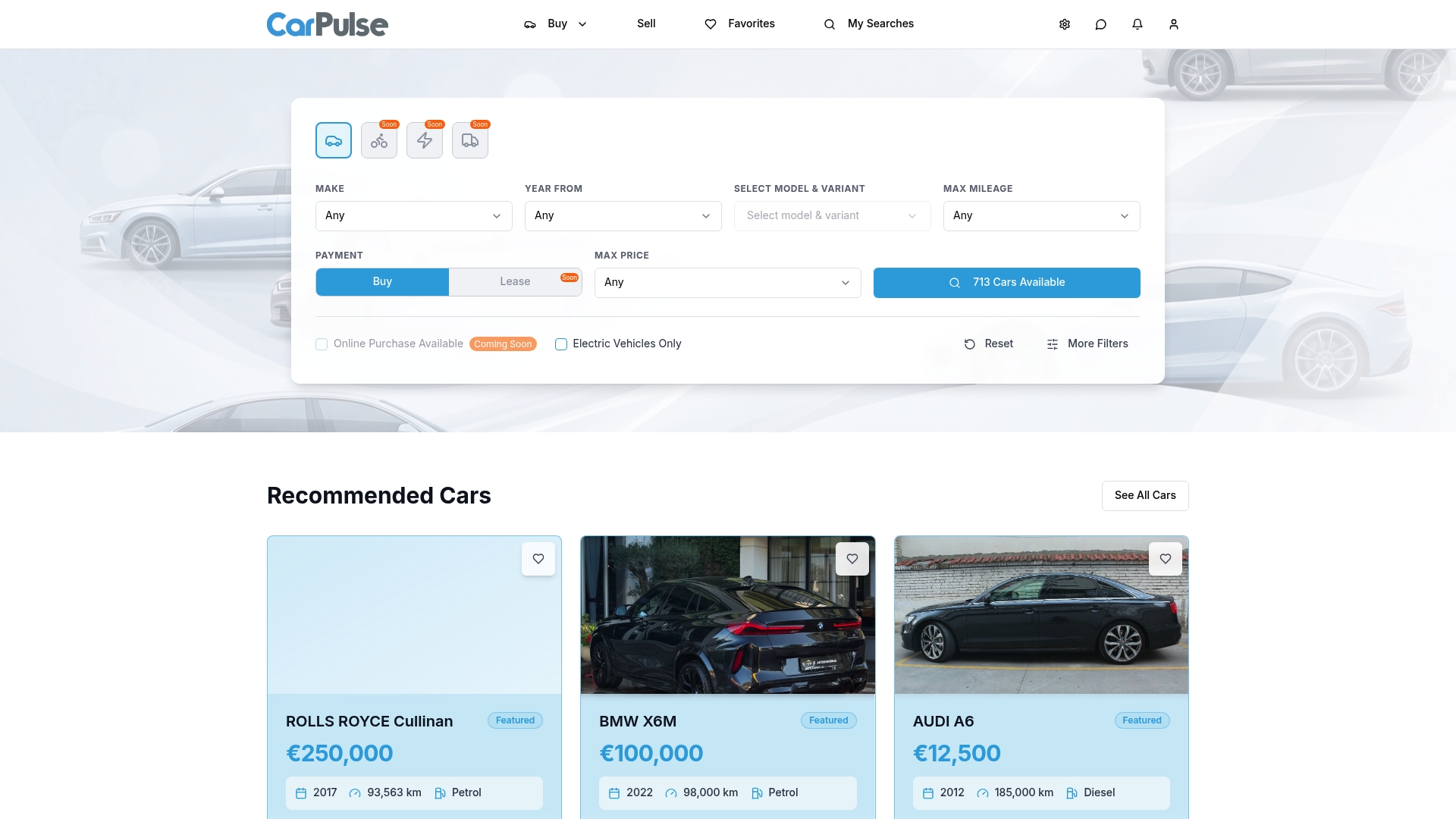
On CarPulse, you can filter listings directly by mileage, so you only see cars that meet your threshold from the start. Browse verified dealer listings and private sellers across Albania, compare prices side by side, and bookmark the cars you want to revisit. The VIN-based listing system means the vehicle details you see are accurate and auto-populated, reducing the risk of hidden surprises. Download the CarPulse app on iOS or Android to search on the go, and get notified the moment a low-mileage listing matches your saved search criteria.
Frequently asked questions
What is the ideal mileage for a used car in Albania?
For most mainstream brands, under 100,000 kilometers is considered low mileage and ideal for reliability and resale in the Albanian market.
Do low-mileage cars cost more?
Yes, low-mileage cars carry a 10 to 20% premium in Albania, but that higher purchase price is generally offset by better reliability and stronger resale value over time.
Can a high-mileage car be a good buy in Albania?
A well-maintained high-mileage car from a reliable brand can sometimes offer better value than a neglected low-mileage alternative, especially when accompanied by complete service records.
Are there risks with buying a very low-mileage car?
Yes. Cars unused for long periods can develop battery and seal problems from inactivity, so always request full service records and arrange an independent inspection before purchasing.