
Guides
How to Choose a Dealer You Can Actually Trust
How to Choose a Dealer You Can Actually Trust

The best car dealers share a short list of traits: they give you pricing in writing before you ask twice, they welcome an independent mechanic, and they treat the sale as the beginning of a relationship rather than the end of one. Knowing those criteria before you walk onto a lot is the difference between a deal you feel good about and one you’re still second-guessing a year later.
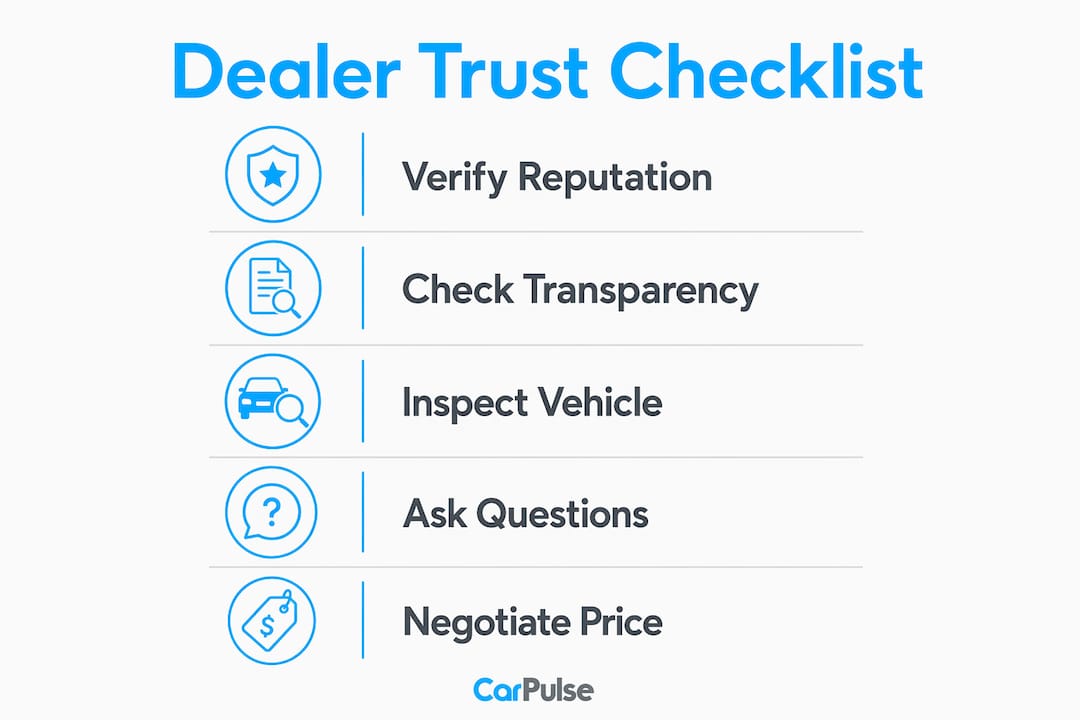
Here is what to look for when selecting a car dealer:
- Transparent, itemized pricing with a written out-the-door figure that includes every fee and add-on
- Verified vehicle history through reports like Carfax or AutoCheck, plus permission for an independent mechanical inspection
- Consistent positive reputation across Google, Yelp, and the Better Business Bureau
- Responsive customer service before, during, and after the sale
- Clear warranty terms in writing, not just verbal assurances
- Fair financing options with rates disclosed upfront and no pressure to focus on monthly payments
- FTC Buyers Guide compliance on every used vehicle, as required by federal law
Each of these criteria is a filter. A dealer who clears all of them is worth your time. One who stumbles on two or three is telling you something.
How to find a reputable car dealership
Start online, before you ever visit a lot. Search the dealer’s name alongside words like “complaint,” “review,” or “scam” to surface problems that a polished website will never show you. The Better Business Bureau is a reliable starting point for checking unresolved complaints and accreditation status.
Once you have a short list, dig into the reviews with a specific lens:
- Google and Yelp ratings matter, but patterns matter more than averages. Look for repeated mentions of bait-and-switch pricing or managers who dismiss negative feedback rather than address it.
- Dealer websites reveal a lot. A professional, well-organized site with clear inventory and pricing signals a dealer who takes transparency seriously. An abandoned or vague site is a warning.
- Word of mouth from people who recently bought a car remains one of the most reliable filters. Ask specifically about the post-sale experience, not just whether they liked the car.
- In-person visits let you read the room. Staff who listen before they pitch, who answer questions directly and without defensiveness, are a strong signal. Pressure to decide quickly is not.
- Licensing and certifications confirm legitimacy. Manufacturer-affiliated dealers operate under performance standards that independent lots do not. Certified Pre-Owned programs from brand-affiliated dealers typically include multi-point inspections and extended warranties.
Pro Tip: Contact your state attorney general’s office or local consumer protection agency to check for unresolved complaints against any dealer you are seriously considering. This step takes five minutes and can save you thousands.

Red flags that should make you walk away
Pressure is the most common warning sign, and it takes several forms. A dealer who rushes you to sign before you have read the documents, who discourages a test drive on your preferred route, or who suddenly “can’t find” the vehicle history report is not a dealer worth trusting.
The specific behaviors to watch for:
- No written out-the-door price. A dealer who resists written pricing is signaling that the finance office will reshape the deal later. Walk away.
- Resistance to independent inspections. The FTC notes that dealer reluctance on inspections usually means the seller has something to hide. No legitimate dealer should refuse this.
- Hidden fees at closing. Add-ons like VIN etching, paint protection, and nitrogen fills are often slipped into deals without discussion. If a fee wasn’t mentioned upfront, push back or decline it.
- Inconsistent or missing documentation. Always verify that the VIN matches across the title, window sticker, and vehicle frame. Missing paperwork on top of an accident report is a reason to move on.
- Negative review patterns. One bad review is noise. Repeated complaints about the same issue, especially if the dealer’s responses are dismissive, is a pattern worth taking seriously.
- Vague or defensive answers about return policies. Ask directly what happens if you discover a problem in the first week. A trustworthy dealer answers that without hesitation.
Why dealer transparency matters more than price
Price gets most of the attention, but transparency is what actually protects you. A dealer who provides itemized quotes upfront without bundling hidden fees into a monthly payment conversation is one you can negotiate with honestly. One who keeps the conversation on monthly figures is almost certainly obscuring the total cost.
Transparent dealers do several things consistently:
- They provide a written out-the-door price before discussing financing
- They explain warranty coverage in plain language, including what is excluded
- They answer detailed questions in writing when asked
- They disclose add-ons individually, with prices, rather than rolling them into the deal
- They put post-sale support policies in writing as part of the sale documents
The monthly payment trap is worth understanding specifically. When a dealer anchors the conversation to “what can you afford per month,” they gain room to extend the loan term, raise the interest rate, or add products without the total cost becoming obvious. Always negotiate on the full purchase price first, then discuss financing separately.
Questions to ask a dealer before you sign anything
The questions you ask before signing reveal more about a dealer than any review platform. A dealer who welcomes them is one worth buying from. One who deflects, rushes, or calls in a manager when you ask basic questions is telling you exactly how the post-sale experience will go.
Ask every dealer these before you commit:
- “What is the out-the-door price, in writing, including every fee and add-on?” This is the foundation. Get it on paper before you discuss anything else.
- “Has this vehicle been in any reported accidents, and can I see the Carfax and AutoCheck reports?” If there is accident history, ask for the repair invoices.
- “Can I take this vehicle to my own mechanic for a pre-purchase inspection?” The answer should be yes, without hesitation.
- “What is the actual interest rate the lender is offering, and what rate are you quoting me?” The gap between those two numbers is the dealer’s financing markup.
- “What is your written policy if I have a problem in the first 30 days?” A dealer who hesitates to put this in writing is one who probably won’t be responsive when you need them.
- “What is the warranty status, and what exactly is covered?” Get the actual warranty document, not a verbal summary.
- “What is your doc fee, and is it negotiable?” Doc fees can be negotiated or offset within the total out-the-door price, even when presented as fixed.
How community involvement reflects dealer reliability
A dealer’s behavior inside the community often mirrors how they treat individual buyers. Dealerships that invest in customer service training, sponsor local events, or hold manufacturer service awards tend to operate with more consistency and accountability than those that do not.
Look for these signals when evaluating a dealer’s values:
- Customer service awards on the walls. Manufacturers like Toyota and Ford survey their dealers’ customers and recognize top performers. These awards reflect verified performance benchmarks, not self-promotion.
- Active community presence. Sponsorships, local partnerships, and event participation indicate a business invested in its long-term reputation, not just the next transaction.
- How they handle complaints publicly. A dealer who responds to negative reviews with specifics and resolution steps is one who takes accountability seriously. Generic or dismissive responses are a red flag.
- Staff training and certifications. ASE-certified technicians in the service department signal a dealer who invests in expertise. That investment shows up in service quality long after the sale.
- Long-term customer retention. Dealers who earn repeat business and referrals are doing something right. Ask the salesperson directly how many of their customers come back for their next vehicle.
Service department hours and loaner availability are worth asking about before you buy. A dealer whose service department is only open weekdays 9 to 5 may not fit your schedule, and that friction compounds over years of ownership.
What the FTC Buyers Guide tells you about a dealer
Federal law requires every used car dealer to display a Buyers Guide in every used vehicle offered for sale, and to give a copy to the buyer after the purchase. This is not optional. A dealer who cannot produce one, or who discourages you from reading it, is out of compliance with federal requirements.
The Buyers Guide tells you:
- Whether the car is being sold with a warranty or “as is”
- What percentage of repair costs the dealer will cover under any warranty
- The major mechanical and electrical systems on the vehicle, including known problem areas
- The dealer’s contact information for complaints
- A reminder that spoken promises are difficult to enforce and should be put in writing
The distinction between a warranty and a service contract matters here. A warranty is included in the purchase price. A service contract, sometimes called an “extended warranty,” is a separate product you pay for. They are not the same thing, and a dealer who blurs that line is worth questioning.
If the “as is” box is checked on the Buyers Guide, the dealer will not pay for any repairs after the sale. Any verbal promises to fix something or cancel the deal must be written directly on the Buyers Guide to be enforceable.
Pro Tip: Even if a dealer certifies a used car and sells it with a warranty, an independent mechanical inspection is still worth the cost. A vehicle history report covers accidents and flood damage but typically misses mechanical problems. Paying for a pre-purchase inspection is almost always cheaper than the first major repair.
How to approach the test drive and vehicle inspection
A test drive is not a formality. It is your best opportunity to catch problems that no report will surface, and you should treat it that way.
Drive the vehicle for at least 30 minutes on a mix of city streets and highway. Listen for noises when accelerating, braking, and turning. Test the air conditioning, heat, all windows, and every electronic feature. If the car has a manual transmission, run through every gear. Bring a passenger and spend time in the back seat if you are buying a sedan or van.
Before the drive, do a visual walk-around. Check for paint inconsistencies that might indicate body repair. Look at tire wear patterns. Uneven wear on the front tires often points to alignment or suspension issues. Pop the hood and look for fluid leaks, corrosion around the battery terminals, and the condition of belts and hoses.
After the test drive, request an independent pre-purchase inspection from a mechanic you choose, not one the dealer recommends. If the dealer won’t allow you to take the car off the lot, ask about mobile inspection services that come to the dealership. If no inspection is possible under any arrangement, that is a clear signal to walk away and find a different vehicle.
Negotiation tips that actually work at a dealership
Most buyers who overpay do so because they negotiate the wrong number. Monthly payment is the wrong number. The total out-the-door price is the right one.
Get pre-approved for financing from your bank or credit union before you visit any dealership. Bringing a rate in writing gives you a real benchmark and removes the dealer’s ability to use financing as a negotiation lever. If the dealer beats your rate cleanly with no fees embedded elsewhere, take it. If they “match” your rate but the monthly payment is higher, the difference has been added somewhere else in the deal.
Negotiate the vehicle price first, completely, before mentioning a trade-in or financing. Dealers who know your trade-in value and monthly budget can structure numbers in ways that look favorable while the total cost climbs. Keep those conversations separate.
Time on lot is a legitimate negotiation tool. A vehicle that has been sitting for 60 days or more gives you real leverage. Ask directly how long the car has been on the lot. If it came from auction, ask for the auction inspection report.
Finally, add-ons presented in the finance office are almost always negotiable or removable. Gap insurance, paint protection, and extended service contracts are profit centers. Evaluate each one individually against what you can buy independently, and decline anything you do not genuinely need.
Dealer incentives and promotions worth understanding
Manufacturer incentives are real money, but they are not always presented transparently. Cash rebates, low-APR financing offers, and loyalty bonuses from manufacturers are applied to the vehicle price before the dealer’s markup. A dealer who presents the post-incentive price as the starting point for negotiation is using the incentive to protect their margin rather than pass it to you.
Ask specifically which manufacturer incentives apply to the vehicle you are considering and how they are being applied to your deal. Get the answer in writing. Seasonal promotions, end-of-model-year clearance events, and end-of-quarter pushes are real opportunities, but only if you know the baseline price before the incentive is applied.
Dealer-specific promotions, like free first-year maintenance or complimentary tire rotations, have genuine value if the service department is one you would actually use. Ask about the service department’s hours, technician certifications, and loaner vehicle availability before you factor those perks into your decision. A free oil change at a service center you cannot conveniently access is not a benefit.
Dealers with strong digital presences often list current promotions on their websites. A dealer whose online listings are current, detailed, and transparent about pricing tends to operate the same way in person.
Key Takeaways
Choosing the right car dealer comes down to one principle: transparency at every stage, from the first price quote to the post-sale warranty, is the clearest indicator of a dealer worth trusting.
| Point | Details |
|---|---|
| Demand written pricing | Always get the full out-the-door price in writing before discussing financing or trade-ins. |
| Insist on independent inspection | A pre-purchase mechanical inspection is worth the cost even when the dealer certifies the vehicle. |
| Check reputation across platforms | Review patterns on Google, Yelp, and the BBB reveal more than any single star rating. |
| Know your FTC rights | Federal law requires dealers to display a Buyers Guide on every used vehicle and provide it after the sale. |
| Negotiate price before financing | Separating the vehicle price from financing and trade-in discussions prevents dealers from obscuring the total cost. |
The dealership relationship most buyers underestimate
The conventional advice on choosing a car dealer focuses almost entirely on price. That is the wrong frame. Price is a single data point. The dealer relationship is a multi-year commitment that includes service appointments, warranty claims, and the occasional unexpected repair. Optimizing for the lowest sticker price at a dealer you do not trust is a trade you will regret the first time something goes wrong.
What actually predicts a good experience is how a dealer behaves when things are not going smoothly. Do they respond to complaints publicly and specifically? Do they put post-sale policies in writing without being asked twice? Do they welcome your mechanic, or do they find reasons to make an inspection difficult? Those behaviors are visible before you buy, and they tell you exactly what you will get after.
The FTC Buyers Guide requirement exists because federal regulators recognized that verbal promises in dealerships are routinely broken. That regulatory context should inform how you approach every interaction. Get everything in writing. Treat verbal assurances as unenforceable until they appear in a document.
Carpulse connects buyers with verified dealerships through a platform built around transparency, VIN-based listings, and clear vehicle details. Browsing verified dealer listings before you visit a lot gives you a baseline for pricing and inventory that makes every in-person conversation more productive.
The buyers who get the best deals are not the ones who negotiate hardest. They are the ones who show up prepared, ask direct questions, and are genuinely willing to walk away. That willingness is not a tactic. It is the natural result of knowing exactly what you want and understanding that the right dealer will welcome your scrutiny rather than resist it.
Recommended
- Sallon Automobilistik në Shitje Shqipëri - CarPulse.al | CarPulse Albania
- Pse të Blini Makina të Verifikuara? Besueshmëri, Vlerë… | CarPulse Albania
- Si të provoni një makinë të përdorur: udhëzues i plotë… | CarPulse Albania
- Provë me Makinë të Përdorur: Udhëzues i Plotë për Shqipërinë | CarPulse Albania