Guides
How Does Buyback Work for Car Buyers and Sellers

How Does Buyback Work for Car Buyers and Sellers

TL;DR:
- A manufacturer buyback occurs when a carmaker repurchases a vehicle due to unresolved defects under warranty, resulting in a permanent branded title. Buyers should verify buyback status through VIN checks, independent inspections, and official DMV records before purchasing or listing such vehicles. Transparency and proper documentation are essential to avoid risks associated with buyback cars, which sell at lower prices and often lack transferable warranties.
A manufacturer buyback occurs when a carmaker repurchases a vehicle from its owner under a state lemon law or warranty settlement because a covered defect could not be fixed within the required number of repair attempts. For buyers, that usually means a permanently branded title and a lower resale price. For sellers, it means mandatory disclosure and documentation. Always run a VIN history check and verify the title brand through your state DMV before you buy or list a buyback vehicle.
Table of Contents
- How does a car buyback differ from a stock buyback?
- Step-by-step: how the buyback process actually unfolds
- What a branded title means for buyers
- How to confirm whether a car was a manufacturer buyback
- Should you buy a buyback vehicle? A quick decision checklist
- What sellers need to know before listing a buyback vehicle
- What a trustworthy marketplace listing should show about buyback history
- Key Takeaways
- The case for transparency over shortcuts
- Useful sources and official references
How does a car buyback differ from a stock buyback?
The word “buyback” pulls double duty. In finance, it refers to a share repurchase where a corporation buys its own stock from shareholders to reduce shares outstanding. That has nothing to do with vehicle safety or title records. In automotive consumer law, a buyback means something much more specific: a manufacturer legally reacquires a vehicle after failing to repair a covered defect within the warranty period.
Every U.S. state has its own lemon law, and the thresholds vary. Some states require multiple repair attempts for the same defect, with the exact number varying by state. Some add a calendar-day trigger if the car is out of service long enough. What they share is the outcome: once the statutory threshold is met, the manufacturer must offer a replacement or a repurchase.
The title brand is the lasting consequence. Under California DMV guidance, a branded title such as “Lemon Law Buyback” stays with the vehicle permanently, warning every future buyer about its history. Most states follow a similar branding requirement.
Step-by-step: how the buyback process actually unfolds
The buyback process explained below follows the most common sequence across U.S. states, though exact timelines shift depending on where you live.
- Defect discovered during the warranty period. The owner notices a recurring problem — engine, transmission, safety system — and brings the car to an authorized dealer for repair.
- Repair attempts begin. The dealer attempts to fix the defect. The owner documents every visit: dates, mileage, repair orders, and what was done.
- Statutory threshold is reached. Once the number of repair attempts or out-of-service days crosses the state’s legal limit, the owner qualifies to file a lemon-law claim. State lemon-law statutes vary on what counts as a “reasonable number of repair attempts” and what remedies apply.
- Claim filed and manufacturer notified. The owner (or an attorney) formally notifies the manufacturer and may go through the manufacturer’s dispute resolution program or file directly with the state.
- Manufacturer offers settlement. The manufacturer can offer a replacement vehicle or a repurchase. A repurchase refunds the purchase price minus a usage deduction calculated from miles driven before the first repair attempt.
- Settlement paperwork signed. Both parties sign a settlement agreement. The owner surrenders the vehicle and receives the refund.
- Title is branded. The state DMV brands the title. From this point forward, the vehicle carries that brand on every future title transfer.
- Vehicle re-enters the used market. The manufacturer or a dealer resells the car, typically at a discount, with the branded title disclosed.
What a branded title means for buyers
A branded title does not automatically mean the car is dangerous. It means a covered defect could not be resolved under warranty. The original defect may have been a software glitch, a persistent rattle, or something more serious. The buyer’s job is to find out exactly which.
Resale value takes a real hit. Buyback vehicles typically sell for less than comparable non-branded cars, and some lenders will not finance them at standard rates. Manufacturer warranties usually do not transfer after a buyback, so the buyer is on their own for repairs.
Before making an offer, work through this checklist:
- Pull a VIN history report from Carfax or AutoCheck and look for the title brand and any open recalls.
- Request the original settlement paperwork to confirm the nature of the defect.
- Ask for all repair invoices from the original lemon-law repair attempts.
- Check the state DMV title records directly to confirm the brand language.
- Get an independent mechanical inspection from a shop that has no relationship with the seller.
Pro Tip: Ask the independent inspector to focus specifically on the system that caused the original defect — engine, transmission, electronics, or structural — plus a full brake and suspension check. A general inspection is good; a targeted one is better.
How to confirm whether a car was a manufacturer buyback
Sellers do not always volunteer this information. Here is how to verify it yourself:
- Run the VIN on Carfax or AutoCheck. Both services flag branded titles and often include the specific brand language (e.g., “Lemon Law Buyback,” “Manufacturer Buyback”).
- Check your state DMV’s title records. Most states offer an online title lookup or a written request process. The DMV record is the definitive source.
- Search NHTSA’s recall database. Enter the VIN at nhtsa.gov to see open recalls and any safety-related complaints filed for that vehicle.
- Request repair invoices from the original owner. Multiple invoices for the same repair at an authorized dealer are a clear signal.
- Look for lemon-law claim references. Settlement paperwork or arbitration records sometimes appear in history reports or can be requested from the seller.
- Watch for red flags in listings. Vague descriptions, missing service history, a price well below market, or a seller who deflects questions about the title brand all warrant extra scrutiny.
On a marketplace like Carpulse, VIN-based listing auto-populates vehicle details, which makes it easier to cross-reference the listed information against an independent history report. If the listing data and the history report conflict, treat that as a red flag.
Should you buy a buyback vehicle? A quick decision checklist
The price gap is the starting point. A buyback vehicle should cost noticeably less than a comparable non-branded car. If the discount is thin, the math rarely works in the buyer’s favor once you factor in potential repair costs and resale limitations.
Walk away if the seller cannot produce the original settlement paperwork, repair invoices, and a clear explanation of the defect. A legitimate buyback has a paper trail. No documentation means no deal.
Work through these questions before committing:
- Is the price gap meaningful compared to similar non-branded vehicles?
- Is the original defect documented and was it fully addressed after the buyback?
- Did the independent inspection come back clean on the affected system?
- Does the seller offer any return window or warranty, even limited?
- Is the title brand acceptable to your lender and your insurance carrier?
If the answer to any of these is “no” or “I don’t know,” keep looking.
What sellers need to know before listing a buyback vehicle
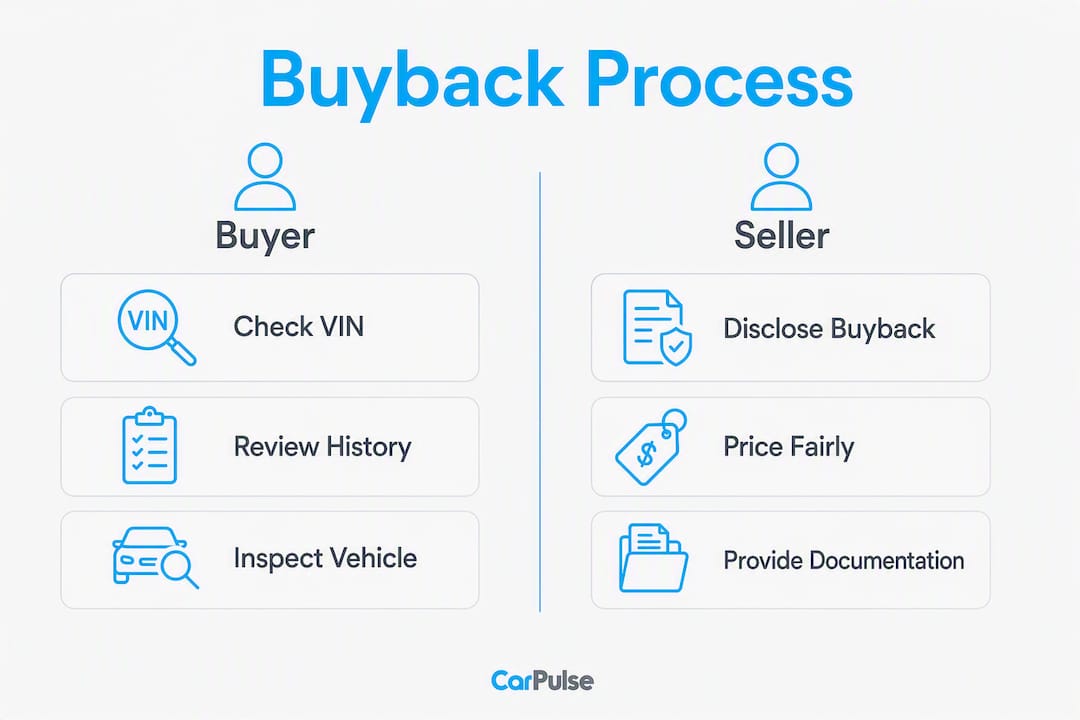
Disclosure is not optional. Failing to disclose a branded title or buyback history can expose a seller to misrepresentation claims under state consumer protection laws. The California DMV’s seller guidance is explicit: sellers must not misrepresent a vehicle’s history, and the title brand is part of that history.
Before listing, gather:
- The original settlement agreement from the manufacturer.
- All repair invoices from the lemon-law repair attempts.
- The current title showing the brand language.
- Any warranty transfer documentation (or confirmation that no warranty transfers).
- A current VIN history report to attach to the listing.
Price the vehicle to reflect the brand. Buyers researching buybacks know the market; an overpriced buyback sits unsold. Attach the history report and settlement paperwork directly to the listing. Transparency speeds the transaction and reduces the chance of a dispute after the sale. For practical guidance on listing and selling a used vehicle, Carpulse’s seller resources walk through documentation and pricing steps.
What a trustworthy marketplace listing should show about buyback history
A credible listing does the verification work upfront. Here is what to look for on any marketplace, and what Carpulse surfaces through its VIN-based system:
| Listing element | Why it matters |
|---|---|
| VIN-linked history report badge | Confirms the report is tied to the actual vehicle, not a generic placeholder |
| Explicit title-brand field | Buyers see the brand language without having to ask |
| Uploaded settlement and repair documents | Removes ambiguity about the defect and its resolution |
| Seller type (private vs. verified dealer) | Sets accountability expectations for disclosure |
| VIN auto-population | Reduces listing errors and makes cross-checking faster |
Carpulse’s verified car listings use VIN-based data population so the vehicle details on the listing match the official record. For Albanian marketplace users researching U.S.-sourced vehicles or understanding how buyback disclosures work on international listings, these transparency features cut through the ambiguity that makes buyback purchases risky.
Key Takeaways
A manufacturer buyback creates a permanent branded title that follows the vehicle through every future sale, making VIN verification and independent inspection non-negotiable for any buyer.
| Point | Details |
|---|---|
| Branded title is permanent | States like California brand the title “Lemon Law Buyback” and that brand never comes off. |
| Buyers must verify independently | Run Carfax or AutoCheck, check state DMV records, and get an independent mechanical inspection before any offer. |
| Sellers must disclose fully | Attach settlement paperwork, repair invoices, and the current title to the listing or risk misrepresentation claims. |
| Price gap is the buyer’s main protection | Buyback vehicles sell for less than comparable non-branded cars; a thin discount rarely justifies the added risk. |
| Marketplace transparency reduces risk | Listings with VIN-linked history reports and uploaded documents make buyback status clear before negotiations start. |
The case for transparency over shortcuts
Most of the anxiety around buyback vehicles comes from information gaps, not the vehicles themselves. A buyback with a fully documented repair history, a clean post-buyback inspection, and an honest price is a reasonable purchase for the right buyer. The problem is the listings that bury the brand in fine print or skip documentation entirely.
From a marketplace perspective, the fix is structural. When a platform requires VIN-based listing, surfaces title-brand fields automatically, and makes document uploads part of the standard listing flow, the information asymmetry that makes buybacks risky largely disappears. Buyers can evaluate the actual defect and the actual repair history instead of guessing. Sellers who disclose upfront close deals faster and face fewer disputes.
The buyers who get burned on buyback vehicles are almost always the ones who skipped the VIN check, trusted a verbal assurance, or let a low price override their due diligence. The process is straightforward when you follow it. The Carpulse marketplace gives both buyers and sellers the tools to do exactly that.
Useful sources and official references
For title-brand lookups and lemon-law rules, go directly to primary sources:
- California DMV: Lemon Law Buybacks and Warranty Returns — authoritative guidance on title branding requirements and seller obligations in California, one of the most detailed state frameworks.
- NHTSA VIN Lookup (nhtsa.gov) — search open recalls and safety complaints by VIN; free and official.
- Carfax Vehicle History Reports (carfax.com) — flags branded titles, lemon-law buyback records, and service history.
- AutoCheck by Experian (autocheck.com) — alternative history report provider; useful to cross-reference against Carfax.
- Chase: Lemon Law Buyback Explainer — plain-language overview of how state lemon laws trigger manufacturer repurchases.
- Your state DMV’s title records — search “[your state] DMV title brand lookup” to find the official portal. The DMV record is always the definitive source for title brand language, regardless of what any history report shows.