Guides
Car Ownership Transfer Steps in Albania: 2026 Guide

Car Ownership Transfer Steps in Albania: 2026 Guide

TL;DR:
- Car ownership transfer in Albania requires notarized contracts and registration within 30 days to avoid heavy fines. Buyers must verify all documents, including VIN and tax clearance, and complete registration promptly at DPSHTRR. Failing to follow these steps risks legal liabilities, delayed registration, and costly penalties.
Car ownership transfer is the legal procedure that officially changes a vehicle’s registered owner from seller to buyer in Albania. The process is governed by the Directorate General of Road Transport Services (DPSHTRR) and requires notarial certification before any registration can take place. Buyers must complete the car ownership transfer steps within 30 calendar days of the sale, or face fines ranging from 10,000 to 40,000 lekë depending on how long the delay runs. Missing that window is the single most common and most costly mistake Albanian buyers make.
What documents are required to transfer car ownership in Albania?

Both the buyer and the seller must arrive at the notary with a complete set of documents. A missing paper stops the process entirely and forces a second appointment.
The seller provides:
- The vehicle’s circulation permit (leja e qarkullimit), which now serves as the primary proof of ownership. Old ownership certificates remain valid but are being phased out.
- A valid national ID or passport.
- Proof that all road taxes and traffic fines are cleared.
The buyer provides:
- A valid national ID or passport.
- Proof of active third-party liability (TPL) insurance for the vehicle.
- Proof of a current technical inspection (vizita teknike).
| Document | Responsible party |
|---|---|
| Circulation permit | Seller |
| Old ownership certificate (if applicable) | Seller |
| Cleared tax and fine records | Seller |
| Valid national ID | Both parties |
| Active TPL insurance | Buyer |
| Current technical inspection certificate | Buyer |
| Notarized sales contract | Prepared at notary |
The circulation permit now consolidates ownership proof into a single document, which simplifies the administrative process compared to the older two-document system. If the permit is lost or damaged, DPSHTRR issues a replacement permit rather than a separate ownership certificate.
Pro Tip: Request a printed tax clearance statement from the local tax office before the notary appointment. Verbal assurances from the seller are not sufficient and will not satisfy the notary.
How does the notarization process work in a vehicle sale?
The notary is not a formality. The notary is the legal gatekeeper of the entire transfer. Only notarized contracts are accepted by DPSHTRR for ownership changes, which means a private written agreement between buyer and seller carries no legal weight for registration purposes.
At the notary appointment, the following happens:
- The notary verifies the identity of both parties using their national IDs.
- The notary checks the vehicle’s status directly through the DPSHTRR system, confirming there are no liens, blocks, or pending debts attached to the vehicle.
- The notary reviews the circulation permit and confirms the vehicle details match the documents presented.
- Both parties sign the sales contract in the notary’s presence.
- The notary certifies the contract, making it legally valid for submission to DPSHTRR.
If the vehicle has an unresolved lien or unpaid obligation, the notary informs both parties and may refuse to proceed. That refusal protects the buyer from inheriting a legally encumbered vehicle. Notary fees for a standard vehicle sale range from 3,000 to 5,000 lekë, depending on the declared sale value and the notary’s office.
Pro Tip: Choose a notary who has direct access to the DPSHTRR online system. Not all offices have real-time connectivity, and a manual verification process can add days to your timeline.
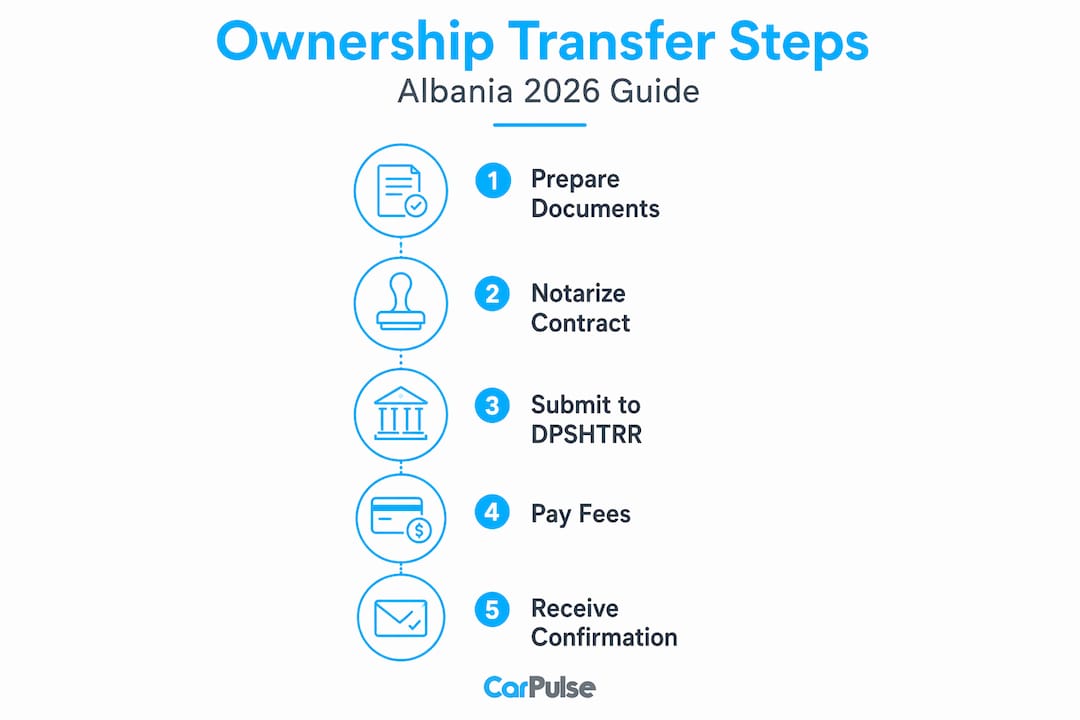
Step-by-step procedure to register the ownership transfer at DPSHTRR
Once the notarized contract is in hand, the buyer takes the lead. The seller’s legal obligation ends at the notary. The buyer must now complete the vehicle ownership transfer guide by submitting documents to the regional DPSHTRR office.
-
Gather all required documents. Bring the notarized sales contract, both parties’ IDs (copies are acceptable), the vehicle’s circulation permit, proof of active TPL insurance, and the current technical inspection certificate.
-
Submit documents at the DPSHTRR regional office. Present the full document set to the officer at the counter. The officer reviews each document for completeness and consistency before accepting the submission.
-
Pay the registration fee. Registration fees range from 2,500 to 5,000 lekë based on the vehicle’s engine cylinder capacity. A larger engine means a higher fee.
-
Request new license plates if needed. If the buyer wants plates registered in their name, new plates cost an additional 3,500 lekë. This is optional but recommended for clarity of ownership.
-
Receive the updated circulation permit. Once fees are paid and documents are accepted, processing typically occurs the same day. The buyer leaves with a circulation permit showing their name as the registered owner.
| Fee type | Amount |
|---|---|
| Registration fee (small engine) | 2,500 lekë |
| Registration fee (large engine) | 5,000 lekë |
| New license plates | 3,500 lekë |
| Late registration fine (30–90 days) | 10,000 lekë |
| Late registration fine (90 days–1 year) | 20,000 lekë |
| Late registration fine (over 1 year) | 40,000 lekë |
The 30-day deadline is firm. Completing the process on the same day as the notary appointment is the safest approach. Many buyers treat the notarized contract as the finish line. It is not. Registration at DPSHTRR is the finish line.
What common mistakes to avoid during car ownership transfer?
Most problems in the Albanian vehicle transfer process are predictable and preventable. Knowing where buyers and sellers go wrong saves time, money, and legal headaches.
- Skipping the notary. Contracts drawn up privately without notarial certification have no legal standing at DPSHTRR. The transfer simply cannot be registered.
- Not verifying tax and fine clearance. Unpaid fines or road taxes transfer with the vehicle unless cleared before the sale. The buyer inherits those debts the moment the contract is signed.
- Paying a deposit before inspection. Expert advice is clear: never pay a deposit without physically inspecting the vehicle and verifying its legal status. Fraud in used car sales often begins at the deposit stage.
- Ignoring VIN consistency. The VIN on the vehicle must match the VIN on the circulation permit and all other documents. A mismatch is a red flag for a stolen or misrepresented vehicle.
- Delaying DPSHTRR registration. Many buyers assume the notarized contract is enough. It is not. Registration must happen within 30 days to avoid escalating fines.
For buyers purchasing a used vehicle, thorough due diligence on vehicle history is not optional. It is the difference between a clean purchase and an expensive legal problem.
Buying a car without verifying its tax status and document consistency is the fastest way to inherit someone else’s financial and legal problems. The notary protects you from liens, but only your own verification protects you from undisclosed fines and mismatched records.
What are the fees and penalties related to car ownership transfer in Albania?
The total cost of a standard vehicle ownership transfer in Albania is predictable if you plan ahead. The notary fee runs 3,000–5,000 lekë. The DPSHTRR registration fee runs 2,500–5,000 lekë depending on engine size. New plates add 3,500 lekë. A buyer who completes the process correctly and on time spends roughly 9,000–13,500 lekë in total administrative costs.
The penalty structure is where costs escalate sharply. Fines for late registration start at 10,000 lekë for delays of 30–90 days, rise to 20,000 lekë for delays of 90 days to one year, and reach 40,000 lekë for delays beyond one year. That means a buyer who waits 13 months to register pays more in fines than the entire legitimate transfer process costs. The math strongly favors acting within the 30-day window.
Beyond fines, an unregistered transfer creates legal ambiguity for both parties. The seller remains the legal owner on record until registration is complete. That exposes the seller to liability for any incidents involving the vehicle after the sale.
Key takeaways
Completing the car ownership transfer steps in Albania requires a notarized contract, full document verification, DPSHTRR registration within 30 days, and payment of fees totaling roughly 9,000–13,500 lekë.
| Point | Details |
|---|---|
| Notarization is mandatory | Only notarized contracts are accepted by DPSHTRR; private agreements have no legal standing. |
| 30-day registration deadline | Buyers must register at DPSHTRR within 30 days or face fines starting at 10,000 lekë. |
| Verify tax and fine clearance | Unpaid debts transfer with the vehicle; confirm a clean record before signing. |
| Check VIN consistency | The VIN on the vehicle must match all documents to confirm the vehicle’s identity. |
| Same-day processing is possible | DPSHTRR typically processes transfers the same day when documents and fees are complete. |
What I’ve learned from watching Albanian car deals go wrong
The Albanian vehicle transfer process is not complicated. It has clear steps, fixed fees, and a firm deadline. What makes it go wrong is almost always human behavior, not the system itself.
I’ve seen buyers hand over cash at the roadside, accept a handwritten receipt, and assume the seller would “handle the paperwork.” That arrangement is not a sale. It is a legal gray zone that leaves the buyer with a car they cannot officially own and a seller who remains liable for a vehicle they no longer have. The notary exists precisely to prevent this.
The other pattern I see repeatedly is buyers who inspect the car carefully but skip the document check entirely. They verify the engine, the bodywork, and the tires. They do not verify whether the VIN matches the circulation permit, whether the technical inspection is current, or whether the seller has outstanding fines. A clean exterior hides nothing about a vehicle’s legal status. For buyers who want to safely purchase a used car in Albania, the document check is as important as the physical inspection.
My honest recommendation: treat the 30-day registration window as a 5-day window. Complete the DPSHTRR submission within the first week after the notary appointment. Life gets busy, deadlines slip, and the fine structure is unforgiving.
— Henri
Carpulse makes buying and selling cars in Albania straightforward
Albania’s car market moves fast. Finding the right vehicle, confirming its legal status, and completing the transfer correctly requires reliable information and access to verified listings.
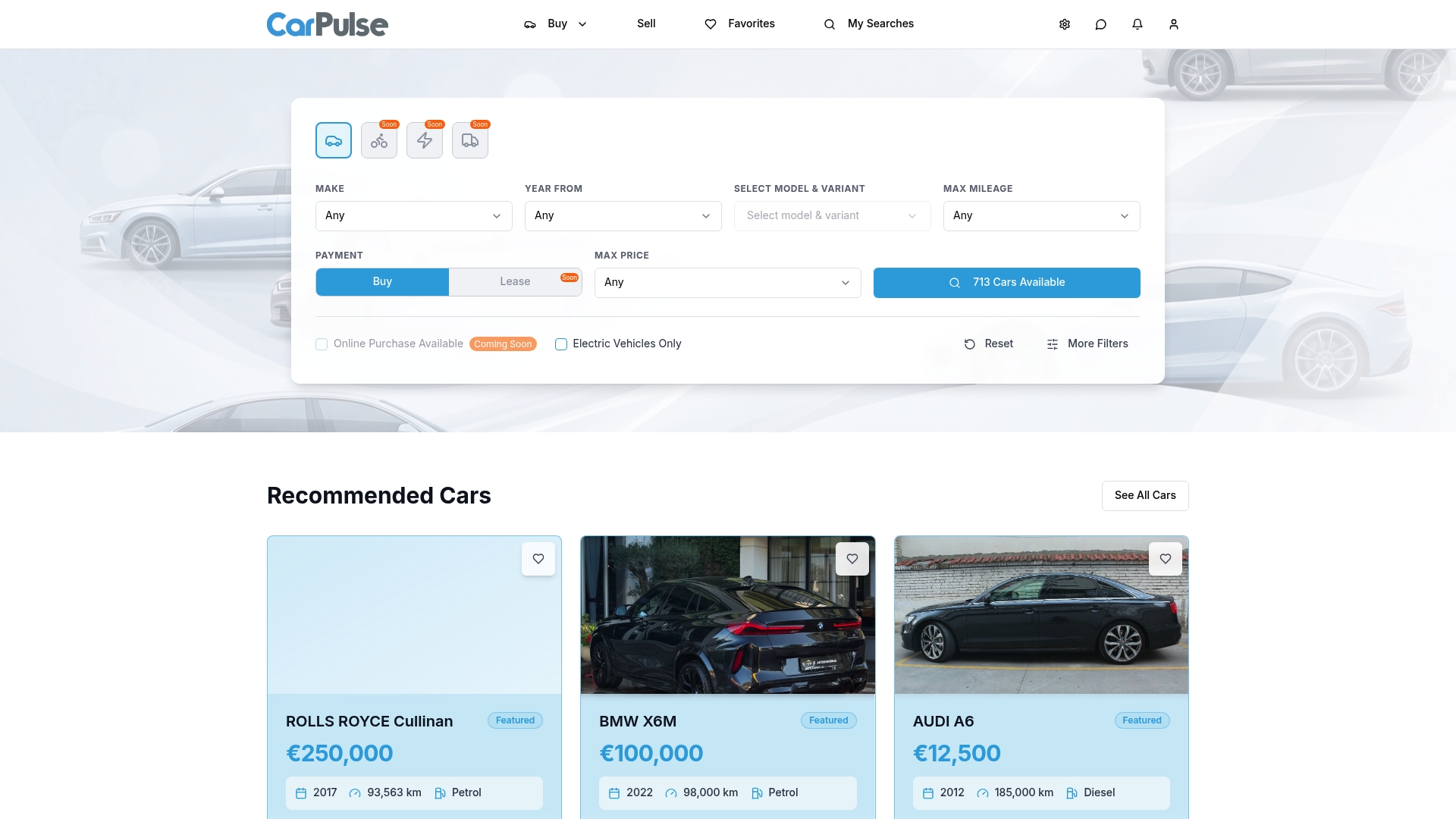
Carpulse is Albania’s largest online car marketplace, connecting private buyers, sellers, and verified dealerships on a single platform. Listings include full vehicle details populated directly from the VIN, so buyers see accurate specifications before making contact. The platform also offers guides on vehicle financing options in Albania, covering car loans and leasing for buyers who need flexible payment structures. Whether you are listing a vehicle or searching for your next one, browse the full marketplace on Carpulse and connect with trusted sellers across Albania.
FAQ
What is car ownership transfer in Albania?
Car ownership transfer is the legal process of changing a vehicle’s registered owner from seller to buyer through a notarized contract and DPSHTRR registration. Both steps are required for the transfer to be legally valid.
How long does the car title transfer process take?
DPSHTRR typically processes the transfer on the same day when all documents and fees are submitted correctly. The full process from notary to registration can be completed within one business day.
What happens if I miss the 30-day registration deadline?
Fines start at 10,000 lekë for delays of 30–90 days, rise to 20,000 lekë for delays up to one year, and reach 40,000 lekë for delays beyond one year. The seller also remains the legal owner on record until registration is complete.
Do I need a notary to transfer car ownership in Albania?
Yes. Only notarized contracts are accepted by DPSHTRR for ownership changes. A private written agreement between buyer and seller has no legal standing for registration purposes.
What is the circulation permit and why does it matter?
The circulation permit (leja e qarkullimit) is the primary document proving vehicle ownership in Albania. It must be presented at both the notary and DPSHTRR, and the VIN on the permit must match the vehicle exactly.